

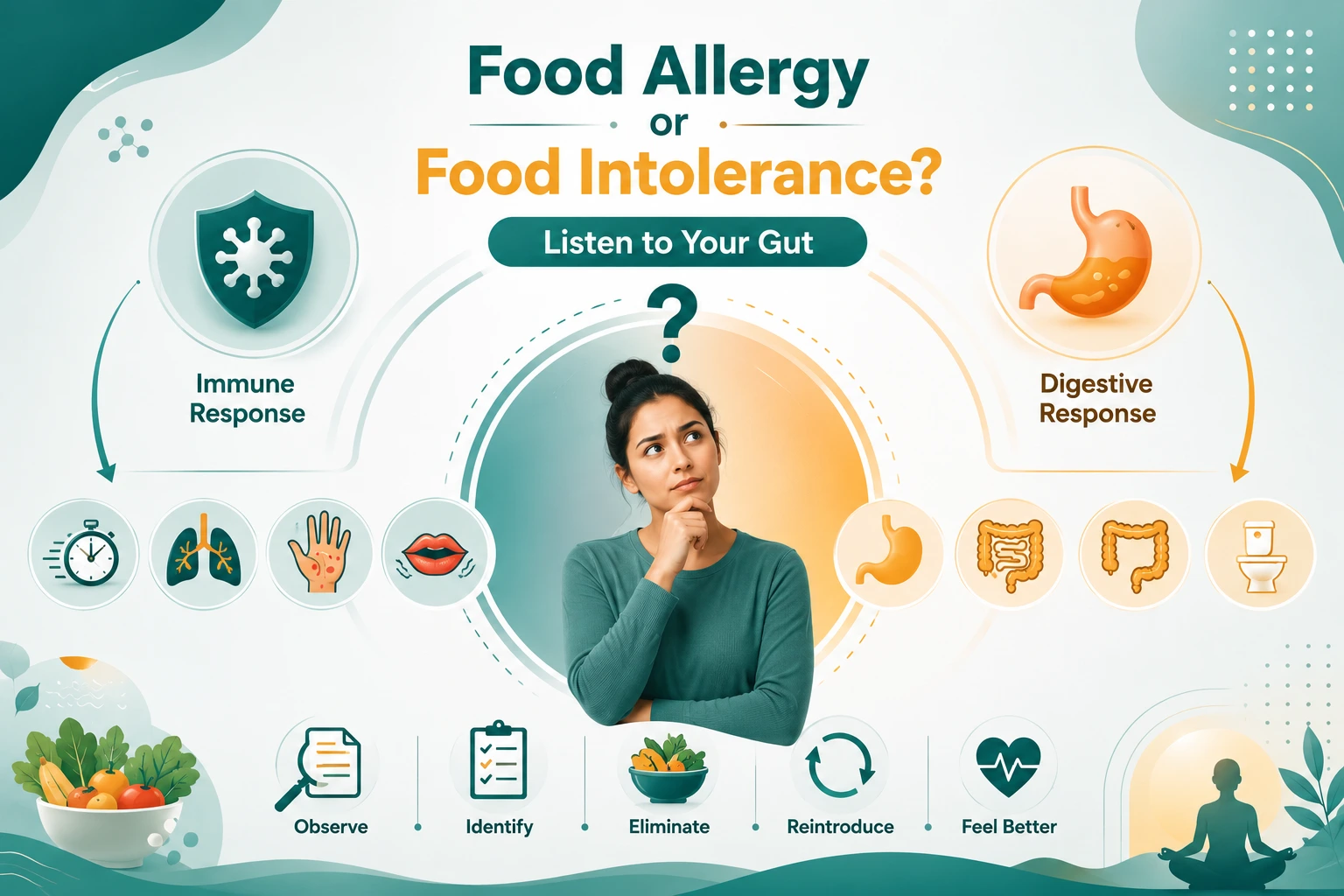
It is quite natural to worry about that queasy feeling of nausea, and bloating after eating something for the first time. That feeling maybe even worrisome if you have tried some seafood, or exotic food for the first time, because it makes you wonder—are my symptoms signs of an allergic reaction, or just my stomach taking time while digesting new food types for the first time. Don’t worry, we’ve got you covered! In this article, you can understand why we have food intolerances, and easy tips to tell if you what you are feeling needs immediate medical attention or it is just your stomach having a bad day.
What is the main difference between an immune and a digestive response?
Immune response
- Food allergies are always a mistake of your body’s immune system in mistaking food as ‘allergens’—particles which can harm the body.
- When this mistake happens, the immune system mounts a response by activating a league of cells which work for it like, the T-cells, B-Cells, and macrophages.
- The result of this activation is rapid closing of your airways due to swelling, violent vomiting episodes, itching/rashes all over the body.
- This response is called an immune response.
Digestive response
- A digestive response is a term used in the medical field to talk about all the normal biological processes that happens to food after you put it in your mouth.
- A definition of digestive response is— the coordinated process of breaking down food, absorbing nutrients, and eliminating waste using muscles, hormones, and digestive juices.
- A digestive response begins at the mouth and goes through the following steps:
Mouth—chewing food/breaking down food with enzymes in saliva
Esophagus—Push food down into the stomach.
Stomach—Strong acids and enzymes churn food into a liquid called chyme.
Small Intestine—Organs like the liver, pancreas, and gallbladder release juices to absorb nutrients.
Large Intestine—The colon absorbs remaining water from waste after which the remaining is termed as stools which are eliminated through the anus.
When should food intolerance symptoms prompt a gastroenterology evaluation?
The confusion between food allergy and intolerance: why it happens?
- It is for a very simple reason—many of the symptoms overlap in both cases.
- Both the conditions share symptoms like stomach upset, nausea, bloating and pains.
- Adding to the confusion, there are certain conditions like the celiac disease. This is a gastrointestinal condition which does not fit neatly into either category. Celiac disease is an autoimmune disorder triggered by gluten, but it is not the same as a wheat allergy or gluten intolerance.
- However, there are a few signs which sets them apart.
Clear-cut warning signs not to ignore—these definitely tell of a food allergy.
- How fast you feel the symptoms: if you feel symptoms within a couple of minutes to few hours immediately after eating, it is mostly food allergy. Allergic symptoms are often quick to develop and magnify unlike food intolerances which will be felt only after a day or more of eating.
- Breathing Issues: if you feel any of the following—wheezing, shortness of breath, a tight throat, or trouble swallowing, these are all classic red flags of an allergic reaction. These issues can quickly escalate into a medical emergency, and need prompt evaluation.
- Skin Reactions: You will definitely also notice skin issues such as an itchy skin, a red rash, or raised bumps called hives. They are rapid to develop and can come all over the body. They also often come along with the breathing difficulties.
- Swelling and Tingling: Sudden swelling of the lips, tongue, mouth, or throat, alongside a tingling sensation can also signal a dangerous allergic response.
Remember, if you feel any of these above four symptoms, do not wait for it to progress further. Visit a good gastroenterologist immediately. These developments are often fatal, and are one of those conditions which can never resolve by itself.
What are the most common hidden triggers for adult-onset intolerances?
- Adult-onset food intolerances develop over time.
- As people age, there are changes in body chemistry, gut health, and lifestyle. These changes alter how food is processed in the body.
- Disruptions to the gut microbiome resulting from stress, illness, or excessive antibiotics can also limit the body’s digestive ability.
Some common hidden triggers for adult-onset intolerances:
- High-FODMAP Carbohydrates: Short-chain carbohydrates found in foods like onions, garlic, apples, beans, and wheat that can ferment in the gut, and cause excessive gas, pain, and bloating.
- Histamines: These are naturally occurring chemicals present in aged, and fermented, such as aged cheeses, wine, cured meats, and sauerkraut.
- Fructose: It is a natural sugar found in fruit, honey, and high-fructose corn syrup that can cause long-term digestive discomfort if the small intestine cannot fully absorb it.
- Sulfites: These are preservatives used in dried fruits, wine, beer, and can trigger digestive distress, skin flushing, or respiratory issues.
- Salicylates: Naturally occurring in many fruits, vegetables, herbs, and spices and can provoke intolerance in some adults.
- Artificial Sweeteners and Food Additives: Artificial sweeteners like xylitol or sorbitol found in diet snacks, chewing gum, and packaged goods are often difficult for the gastrointestinal tract to process smoothly; they trigger food intolerance symptoms very easily.
Why does enzyme deficiency cause sudden gas and bloating after meals?
- When your body lacks specific digestive enzymes, it cannot break complex food molecules into smaller nutrients for absorption in the small intestine.
- Instead of being digested normally, these undigested food particles travel into the large intestine (colon), where there are normally trillions of gut bacteria.
- These bacteria feast on these particles through a process called fermentation.
- Fermentation produces large volumes of gases within very short time.
- As these gases accumulate quickly, they expand the intestinal walls, leading to sudden abdominal distension, pressure, and painful bloating shortly after finishing a meal.
How does an elimination diet help identify problematic foods safely?
- An elimination diet is considered as the clinical gold standard for identifying hidden food sensitivities.
- It works by systematically planning and removing dietary triggers. By doing this, one can test the body’s response in an orderly and confident way.
Following the elimination diet protocol:
- During the initial elimination phase, some common foods triggers well-known through research such as dairy, gluten, soy, eggs, and high-FODMAP carbohydrates are removed from the diet.
- This step is observed for about two to four weeks to allow your gut to settle, reduce any bodily inflammation. it also helps to establish a clear baseline for symptoms.
- Once symptoms subside, individual food types are re-introduced one at a time in a structured way.
- This is the monitoring period, and it allows you to isolate exact triggers without worrying about which ingredient is triggering your symptoms.
- By pairing this structured re-introduction with careful symptom tracking, this structured approach ensures food intolerances are pinpointed accurately without risking nutritional deficiencies or unnecessary long-term restrictions.
However, this diet is best followed when you work with a registered dietitian or trained gastroenterologist as eliminating such wide food types can easily lead to nutritional deficiencies and malnutrition.
Considering following the elimination diet, or even just wondering a lot about the strange feeling in your stomach? Smiles Institute of Gastroenterology, Bengaluru has trained doctors who can evaluate your symptoms and help you through your diagnosis smoother than you think. Trained dieticians can even help with the elimination diet, and help you re-establish your food structure. Your confidence to try and enjoy new foods is just a small visit away.
Frequently Asked Questions
1.What is the main difference between food allergy vs food intolerance symptoms?
The single main difference in between the food allergy and food intolerance lies in its symptoms. While symptoms of food intolerance are mainly restricted just to the intestinal regions, food allergy is a systemic/whole body condition. Hence, if you have food intolerance you would feel just bloating, gas, or stomach pains after a day or so of eating; food allergy manifests quickly and you would feel breathlessness, skin hives, itching, and nausea.
2. Why do adults suddenly develop new food intolerances later in life?
Dr. Parameshwara CM explains this phenomenon very clearly and easily as—aging. As we age, and under the duress of many environmental/lifestyle changes, the way our body digests and processes food changes. Even if lifestyle/environmental aspects are controlled, as we age, there are several hormonal fluctuations which can easily slow or change the digestive responses of our body. Thus, it is natural to develop food intolerances in adult life.
3. How do you safely run an elimination diet to identify problem foods?
To safely run an elimination diet, remove your suspected trigger foods (like dairy, gluten, or high-FODMAP items) from your diet for 2–4 weeks until your symptoms resolve. Once you establish a symptom-free baseline, reintroduce one eliminated food at a time in small portions over 1–3 days. Follow this by a 3-day period to observe any delayed digestive reactions. More importantly, track your meals and symptoms in a daily log. It is also essential to avoid eliminating multiple core food groups at the same time without professional guidance. This ensures you maintain a balanced nutrition throughout your diet period.
4. When should you see a gastroenterologist for food intolerance symptoms?
You should see a gastroenterologist if your symptoms are severe, persistent, or accompanied by other red-flag signs such as unexplained weight loss, severe abdominal pain, blood in your stool, diarrhoea, or difficulty swallowing. These are also signs of conditions like celiac disease, inflammatory bowel disease (IBD), or small intestinal bacterial overgrowth (SIBO) rather than a simple food intolerance.
