

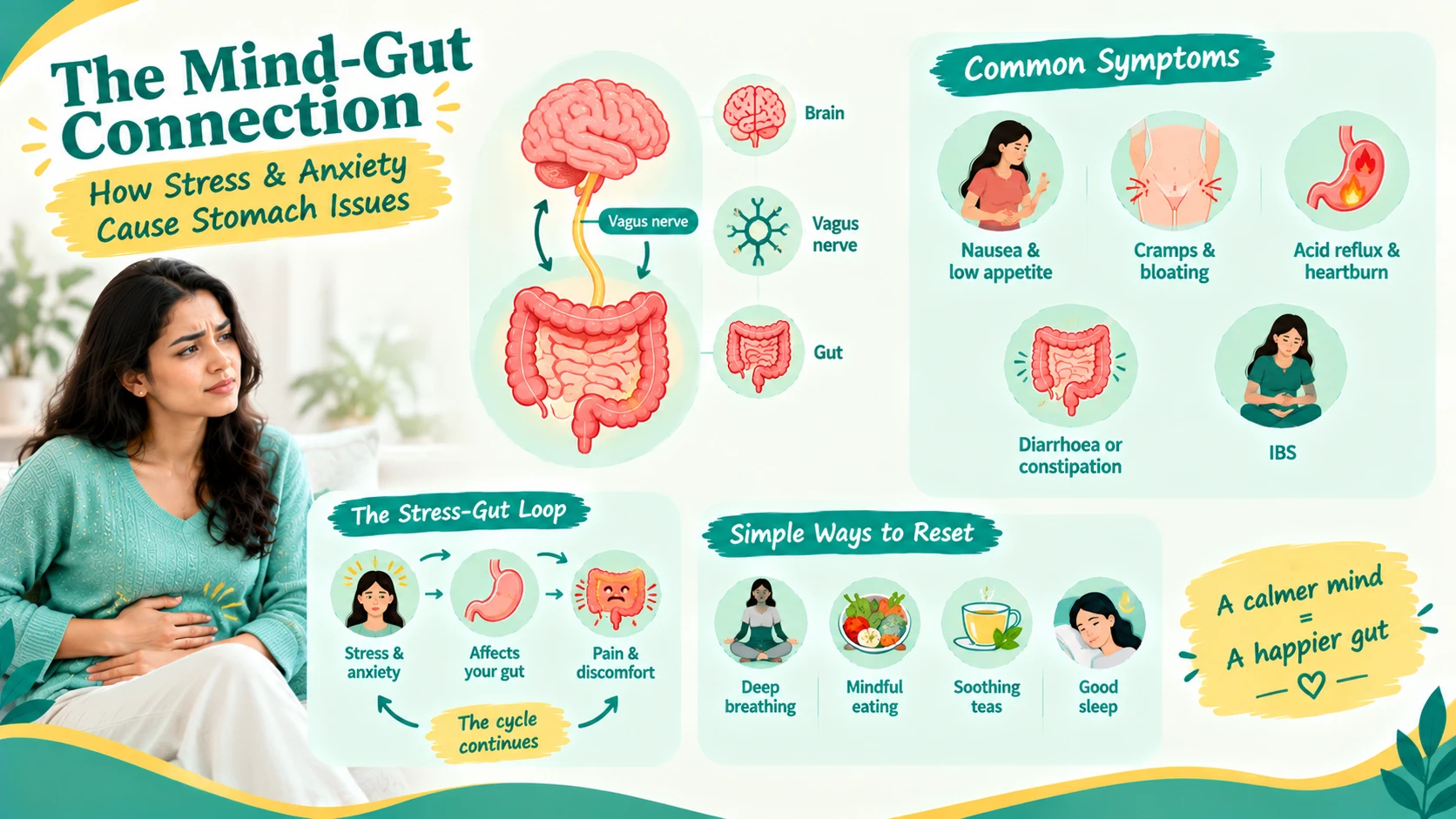
Did you know this fun fact: the organ with the highest number of neurons is, of course, the brain. But do you know which organ contains the largest collection of neurons outside your head? It’s your gut! The intestinal tract is far more active and complex than most people realize.
Sure, the gut is where all our food is digested and nutrients are absorbed. But increasing scientific evidence shows that the gut does so much more—it plays a direct role in regulating your immune system, balancing your sleep cycles, influencing appetite, and controlling your mood. It does this because your gut is in constant communication with your brain through a massive bundle of neural fibres called the Vagus nerve.
Ever noticed that when you’re excited, you suddenly need the restroom? That’s your sending messages straight to your gut. What happens when those emotions are stress and anxiety? Your gut takes a hit, too. Let us look at how this mind-gut connection works.
The Gut-Brain Axis: Your body’s internal phone.
The gut-brain axis is a complex, two-way network connecting the brain and spinal cord directly to your digestive tract.
There are a few important players involved in this axis:
1. The Vagus Nerve: This massive nerve acts like a high-speed fiber cable running from the base of your brain down into your abdominal organs.
- This nerve acts two way: it gives real-time updates about gut conditions to the brain, while sending motor commands from the brain back down to coordinate digestion.
- Thus, it mediates important digestive reflexes (vagal reflexes) that automatically adjust gut function to changing conditions, such as chemical shifts like when you feel stressed and there is high-cortisol produced.
2. The “Second Brain” of the gut region: Within the walls of your entire digestive tract is the enteric nervous system (ENS).
- It contains over 100 million nerve cells: that’s more than even your spinal cord!
- It is called the “second brain” because it can manage digestion on its own.
- It also remains sensitive to signals sent down from the brain.
3. The gut bacteria: Your gut bacteria actively take part in this whole communication too!
- They shape the gut-brain connection by producing signals that travel directly to the brain.
- Your brain and gut also continuously alter the gut internal environment in return for the growth and survival of the gut bacteria.
- When this bacterial balance is disrupted, it can trigger or worsen neurological conditions, mental health struggles, and functional digestive issues. These problems often seem like they lack an obvious physical cause—like IBS or anxiety.
What Happens to the gut-brain axis during Stress?
- When you experience stress, anxiety, or fear, your brain releases a flood of stress hormones like cortisol and adrenaline.
- These hormones are made to make your body understand about the external cues of danger.
- They divert energy, oxygen, and blood flow to organs like muscles and heart to keep you alive, and deliberately reduce immediate non-essential functions like digestion.
When this happens, the gut reacts in the following ways:
- Changes in its movements: Stress hormones can cause the stomach to empty too slowly (leading to nausea, and fullness) or cause rapid contractions in the colon which pushes the food out quickly (leading to sudden diarrhea and cramping).
- Reduced blood flow: Blood is pulled away from the gut lining and diverted to immediate essential parts like the heart. This reduces oxygen in the gut and makes it weaker.
- Increased pain sensitivity: Stress lowers your pain threshold. Normal gas or intestinal movement that wouldn’t usually bother you, can suddenly feel intensely painful or cramped.
Example: Imagine you’re about to give a speech. Your heart pounds, your mouth goes dry, and your stomach feels tight even when nothing is wrong with your food. Your body is simply diverting resources.
Common Symptoms of Stress-Induced Stomach Issues
Stress disrupts the normal digestive rhythm which can manifest as everyday physical symptoms:
- Nausea & appetite loss: Since the gut is not moving normally, the stomach empties slower. Slower stomach emptying combined with elevated stress hormones tells the brain not to send any hunger cues.
- Abdominal cramping & bloating: Tense gut with uncoordinated muscle contractions in the intestines can trap gas resulting in painful spasms.
- Acid reflux & heartburn: Anxiety relaxes the valve stopping your food from going back up your throat. This allows the stomach acid to be burped up along with gas, to cause acid reflux.
- Diarrhea or constipation: Sudden and high stress often triggers urgent loose stools, while long-term anxiety can slow bowel motility causing constipation.
- Irritable Bowel Syndrome (IBS). IBS is a long-term condition with abdominal pain and changes in stool habits. Research has reported that psychological stress can even trigger IBS symptoms and make them worse, by changing how the gut moves and how sensitive it is (doi: 10.3748/wjg.v20.i39.14126).
The Stress-Gut Unending Loop
Since the gut-brain talk works both ways, it can create a vicious loop. The loop goes like this: you feel stressed—this releases cortisol or adrenaline which works on your gut—increases gut movements making you feel pain and needing a toilet in public— this worry makes your brain release stress hormones—your gut reacts more to this.
Research reports that gut-related problems are often linked with anxiety and low mood, and that IBS is a good example of this communication breaking down (https://pubmed.ncbi.nlm.nih.gov/25830558/).
Calm One and You Calm the Other: advantage of the gut-brain cross-talk
Some simple daily practices to help reset the gut-brain cross-talk are:
- Deep Breathing: Diaphragmatic breathing (inhaling deeply so your abdomen rises, then slowly exhaling) activates a rest and digest state, restoring your normal gut function and movements.
- Mindful Eating: Eating meals while scrolling on your phone, working under tight deadlines, or driving almost always does not digest well. Chew your food thoroughly, and allow your body to stay relaxed while eating.
- Warm Teas: Mild teas like ginger-, peppermint-, or chamomile tea help relax intestinal spasms. When you calm the spasms, your brain knows it’s safe to relax.
- Important sleep cycles: Long-term sleep deprivation raises cortisol levels; it is important to get 7 hours of sleep at least.
Your stomach and your mind talk more than you realize. When stress and anxiety turn up, your gut often feels it as nausea, cramps, bloating, or bowel changes. The symptoms are not at all imaginary in stress based stomach issues. And since the cross-talk works both ways, caring for your mental wellbeing helps your stomach, and caring for your gut can lift your mood.
Frequently Asked Questions (FAQ)
1. Can anxiety really cause stomach pain?
Yes. Anxiety activates stress hormone release that change how your gut moves. This can cause pain, cramps, and nausea even when there is no infection or damage.
2. How do I know if my stomach issues are stress-related?
If your symptoms flare or coincide with stressful periods and calm down when you relax, stress is likely the cause. However, always see a certified gastroenterologist if you have weight loss, blood in your stool, or persistent vomiting.
3. Can improving my gut health improve my mood?
Because the gut and brain communicate both ways, gut changes can influence mood and anxiety.
4. Why do I feel nauseous or lose my appetite whenever I am nervous?
When your body senses stress, it activates the well-known “fight-or-flight” response. Because of a perceived threat (whatever stress you are going through), your brain slows down stomach activity, which directly causes nausea, a full feeling, or a sudden loss of appetite.
