

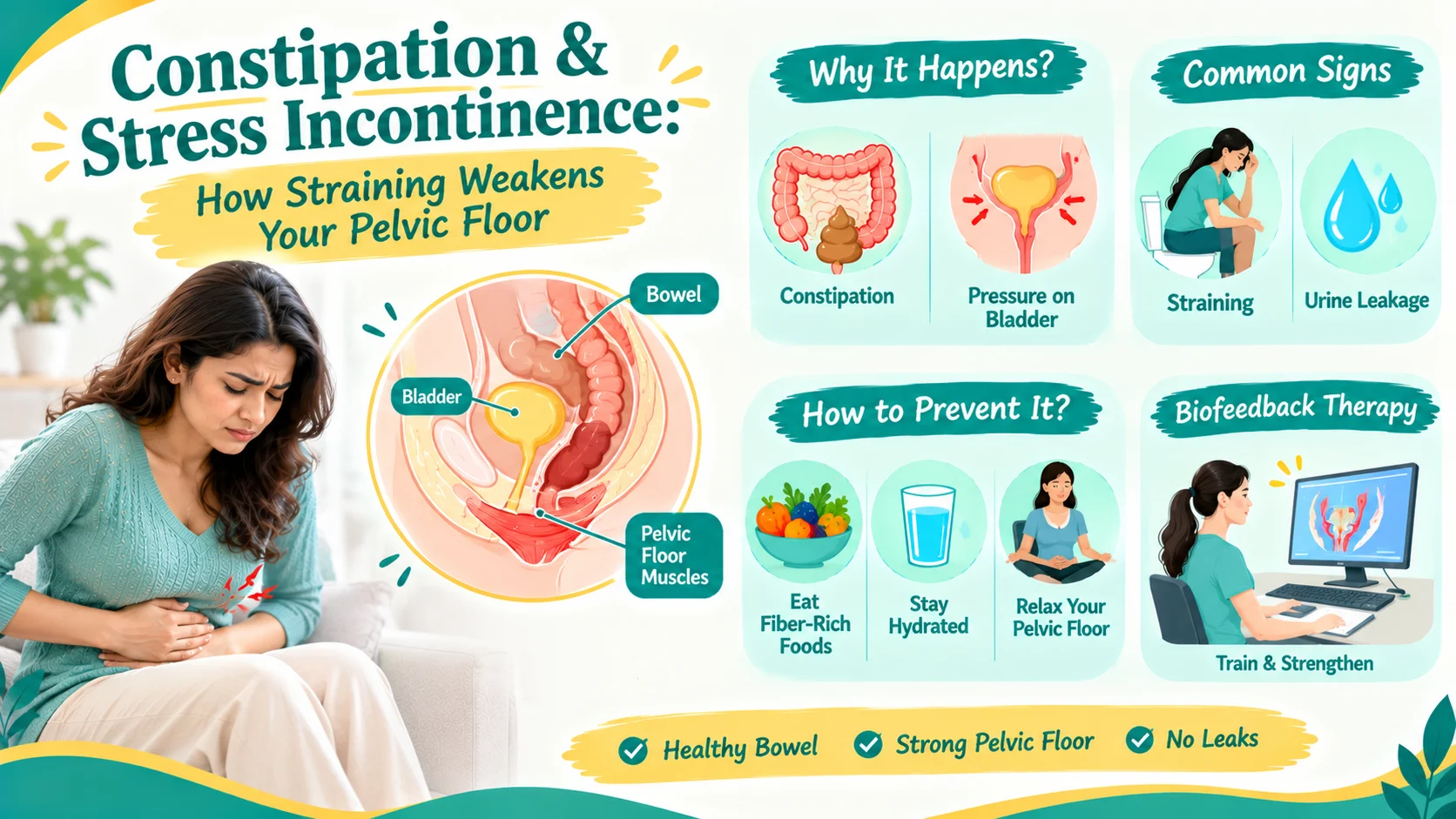
Almost everyone experiences constipation at some point in their lives. But have you ever noticed how when you’re backed up, you also feel the urge to pee more often, or even leak unexpectedly? You aren’t imagining it. Most muscles in our body are inter-linked; thus, if a muscle is impacted for any reason, the effect can be felt even in surrounding muscles and body parts too. Muscles do more than just giving structure to the body; they also help effective functioning of the organs they are around. When the functioning of one organ is compromised for any reason, you may sometimes find that other nearby organs are affected too—even if they function differently. Let’s explore how these two seemingly separate functions are closely connected—and what you can do to keep both working smoothly.
Can a full, impacted colon press against the bladder and increase urine leakage?
- Yes, a full colon can also impact bladder control.
- When bladder trouble strikes alongside constipation, it is natural to assume a biological cause—such as a spreading infection leading to a urinary tract infection (UTI).
- However, in most cases, urine leakage caused by a backed-up colon comes down primarily to physical, mechanical pressure.
- In the pelvic region of your body (lower abdominal area), the bowel (long intestine where the stools collect) and bladder sit side by side and share the same network of pelvic floor muscles and nerve pathways.
- Since they lay so close to one another, any trouble in one area easily spills over to affect the how the other organ functions.
- Think of your bowel and bladder as two flexible, expandable pipes lying side by side in a tight space. When stool builds up and widens one pipe, it physically pushes against the neighboring pipe.
- This constant external pressure means there is less room for the bladder to fill comfortably. It also irritates nearby shared nerves and puts extra strain on the bladder wall.
- Altogether, these reasons ultimately force urine out and leading to leakage, or incontinence.
Constant straining to pass hard stools = weak pelvic floor?
- Yes, it can happen!
- A full colon does not just disrupt your bladder functioning; over time, it also takes a toll on a big muscle group in this area—the pelvic floor muscles.
- When you sit on the toilet, when you use the toilet, it would seem that most of the straining and pushing is done by the muscles around your waist as you can visibly see them contract when you push out stools.
- However, below all the muscles and organs, another muscle group—your pelvic floor muscles play an equally important, if not greater role in helping stool leave your body.
Pelvic floor muscles and poop: the deep and silent connection
- To show the importance of pelvic floor muscle in a smooth and strain free toilet time, researchers used diagnostic tools like anorectal manometry and electromyography (EMG).
- Using these, doctors were able to clearly show a precise co-ordination between the abdominal muscles (around your waist) and the pelvic floor muscles (underneath your rectum and bladder-present inside your body) during stool passage from the body.
How pelvic floor muscles help you poop
- Normally, when you use the toilet, your abdominal muscles contract to push downward.
- At the same time, your pelvic floor muscles must relax and lengthen. They behave almost like opening a trapdoor—so the rectum can straighten and let stool pass.
- This relaxing must happen consciously, and must be done by you.
- Problems arise when these pelvic floor muscles accidentally contract or tighten instead of relaxing, or when hard stools force you to push against the contracted muscles.
Repeated force of pushing instead of relaxing weakens pelvic floor muscles
- When you are constipated and repeatedly strain to force hard stools past a tight pelvic floor, there is a huge downward force on these muscles.
- When this action happens repeatedly, it can damage the pelvic floor muscles; imagine a rubber band being stretched repeatedly—which only loosens over time—and finally snaps.
- Once weakened, the pelvic floor muscles can no longer shut bladder opening tightly.
- Thus, when you exert any small force even just a cough, laugh, or sneeze, it can leak urine through the opening which is not shut completely.
- This leakage is medically termed as urine incontinence.
What dietary and hydration adjustments prevent straining to protect bladder control?
- Load up on soluble dietary fibre and natural gut-movers:
- Soluble fiber is majorly found in foods like oats, lentils, chia seeds, apples, bananas, and vegetables.
- Including whole grains instead of their refined versions, for ex: red or brown rice instead of white rice, whole wheat atta instead of maida, broken wheat granules in place of semolina or rava make great inclusions for adding fiber in your diet.
- Gut movers are foods like soaked prunes, figs, and kiwifruit. They help move the food along in your gut and stimulate bowel movements.
- Fiber is effective only with water:
- It is natural to reduce liquids when facing urine incontinence.
- This results in dehydration which worsens both constipation and urine incontinence.
- Aim to sip water steadily throughout the day so fiber can absorb moisture and keep stools soft to pass.
Dehydration worsens urinary incontinence?
- Dietary fiber acts like a dry sponge. Without enough water, adding extra fiber can actually make stools harder and more difficult to pass. This worsens constipation—impacting the bladder holding capacity.
- Dehydration actually makes urine more concentrated, which irritates the urinary bladder, and worsens its capacity to hold urine tightly.
How do the above two steps help constipation induced urine incontinence?
- Soft stools pass easily with minimal effort—meaning they do not push forcefully against a tight or contracted pelvic floor.
- When you don’t bear down and strain on the toilet, there is no overstretching and loosening of pelvic floor muscles.
- Optimally functioning pelvic floor muscles hold the bladder shut effectively—eliminating urine leakages unexpectedly.
Why do women with both constipation and stress incontinence need a unified pelvic treatment?
-
- Women in general deal with a lot of factors which can affect their pelvic floor health.
- The physical demands of pregnancy, childbirth, and hormonal shifts play a major role in how much the pelvic floor stretches.
- Apart from this, ageing is the single most common factor for loosening this important muscle.
- The pelvic floor muscle function needs to happen in a contrary manner for the effective function of stool passage and urine holding capacity.
- However, because both symptoms stem from the same underlying coordination issue, women often need a unified approach that retrains the entire pelvic floor to both contract effectively (to hold urine in) and relax completely (to let stool pass).
- Training the pelvic floor to tighten helps urine incontinence significantly; however, a tight pelvic floor can make you strain when you need to pass stools.
- On the opposite, relaxing them too much can often worsen urine leakages.
One muscle to hold them all, one muscle to bind them!
How can biofeedback therapy treat both pelvic floor bowel dysfunction and bladder leaks?
-
- Biofeedback therapy is a non-invasive form of re-training your pelvic floor muscles to function effectively.
- Pelvic floor muscles are inside your body and cannot be seen actively while you contract or relax them.
- To see their strength and if they are functioning correctly, a specialized therapist called pelvic floor therapist, will attach sensors to translate your deep muscle activity into real-time visual or audio signals on a screen.
- This measurable feedback allows you to consciously feel and retrain how your pelvic floor responds in real time.
Both bowel dysfunction and bladder leaks results from poor pelvic floor muscle coordination.
Thus, biofeedback helps across the entire pelvic region in several important ways:
- Helps you understand how to relax during a bowel passage: Biofeedback can train you to consciously recognize the pelvic floor tension, so you can relax the muscles and the stool can pass without straining.
- Helps keep you pelvic muscles contracted correctly, to control urine leaks: Your therapist can also ensure you are engaging the correct pelvic muscles muscles—not your abdomen or thighs when practicing contractions. This effective way of contracting the muscles ultimately strengthens them to control any urine leaks.
- Retrains your bladder and brain coordination: Biofeedback therapy also retrains the nerves connecting your brain to the pelvic muscles, to strengthen the control you can consciously exert to contract the muscles.
Many women often treat constipation and urine leakages as separate issues. In fact, half of the women in India often feel these symptoms but do not report them together—most often unknowingly. While treating constipation is a healthy way to treat hard stools, and go to the root of this condition, it is often not enough. This is mainly because repeated episodes of constipation and straining would’ve already loosened the pelvic floor muscles. The biofeedback therapy—provided by specialists at Smiles Institute for Gastroenterology, Bengaluru is a significant and effective way to treat urine incontinence due to constipation. If you experience urine leakage and constipation, do not wait for it to get resolved naturally—take an appointment for safe and effective non-invasive treatments for your confidence.
Frequently Asked Questions (FAQ):
Can treating constipation actually stop my bladder leaks?
Yes, in some cases clearing out backed-up stool can relieve the physical pressure on your bladder which often improves or stops urinary leakage.
Should I do Kegel exercises if I have both constipation and urine leakage?
Not without guidance. Kegels on an already tight pelvic floor can worsen constipation, as they cannot effectively relax during a bowel movement.
Will drinking more water make my urine leakage worse?
No. It often leads to dehydration which actually makes urine more concentrated and irritating to the bladder, making you feel like peeing more often and worsening incontinence.
Is pelvic floor biofeedback therapy painful?
Not at all; it is a completely painless, non-invasive training session. It uses sensors to show your muscle activity on a screen so you can learn to relax and strengthen them properly.
When should I see a doctor about constipation and bladder leaks?
Consult a specialist if your symptoms persist for more than a few weeks despite diet and hydration changes, or if you experience blood in your stool or urine, or a feeling of incomplete bowel movement.
