

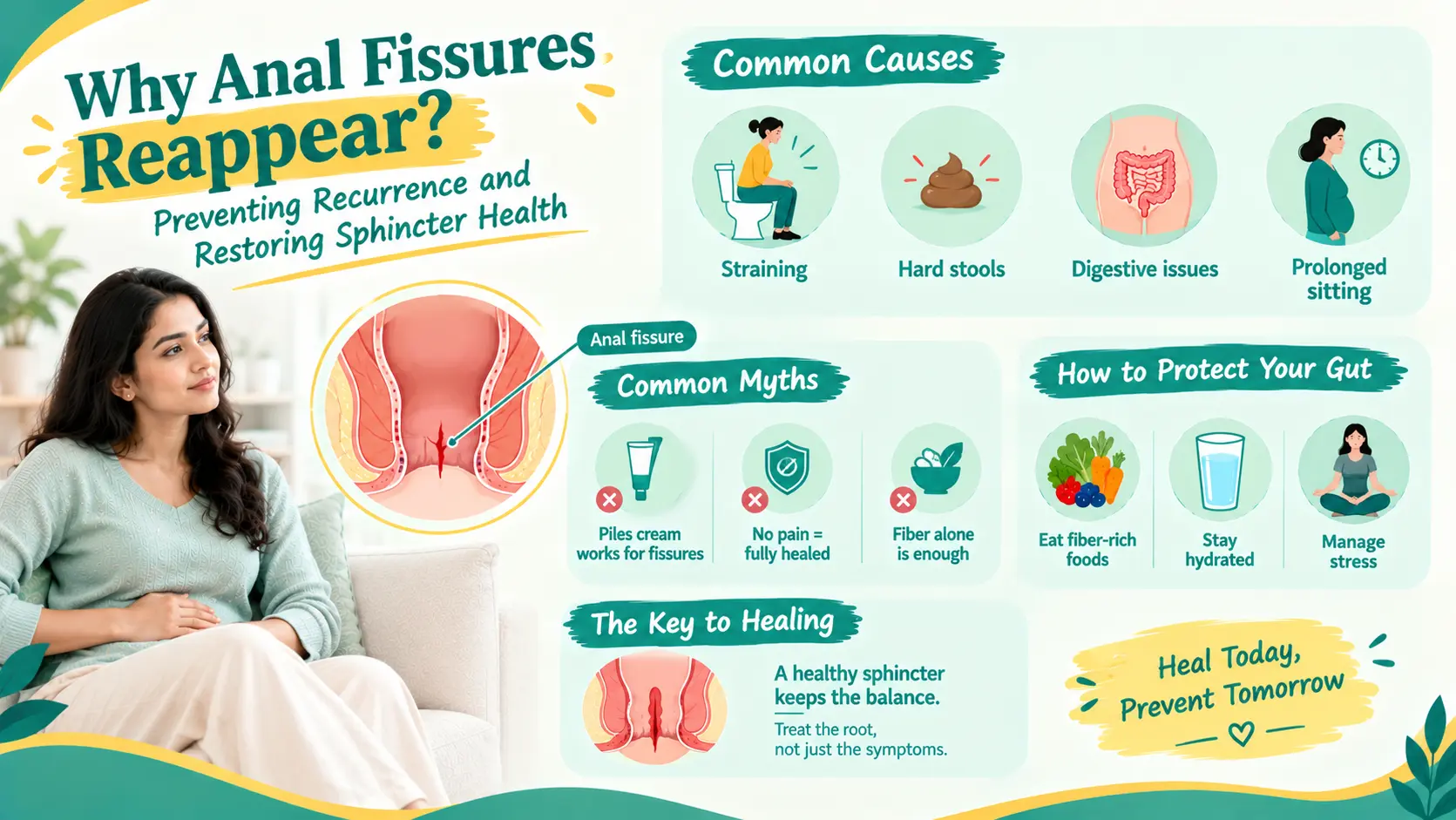
Anal fissures are a very common condition where there are superficial tears formed in the skin which lines the anal opening. Since they form primarily due to intense straining when passing bowels, they can develop irrespective of age or gender. However, due to their superficial nature, they can also be easily cured.
However, sometimes the healed cuts in the anal skin tear back again due to multiple causes. And you may feel the sharp pain during stool movements recurring beyond 6 weeks. These are recurring fissures and need a different treatment approach. Read on to know how recurring fissures come and why curing them needs something beyond diet and laxatives.
Fissures: what are they?
- A fissure is a crack in the surface of anything, it the same with anal fissures.
- An anal fissure is a small tear or cut in the thin tissue lining the lower anal canal—similar to crack in the skin of your feet. And just like how your feet pain when you put intense pressure on the cracked skin, if you have an anal fissure taking a normal bowel movement can turn out to be sharp, intense, and painful.
- Having fissures is described often as feeling like passing razor blades or glass along with bright red blood during or immediately after a using the toilet.
- When anyone goes through this even for a few days, it can feel like fissures are never healing.
Is it common?
- However, just because this condition is in the anal region, does not make it any less important, no matter how awkward it can get to talk about.
- In fact, the numbers alone can make you see how common it is—approximately 18–32% of adult population show fissures in India (DOI : 10.7860/JCDR/2019/38478.12563).
- Most acute fissures heal by themselves with basic lifestyle changes. However, when a fissure keeps tearing open or fails to heal after 6 to 8 weeks, it becomes a chronic, recurring fissure that requires specialized attention.
What happens when someone has a chronic fissure?
The treatment changes from basic dietary changes to an ensuring the tears do not go deeper, thus saving vital muscles from injury and any complex surgeries needed for their treatment.
Common misconceptions about anal fissures: the delay leading to recurring fissures
Misunderstanding anal fissures makes people to use the wrong treatments, most often everyone just thinks a normal piles ointment works even on fissures!
Such misconceptions often delay healing and allow a simple tear to become recurring—which then need complex treatments. Clearing up these common myths is the first step toward simple an effective relief:
Myth 1: “Fissure is same as piles, so I can use standard piles cream.”
- The Reality: While both conditions cause anal pain and bleeding, piles are swollen blood vessels, and fissures are open tears in the anal tissue lining. Standard piles creams often contain ingredients that can irritate the open cut or fail to relax the underlying sphincter muscle (needed for proper blood flow), worsening the small fissure.
Myth 2: “If the pain stops, the fissure is 100% healed inside.”
- The Reality: Pain often reduces before fragile new skin tissue fully strengthens and is fully functional. Stopping your high-fiber diet and other topical treatments the moment pain disappears frequently causes the delicate skin to re-tear during the next toilet visit.
Myth 3: “Fissures are caused only by severe constipation.”
- The Reality: Passing hard, dry stool is the most frequent cause since it stretches and tears the anal skin. However, long-term diarrhea, prolonged toilet sitting, childbirth, or having hyperactive anal sphincter muscles can also tear the delicate tissue just as easily.
Myth 4: “Eating fiber alone will fix a chronic fissure.”
- The Reality: Fiber softens stool, but taking fiber without upping water intake make stool harder to pass, worsening the tear.
Can anal fissures affect sphincter health?
Treatment of recurring fissures is more than just fiber and water. Recurring fissures go deeper and underneath the anal skin is a ring of muscles called the anal sphincter.
The anal sphincter is the key to curing recurring anal fissures. They are vital to the functioning of the anal canal and dictate a lot of recurring anal fissure symptoms.
Thus, it helps to first understand the gatekeepers of the anal canal: the anal sphincter muscles.
Why your anal sphincter muscles matter?
The working of the anal canal opening is controlled by two main muscle rings that work together. They help control bowel movements and open when the bowels need to be let out of the body. They are:
- The Internal Anal Sphincter (IAS): A ring of smooth muscle that stays contracted to keep stool inside until you are ready to use the restroom.
- The External Anal Sphincter (EAS): A ring of skeletal muscle that you can consciously control at any time.
Together, these muscles behave like a valve for your digestive system. However, when an anal fissure forms, their system is thrown off balance.
How recurring fissures damage sphincter health ( well-known as the Spasm-Ischemia cycle)
When a fissure recurs and becomes long-term (over 6–8 weeks), it does not just stay as a surface skin cut, it also affects the functioning of the IAS or inner sphincter muscle.
It works through a vicious cycle:
- The Trigger: When you use toilet and have long-term anal fissure, the sharp pain causes the internal sphincter muscle to squeeze hard and go into a tight spasm (hypertonia).
- Ischemia follows: When the internal sphincter remains shut, it squeezes the blood vessels in the anal lining, thereby restricting blood flow. This lack of blood flow is called ischemia.
- Delayed healing: Without blood flow, the anal skin tear on the outside cannot close. Instead, just like foot cracks, the edges of the tear harden making deep fissures.
- The cycle continues: the anal skin tear remains unhealed and open, causing sharp pain when stool movements happen. This pain triggers the anal sphincter to remain closed-which in turn keeps blood supply down.
- Permanent Muscle Fibrosis: If this cycle continues for months or years, the contracted sphincter muscle can undergo permanent changes leaving the muscle permanently tight, less elastic, and increasingly prone to future tears.
How treatment changes for recurring fissures?
This is why treating a recurring fissure requires more than just softening your stool. Treatment must focus on relaxing the internal anal sphincter muscle (using specialized medications or physical therapy) to restore blood flow, and break the Spasm-Ischemia cycle to protect your anal muscles in the long-term.
Preventing recurring fissures to protect your sphincter
Breaking the above described cycle requires a multi-step approach. By relaxing the sphincter muscle, and restoring blood flow, the fissures will automatically heal.
1. Keeping stools soft every day is the most crucial step-so fiber up and hydrate: Fiber adds bulk to your stool, but without plenty of water, it makes stools even harder. Rely on natural soluble and insoluble fiber from fruits, vegetables, and whole grains instead of relying on laxatives.
2. Be more aware with bathroom habits: Never sit on the toilet for long periods by reading or scrolling. Sitting increases pressure on the anal canal, putting strain on the anal skin.
Do not ignore urges to use the toilet, but never push forcefully.
3. Actively relax the sphincter muscles: You can do this naturally through-
- Use sitz baths: Soaking your anal opening in warm water especially after a bowel movement helps to relax muscle tightness and boost blood flow.
- Use Prescribed Ointments Consistently: If your doctor prescribes topical muscle relaxants use them for the full prescribed course. Do not stop just because the initial pain fades; the internal muscle needs time to fully relax and heal.
4. Address Underlying Tension: Many people who have chronic fissure have tension in their entire pelvic floor/lowermost muscles. Work with a specialized pelvic floor physical therapist for targeted breathing and relaxation exercises to release the muscle tension.
Dealing with a recurring anal fissure often feels fearful and never-ending, but you do not have to live in this fear. Understand that chronic fissures are caused by an underlying muscle spasm and not just a one-off constipation episode—this is the key to permanent cure.
By combining soft bowel habits, warm sitz baths, and targeted medical therapies to relax the internal sphincter muscle, you can restore healthy blood flow and achieve effective recovery. The awkward talk you fear is delaying your care; speak to a qualified colorectal specialist at Smiles Institute of Gastroenterology, Bengaluru as soon as you feel that sharp pain to protect your long-term digestive comfort.
Frequently Asked Questions (FAQ)
How do I know if my anal fissure is recurring fissure?
An acute fissure is surface-level tear that usually heals in 2–4 weeks with lifestyle adjustments. A fissure becomes recurring when it opens up repeatedly over 6–8 weeks no matter the measures you adopt.
Can an unhealed fissure turn into an anal fistula or abscess?
No, a fissure cannot become a fistula. However, the open skin tear means that underlying mucus glands are exposed to fecal bacteria. If the glands get infected over a long-term they can form fissures.
Is it normal for a fissure to bleed every time I pass stool?
Yes, it is common to see bright red blood on the stool when passing a bowel movement when you have a fissure. However, any persistent or heavy bleeding should always be evaluated by a healthcare provider to rule out other underlying digestive issues.
How long does it take for the internal anal sphincter to fully relax and heal?
While sharp pain can disappear within 2 weeks of starting prescription muscle-relaxing ointments, full healing of underlying muscle usually takes 6–8 weeks.
When should I see a specialist for a recurring fissure?
You should consult a colorectal specialist if your symptoms persist beyond 2–3 weeks, if pain disrupts your daily activities, or if you experience repeated flare-ups. A specialist can prescribe targeted medications or discuss minimally invasive procedures to break the spasm cycle before it becomes too late.
