

What are Rectovaginal Fistulas?
Fistula is a medical term used when there is an abnormal tube-like connection formed within the body. Fistulas can form anywhere in the body, and is formed when there is a long-standing infection or inflammation in any region of the body. Chronic infection or inflammation results in collection of infectious or bodily liquids. To drain out these liquids and prevent them from spreading further in the body, fistula/ tunnel-like structures are formed from the site of infection to an opening in the skin.
Anorectal fistulas are formed when there is chronic infection in the mucus secreting glands present in the anal canal. Anal fistulas become very painful, and significantly impact the quality of life. Although anal fistulas are more common in men than women, about 10—20% of women facing fistulas suffer from a specific subtype called the rectovaginal fistula, that significantly impacts female reproductive and digestive health. A rectovaginal fistula forms between the rectum and the vagina, allowing gas or stool to pass through the vaginal opening. Let’s read more about rectovaginal fistulas in this article.
What exactly is a rectovaginal fistula (RVF)?
- This sub-type of fistula occurs exclusively in women due to the organs involved.
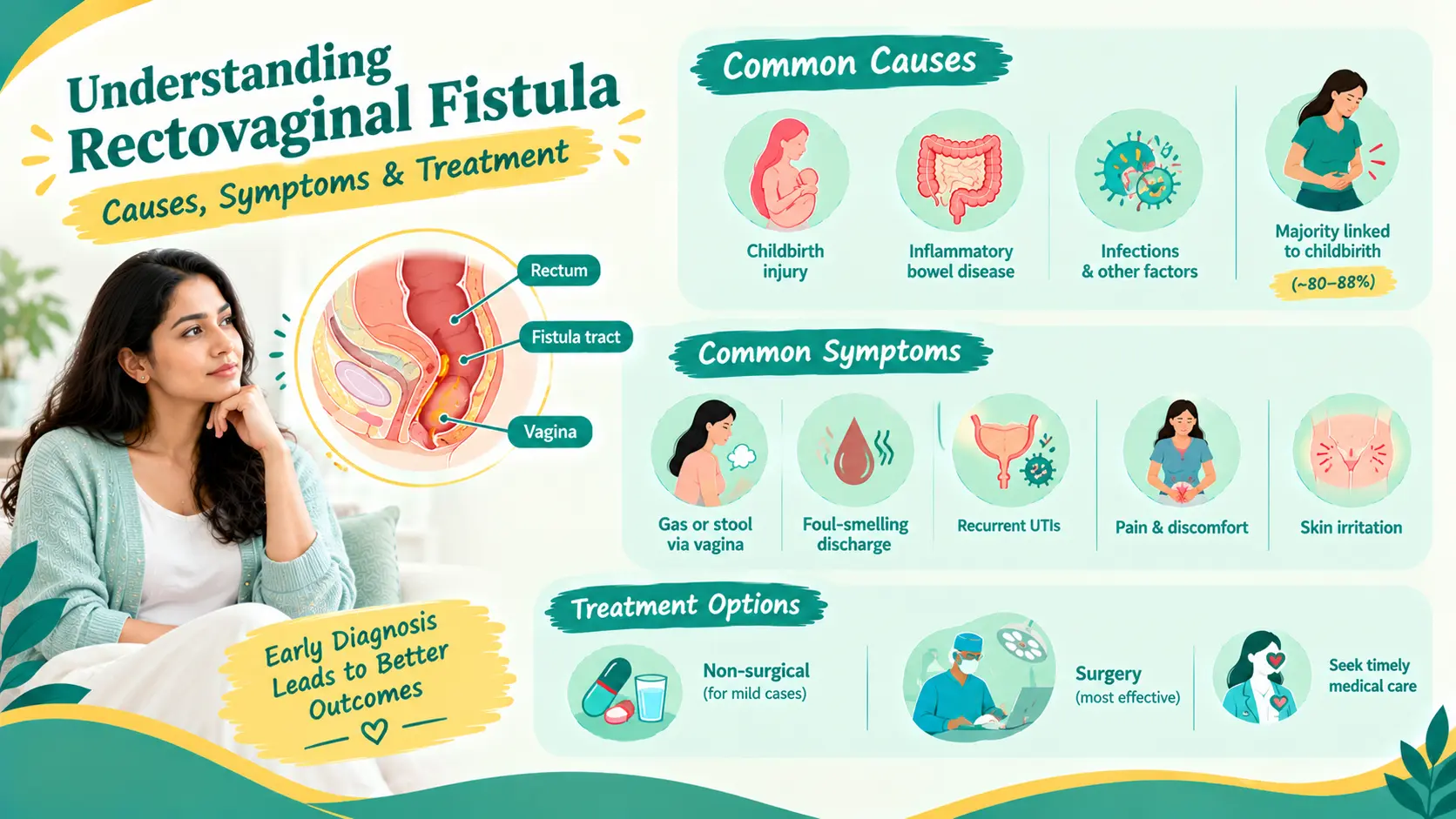
- Here, the fistula or tube-like connection forms between the rectum—where stools are stored before exiting from the body, and the vagina—a portion of the female reproductive organ with an opening at its end.
- A rectovaginal fistula can form due to many reasons including infection in anal glands, or vaginal infection/trauma. However, the most common reason is injuries from childbirth.
- The world-wide instances of this condition ranges from 50,000-100,000 per year.
- Many medical reports suggest a direct correlation with developing countries and the rate of RVFs.
- This is mainly attributed to the lack of access to proper gynaecological expertise and timely emergency care during childbirth in many parts of developing countries.
- The burden in India: According to a global epidemiological report published in BMJ Global Health (e020877), India’s RVF numbers are disproportionately high, making up for ~150,000 obstetric fistula cases—nearly one-third of the total global numbers.
- Since the tunnel connects the rectum and vagina, patients frequently experience distressing symptoms like passing gas or liquid/solid stool involuntarily through the vagina, chronic vaginal discharge, recurrent urinary tract infections (UTIs), and severe localized skin irritation.
- Beyond physical discomfort, rectovaginal fistulas lead to significant emotional trauma too. Many women also face disruptions in their intimate time, social stigma, and anxiety.
Rectovaginal fistula causes—childbirth and beyond.
Childbirth injuries make up majority of the RVF cases, but it is not the only cause of this condition. Since a rectovaginal fistula by nature involves two organs—the rectum and vagina, other conditions affecting these organs also can lead to formation of fistulas.
Below, you can understand the different causes of RVF, categorised by prevalence and under the origin affected initially before the fistula formation.
1. Obstetric (childbirth related) Trauma (~80 – 88% of cases):
- 3rd and 4th-Degree Perineal Tears: During a difficult vaginal delivery, the perineum (tissue between the vagina and anus) tears, and sometimes it can extend all the way into the anal tissue. If these deep tears do not heal completely, a persistent fistula channel can develop.
- Prolonged Labour: long labour time presses the baby’s head against the pelvic muscles, cutting off blood supply sometimes. When this happens, sometimes, the tissue between the anus and vagina can breakdown and form a hole due to the pressure and low blood flow.
- Episiotomy Complications: an episiotomy—a small cut made in the vaginal opening to help a baby come out, can become infected if not healed well or kept hygienic till it heals. The infection eventually leads to fistula formation.
2. Gastrointestinal Conditions (~8 – 12% of cases)
- Digestive related disorders involving long-term inflammation in the bowels(intestines) can gradually damage neighbouring pelvic organs—the rectum and vagina over time.
- Conditions like Crohn’s Disease, diverticulitis, and ulcerative colitis often cause severe and long-standing inflammation in the intestinal regions. In some severe cases, the inflammation gets very severe to go through the entire intestinal wall. In ulcerative colitis, the inflammation occurs in the rectal wall, weakening it severely. Weakened intestinal or rectal walls are easily prone to infections and fistula formation.
3. Anal Infections and other conditions like malignancies (~4 – 8% of cases)
The following conditions account for minority of the total rectovaginal fistula cases, as they rarely result in RVF formation.
- Anal Abscesses: The anal canal contains tiny glands which can become clogged and infected, leading to an abscess (a pocket of pus). To drain this fluid, instead of the fistula being formed from the abscess to the skin, it can sometimes tunnel into the vagina, leading to RVF.
- Surgical Complications: Procedures involving the pelvic area like hysterectomies, or rectocele repairs can sometimes involve accidental tissue damage, suture line openings, or post-operative infections which can lead to a fistula.
- Pelvic Radiation Therapy: Radiation used to treat cervical, uterus, or rectal cancers can weaken nearby healthy tissues sometimes, making them more prone to fistula formations between the rectum and vaginal walls.
- Malignancies: Advanced or late-stage tumours originating in the rectum, cervix, or vagina can grow through the tissue barrier between these organs, damaging the lining of these organs. This directly leads to fistula formation between the rectum and vagina.
What do rectovaginal fistula feel like?
In women, the rectum and vagina are well separated due to the presence of the perineum tissue. When this tissue is opened or compromised, contents in the rectum can easily pass into the vaginal canal. Hence, the severity and complexity of RVF symptoms depend largely on where and how the fistula is formed in between the two organs.
Common symptoms women face if there is a RVF are:
- Involuntary Passage of Gas or Stool via the Vagina: This is the hallmark symptom of an RVF. Depending on the size of the fistula, patients may notice gas or even stool (faecal matter) leaking through the vaginal opening.
- Foul-Smelling Vaginal Discharge: A persistent or foul-smelling vaginal discharge is very common with RVF due to fluid drainage from the fistula tract.
- Recurrent Vaginal & Urinary Tract Infections (UTIs): With faecal matter, bacteria also enter the vaginal canal which often leads to frequent, and persistent (recurring even after antibiotic treatments) vaginal or urinary tract infections.
- Pain & Discomfort: The presence of a physically formed tract, and also the underlying infections can make women feel a deep pelvic pain which worsens during sexual intercourse or during bowel movements.
- Skin Irritation: Due to stool and moisture drainage constantly it leads to severe irritation, redness, and burning, around the vulva, perineum, and thighs.
Treatment options of rectovaginal fistulas.
Treatment options for most RVFs mostly remain the same as anal fistulas—surgery. However, some mild, superficial cases may heal with non-surgical care.
- Non-Surgical & Conservative Management: For small fistulas antibiotics significant help to clear infections, while stool softeners and hygiene measures to reduce tissue irritation. However, this option remains only for slightly superficial fistulas.
- Surgical Interventions: Surgery is till date, the best treatment option to close the fistula tract permanently. Common procedures include using a patch of healthy rectal tissue to cover the opening, or inserting a seton (a medicated thread) to heal deep long, term infections to drain out before closing the tract completely.
Living with a rectovaginal fistula can be physically challenging and can take a significant emotional toll. However, most of the RVF are a side-effect of childbirth, a sensitive time during which you may not have entire control over. Almost all rectovaginal fistulas are treatable but it is always best treated with early medical consultations for an accurate diagnosis, preventing secondary complications, and outlining an appropriate care plan tailored to your specific condition.
By nature, RVFs are also not very socially talked about. So, if you or a loved one are experiencing any of the symptoms of a rectovaginal fistula discussed above, timely medical evaluation can significantly improve your health and quality of life. For a comprehensive diagnostic evaluation and empathetic care, consult the department of colorectal care at Smiles Institute of Gastroenterology, Bengaluru.
