

How do you treat a perianal abscess?
An abscess is a medical term which means a pocket which is formed to collect pus; in common terms, it is called a boil. Abscesses can form almost anywhere in the body, but are found more commonly where there are glands—like sebaceous glands, and mucus glands, or in closed areas like armpits, groin, anal region, or the region between the buttocks.
Did you know?—abscesses actually help you!!
They may be painful, but they are so helpful to keep your body safe. Abscesses are generally formed when there is an active infection your body is fighting off. The result of that infection is pus—a collection of bacteria and dead cells. If the pus were to spread around to nearby healthy tissues, the infection might spread and the cost of fighting the spreading will be higher for the body, as it would need more immune cells and higher energy.
Thus, to preserve the health of the surrounding tissues/body parts, and to avoid spreading the infection to them and more importantly into the blood stream, your body makes a special holding pocket. This pocket is where all the infection is fought off in a contained manner. This pocket is called an abscess.
An abscess which forms near the anal mucus glands is called a perianal abscess. The good news is that, most of the time, you would just need a very small procedure performed in just minutes to cure it completely.
What is the root cause of perianal abscess?
Out of every 100 cases which a doctor treats for perianal abscess, 90 of them are found to have a common cause—blockages in the mucus glands which line the anal opening; this is one of the root causes of perianal abscess. The remaining 10 cases develop perianal abscess as a secondary symptom, meaning, there is a primary underlying long-term/chronic disease in the body which can have perianal abscess development as one of the many side-effects. Let us look at both the causes in a little more detail.
The primary root cause:
Blocked anal mucus glands.
- The anus is the last part of the digestive system in your body, and is meant for pushing out all the digested waste, which can also contain a lot of pathogenic/disease causing bacteria such as Escherichia coli (E. coli), , Klebsiella pneumoniae, Enterococcus, and Staphylococcus species.
- There are about 10—12 mucus glands which line the anal opening, to help lubricate the passage of stools.
- However, when debris (stool particles) get stuck in these glands, they can cause infection, which results in production of pus.
- To effectively contain it and fight this infection, an abscess is formed near the glands. This is called a perianal abscess.
Other uncommon causes of perianal abscess:
- Inflammatory Bowel Disease (IBD): Other long-term gastrointestinal conditions like Crohn’s disease cause inflammation throughout the digestive tract. This inflammation can happen through the tissues all the way to the anal tissues, resulting in abscess formations.
- Sexually Transmitted Infections (STIs): Infections such as chlamydia, gonorrhea, syphilis, and herpes virus can cause severe inflammation in the rectal and anal canal leading to abscess formation.
- Trauma or physical injury: Any trauma from medical procedures, anal intercourse, or enemas can tear the anal lining, which makes it easier for bacteria and stool particles to get stuck into the inner layers of the tissues.
- Weak immune system: Individuals having weak immune systems from HIV/AIDS, or undergoing chemotherapy, or even having uncontrolled diabetes are more vulnerable to tissue infections and thus, abscess formations.
- Anorectal cancers: Anal or rectal tumour can block the gland from drainage making the perianal area more susceptible to infection.
- Tuberculosis: Extrapulmonary tuberculosis (TB in areas apart from the lungs) which happen in gastrointestinal or perianal region, can lead to perianal abscesses.
What are the first signs of an abscess?
Even before you notice that you may have a boil near the anal opening, there are some tell-tale signs which can warn you of what is happening underneath the anal skin. Noticing these symptoms can work greatly to your advantage, as you can take action with conservative remedies which work quite well when a perianal abscess has just begun to form.
Keep a look out for the following:
- At the beginning, a developing perianal abscess will start as a vague feel of pain
- You may also have a sensation of fullness near the rectum
- These two symptoms overlap with that of a mild haemorrhoid, which can naturally be quite confusing to anyone initially.
- However, this discomfort evolves into a sharp, throbbing pain because the anal gland infection begins from within the gland and can spread outward into the nearby tissues.
- This pain also feels aggravated by normal daily movements like walking, sitting down, or having a bowel movement.
When to worry about a perianal abscess?
- In general, the cycle of an abscess begins at its formation and it fills up with a lot of pus and liquid, followed finally by it bursting/emptying.
- However, sometimes, the primary infection does not get cleared up, which causes the abscess to recur and in fact, extend deeper into the surrounding fat layers of the buttocks.
- When this happens, the abscess needs immediate medical treatments to prevent further complications.
Worrying symptoms of perianal abscess (if you observe this, seek immediate medical attention)
- High Fever and Chills: A temperature above 101°F often indicates the infection is not local to the anal region and is spreading through the body.
- Malaise: A general feeling of being profoundly unwell, weak, or lethargic.
- Inability to Sit or Walk: if you feel that the pain becomes throbbing and intense, and that normal movement is impossible, do visit the doctor at once.
- Urinary Retention: Very rarely, if the abscess goes very deep, the swelling can press against the urethra (tube through which the urine passes out), making it difficult to pass urine.
- Spreading Redness: If the redness on the skin is expanding away from the original infection region, it is a sign that the infection is spreading through the soft tissue.
- Skin Necrosis: Any darkening, turning purple, or blackening of the skin over the abscess site.
If you observe any of the symptoms, visit a good colorectal specialist for physically draining the perianal abscess to help you recover.
What is the best treatment for a perianal abscess?
The best treatment for perianal abscess is one which addresses the root of the abscess formation—be it any gland infection or any of the other uncommon causes listed above.
Only when the infection is treated does the abscess completely go away, and not forma again.
Do antibiotics work on perianal abscesses?
No. While it is natural to think that to treat an infection you need antibiotics, it works a little differently for perianal abscesses.
- Most abscesses start from within the anal glands. You may notice healing on the skin surface, but the residual infections in the glands does not get treated unless opened and drained.
- Even if an abscess bursts on its own, it does not completely drain out, leading to fistula formations.
- The surrounding fat tissue layers do not help in containing infection. Instead, the abscess can easily push through the fat to become deeper, and inaccessible to non-invasive treatments.
- The same fat layers also make blood circulation very less around the abscess. Because oral antibiotics travel through the bloodstream, they cannot easily reach the interior of the abscess with enough strength to treat the infection.
- For these reasons, doctors find it best to treat an abscess by opening and draining it. Antibiotics are often prescribed for supportive measures alongside the main treatment.
What then is the best way a perianal abscess is treated?
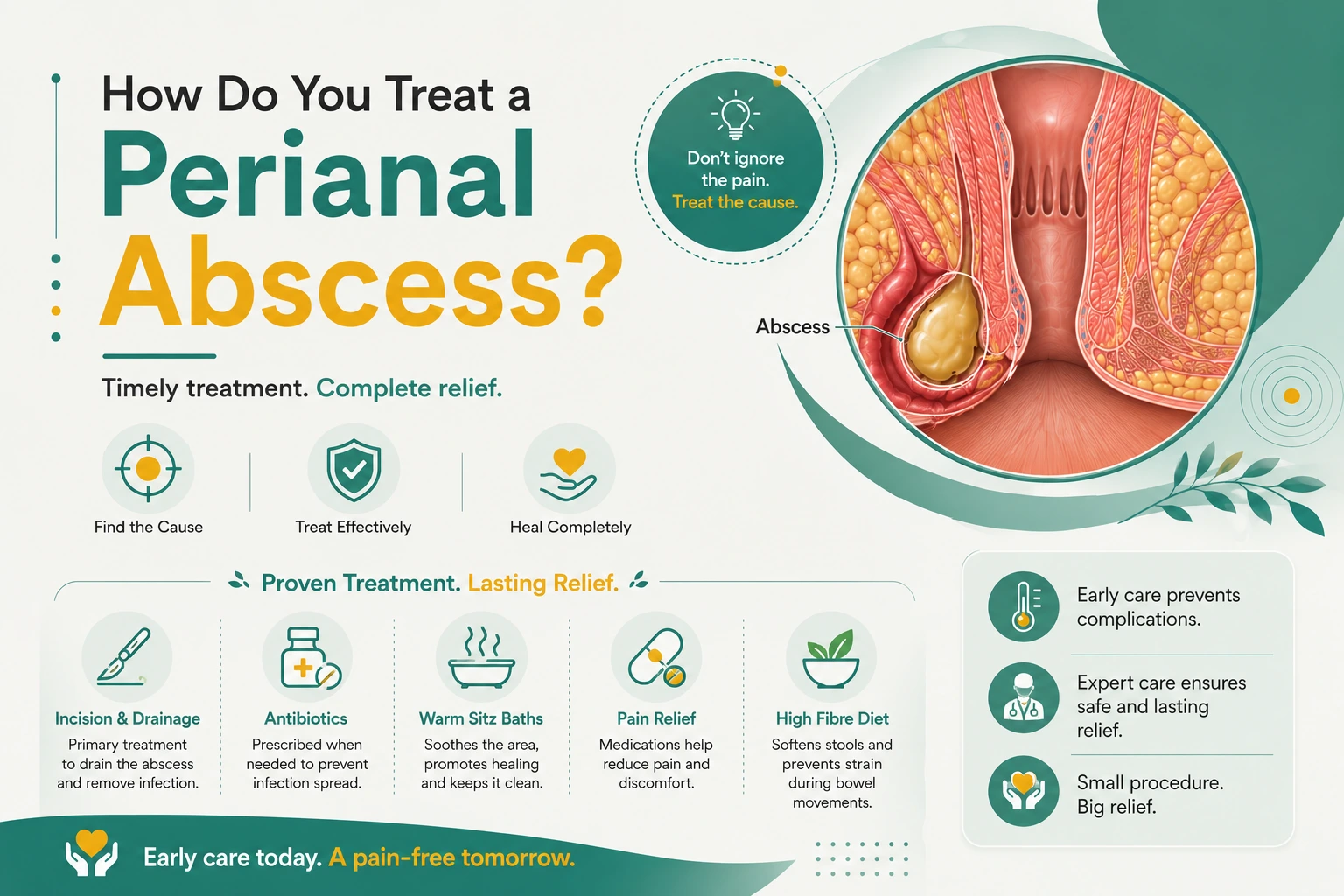
Because of the reasons listed above, and the fact that an abscess is a pocket of pus under the skin, the best way to treat a perianal abscess is to make incisions to drain the abscess, and follow it with other natural remedies to help heal the abscess sit at home.
When you are getting a perianal abscess treated, you will most likely encounter the following steps:
For immediate and complete relief, a doctor will focus on removing the infection and preventing complications.
- Incision and Drainage (I&D): This is the standard, primary treatment for almost all perianal abscesses. After numbing the area, a small opening is made in the skin over the abscess, and the pus is drained.
- Antibiotics: While antibiotics alone cannot cure an abscess , your doctor may prescribe them with the incision and drainage procedure in cases with diabetes or weakened immunity to prevent infection spread.
- For Deeper abscesses: If the abscess is unusually deep or caused by other conditions like Crohn’s disease, drainage is done under general anesthesia. Sometimes, a catheter or drain may be left in place to ensure all fluid drains out completely.
Home Care after the drainage
You may also be prescribed these home remedies to support your recovery at home:
- Warm sitz baths: Using a warm water soak for 15-20 minutes helps to clean the and improve blood flow.
- Pain medications: Medications like ibuprofen or paracetamol can help with the reducing the pain from the incision.
- Stool softeners: To avoid passing hard stools which can make matters worse, you may also be asked to up your fibre, and water. You can also ask your doctor for stool softener options to ease things effectively.
While perianal abscess may seem like just a tiny boil near the anus, the pain and irritation felt can cause intense discomfort in daily life. The strongest step you can take at such a time is not believe in unscientific remedies which sound easy and fast in action. Perianal abscesses are well reported to be incurable with just diet changes, or washing the area with soap and water. They cannot be cured with just oral antibiotics either. The best way to permanently cure this tiny but painful problem is to visit qualified and expert experts, like those at Smiles Institute of Gastroenterology, Bengaluru. The most effective treatment is just a small consultation away.
Frequently Asked Questions:
Q1: What is the most effective treatment for a perianal abscess?
Answer: The primary and most effective treatment for a perianal abscess is a minor medical procedure called Incision and Drainage (I&D). A specialist numbs the area, makes a small opening over the abscess, and completely drains the collected pus. Because an abscess is an enclosed pocket of infection in tissue with limited blood supply, opening and draining it provides immediate pain relief and allows the tissue to heal.
Q2: Can a perianal abscess be cured with oral antibiotics alone?
Answer: No, oral antibiotics alone cannot cure a perianal abscess. While antibiotics travel through the bloodstream, the surrounding fatty tissue around the anus has limited blood flow, preventing medication from reaching effective concentrations inside the pus pocket. Antibiotics may be prescribed alongside incision and drainage to support recovery—especially in individuals with diabetes or weakened immune systems—but drainage is required to clear the infection.
Q3: What causes a perianal abscess to form?
Answer: Up to 90% of perianal abscesses are caused by blocked anal mucus glands that become infected with intestinal bacteria (such as E. coli). The remaining 10% are linked to underlying conditions including Inflammatory Bowel Disease (IBD/Crohn’s disease), sexually transmitted infections (STIs), physical trauma to the anal canal, weak immune systems, or extrapulmonary tuberculosis.
Q4: What are the early signs that a perianal abscess is forming?
Answer: Early signs include a vague dull ache or a sensation of fullness near the rectum, which is often initially confused with a hemorrhoid. Over time, this progresses into a sharp, throbbing pain that worsens when sitting, walking, or having a bowel movement. Redness, swelling, and localized warmth near the anal opening are also key early indicators.
Q5: When does a perianal abscess require immediate emergency medical care?
Answer: You should seek urgent medical attention if you experience a high fever (above 101°F/38.3°C), severe chills, inability to sit or walk, difficulty urinating (urinary retention), rapidly spreading skin redness, or darkening/blackening of the skin over the abscess site. These warning signs indicate that the infection may be spreading deeper into soft tissues or into the bloodstream.
Q6: How do you care for a perianal abscess after drainage at home?
Answer: Home care after an incision and drainage procedure includes:
Warm Sitz Baths: Soaking the anal area in warm water for 15–20 minutes 2 to 3 times a day to clean the site and boost blood flow. Pain Management: Taking prescribed or over-the-counter pain relievers (like ibuprofen or paracetamol). Stool Softeners & High Fiber: Increasing fiber and fluid intake to keep stools soft and prevent strain during bowel movements.
