

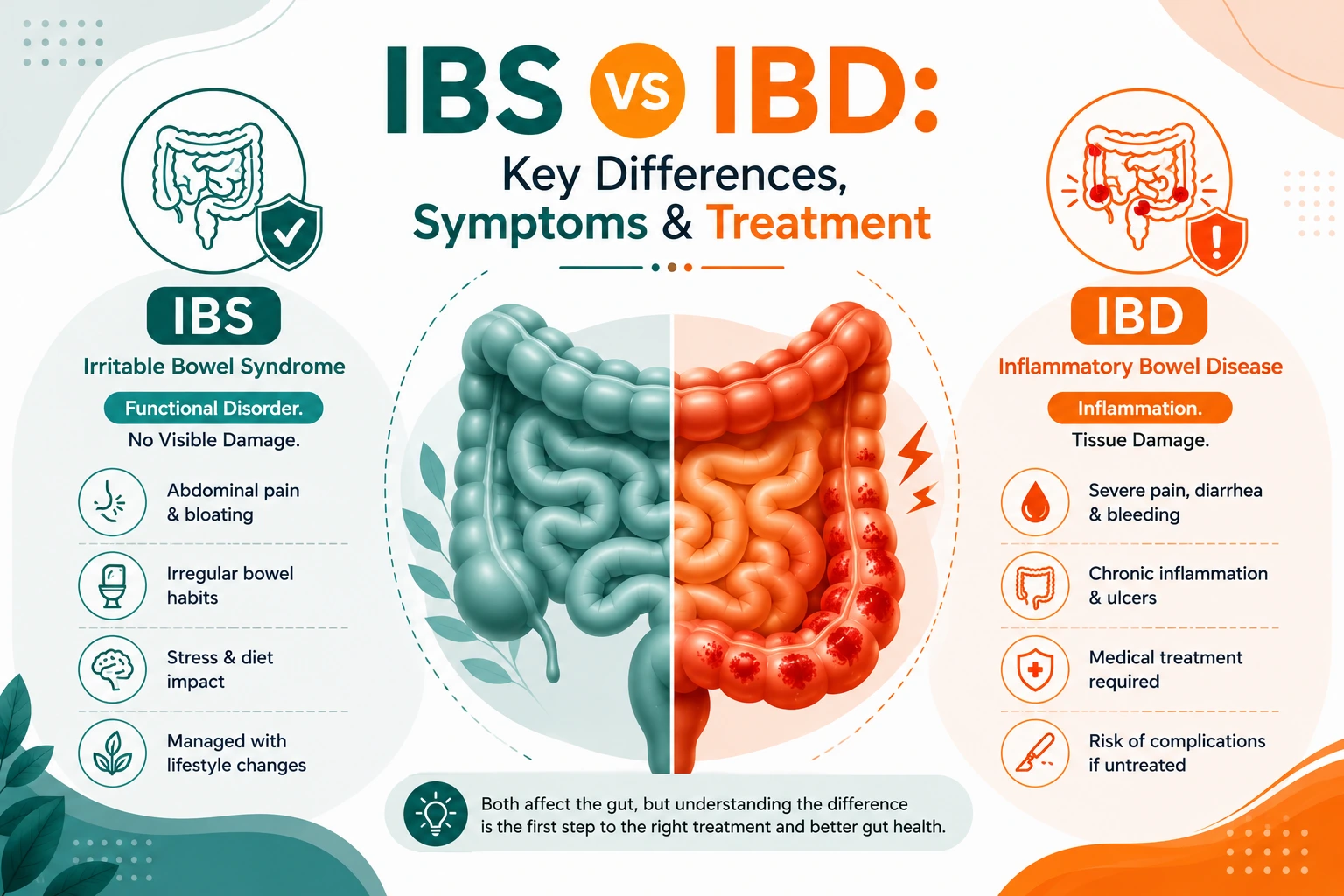
IBS stands for Irritable Bowel Syndrome, and IBD is Inflammatory Bowel Disease. Both develop in the gut region or the intestines, both have many symptoms which overlap; hence, it’s very easy to get confused. Are they different terms used interchangeably for the same condition or are they medically different? This article addresses this exact confusion which many very naturally have. Understanding the difference is more than just about getting the terminology right, it’s also a strong first step toward getting the right treatment and taking control of your gut health.
What is IBS?
Irritable Bowel Syndrome (IBS) is purely a functional disorder, meaning a set of symptoms which occur together even if they are from different causes. These symptoms develop primarily in the gut, also referred to as bowels in the medical field. The main symptom often is abdominal pain or cramping, usually accompanied by other uncomfortable symptoms like bloating, gas, and unpredictable bowel habits that alternate between constipation and loose, watery stools or Diarrhea.
IBS is a very common condition, with medical reports suggesting numbers as high as about 7% in urban areas, and 4% in rural areas. With a population as large as in India, those percentages mean that a staggering 30–40 million people living with this syndrome.
IBS can affect individuals of any age; however, it is most frequently diagnosed in young to middle-aged adults (15–45 years). Even in the Indian population, data reveals that most of the cases are actively managed by adults from the 30–50 years age bracket.
IBS is also found to be highly gender-biased, with women almost twice as likely to be diagnosed with IBS as men.
However, the reassuring news about IBS is, it is a functional disorder/syndrome rather than a debilitating condition like a disease. This means that, you may be experiencing the symptoms quite strongly, but since it is IBS, it does not cause permanent damage, inflammation, or ulcers in the digestive tract. This is the major difference from conditions like Inflammatory Bowel Disease (IBD), which cause damage, and can cause alteration or scarring in the intestinal tissue.
How is it different from IBD?
It is easy to confuse IBS and IBD, as both of the terms sound the same, and also affect the same region—the bowels/gut/intestines. However, IBS and IBD are quite different in the way they function, and also manifest. Here is a comparison table to give you a clear picture of the two gastrointestinal conditions.
| The difference | IBS (Irritable Bowel Syndrome) | IBD (Inflammatory Bowel Disease) |
| Classification | This is mainly a functional disorder where the gut looks normal structurally but doesn’t move or function properly. | Here there are visible structural changes to the bowels from the immune system attacks on the gut. |
| Types | Classified by symptoms: IBS-C (constipation), IBS-D (Diarrhea), or IBS-M (mixed). | Main types are Crohn’s Disease and Ulcerative Colitis. |
| Physical appearance | The intestinal lining looks completely normal and healthy even under severe symptoms. | The intestinal lining is red, swollen, and also shows ulcers. |
| Main symptoms | Abdominal pain, gas, and alternating constipation/Diarrhea. | Severe pain, frequent Diarrhea, bloody stools, unexplained weight loss, and fever. |
| Complications | Does not cause permanent damage, or increase the risk of colon cancer. | Can cause severe scarring, malnutrition, and increases colon cancer risk. |
| Primary treatment | Holistic support like dietary changes, and stress management. | Strong anti-inflammatory drugs, immunosuppressants or sometimes surgery. |
Why the confusion happens between IBS and IBD?
It is very natural to mistake one of these conditions for the other. Afterall, the way they make you feel looks highly similar. Both of them show symptoms in the same body region too, so it is easy to get them mixed up. Here is a look at some common points where it feels like IBS and IBD mimic each other:
| The shared symptom | The common feeling | Why It Happens |
| Abdominal Pain & Cramping | Feels mild to severe distress in the stomach area. | Symptoms happen because the gut muscles spasm (IBS) or there is tissue inflammation (IBD). |
| Change in bowel habits | Frequent episodes of Diarrhea. | This happens when the digestive tract moves too quickly, so there is more water in the stools and hence, Diarrhea. |
| Bowel Irregularity | Alternating episodes of constipation and Diarrhea. | When the normal gut contractions are disrupted, the normal soft consistency of stools vanish. Instead based on how fast/slow the intestines move, you will have hard or watery stools. |
| Bloating & Gas | A tight feeling and visibly swollen belly after eating. | When there is trapped gas because of changes in the gut movement, this symptom develops. |
Is IBS treated differently from IBD?
It is now abundantly clear from the above two tables how the two conditions differ, and why the confusion exists in general.
However, it is also a common assumption that since the two affect the bowels, any medications targeting the bowel region should help with improvement from the symptoms.
But because of the differences in the way these conditions develop, the treatments for the two conditions also widely differ.
Treatment Approach for IBS
- Treatments for IBS rely heavily on holistic approaches which can strengthen the gut-brain cross-talk. Since IBS does not cause inflammation or structural damage, treatments focus on managing symptoms, and restoring the normal rhythm to the digestive tract.
- To this effect, doctors often recommend the Low-FODMAP diet, which temporarily eliminates certain sugars (like those found in wheat, dairy, onions, and certain fruits) that can cause excessive gas and bloating.
- Since IBS is primarily found to develop when the gut-brain talk is disrupted, treatments also focus on re-establishing this connection. Therapies like cognitive behavioral therapy (CBT), gut-directed hypnotherapy, yoga, and regular exercise are widely used to calm the nervous system.
- Some medications like anti-diarrheal medications, fiber supplements, and laxatives are given to help with the specific symptoms. Probiotics are also introduced heavily to help support the gut microbe population and to reduce bloating.
Treatment Approach for IBD
- IBD is a disease where the immune system actively attacks the gut lining. This causes ulcers and bleeding. Thus, the treatments focus on aggressively controlling inflammation, healing the tissue, and to prevent permanent scarring.
- Anti-Inflammatory medications are used to quickly reduce active, acute swelling and inflammation during a flare-up.
- Immunomodulators are used to reduce or regulate the activity of the body’s immune system from attacking its own gut region.
- In severe cases, specialized liquid diets or temporary intravenous (IV) nutrition are used to give the bowel a complete rest so it can heal.
The shared symptoms of IBS and IBD make it incredibly easy to confuse the two, but their understanding is vital for your health, as it helps you understand your doctor’s queries, and treatment approaches. IBS is a frustrating functional syndrome that responds best to holistic and consistent lifestyle changes to observe complete symptom management. But IBD is a structural disease which needs prescribed medical interventions.
Recognizing whether your gut is simply overreacting or facing active inflammation can help you take active control to see observable differences in your health. If you are struggling with any of the above persistent digestive issues, remember that you don’t have to guess. Consulting any among the host of excellent and empathetic specialists at Smiles Institute of Gastroenterology, Bengaluru for an accurate diagnosis is the first and best step to clear up the confusion and take charge of your health.
Frequently Asked Questions:
1: What is the main IBS vs IBD difference?
The main difference lies in structural damage and inflammation. IBS (Irritable Bowel Syndrome) is a functional disorder, meaning the gut looks structurally normal, but its motility is disrupted. IBD (Inflammatory Bowel Disease) is a structural disease involving immune system attacks that cause visible inflammation, ulcers, and permanent tissue damage in the digestive tract.
2. Do IBS and IBD share any common symptoms?
Yes, both conditions affect the digestive tract and can cause overlapping symptoms such as chronic abdominal pain, cramping, gas, bloating, and irregular bowel habits (diarrhea, constipation, or both). However, IBD can also cause severe red-flag symptoms like bloody stools, unexplained weight loss, and fever.
3. Can IBS turn into IBD over time?
No, IBS does not turn into IBD. Because IBS does not cause cellular inflammation, tissue destruction, or alterations to the intestinal lining, it cannot evolve into IBD or increase your risk of colon cancer. However, an individual can be diagnosed with both conditions independently.
4. How does IBS treatment differ from IBD treatment?
IBS treatment focuses on symptom management through holistic approaches, including low-FODMAP diets, stress management (such as gut-directed hypnotherapy or CBT), fiber supplements, and antispasmodics. IBD treatment requires aggressive medical intervention to stop active inflammation, typically involving immunosuppressants, anti-inflammatory drugs, biologics, or surgery.
5. When should I see a doctor in Bengaluru for gut issues?
You should consult a gastroenterologist if you experience persistent bowel changes, bloody stools, severe pain, or unexplained weight loss. Specialists at institutes like the Smiles Institute of Gastroenterology in Bengaluru can perform diagnostic evaluations (such as stool tests or colonoscopies) to accurately distinguish between IBS and IBD
