

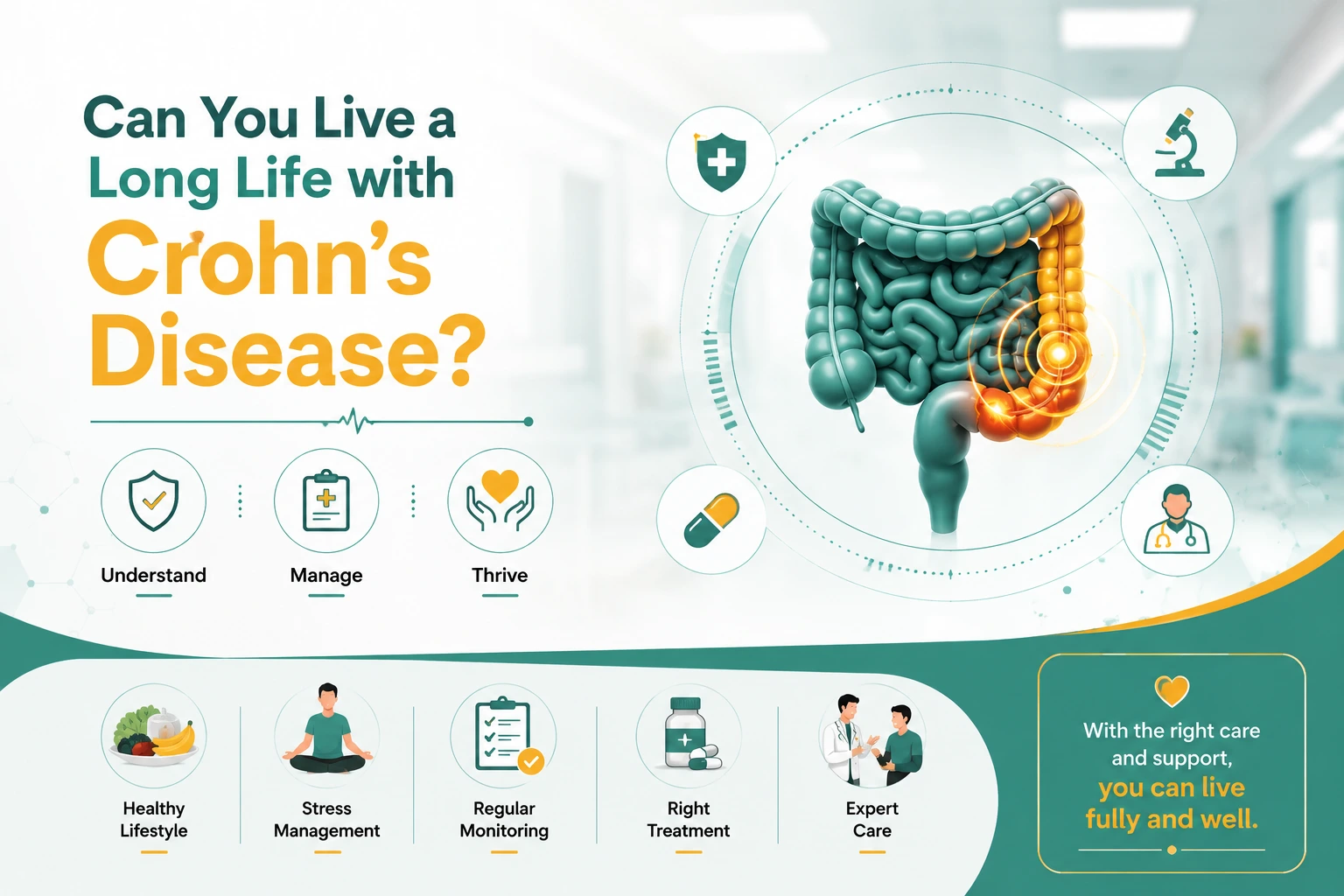
Can you live a long life with Crohn’s disease?
Crohn’s disease is a type of autoimmune disease which develops or targets mainly the digestive system. An autoimmune disease is a mistake happening in the normal functioning of the body; in Crohn’s disease, the immune cells which are normally fight off harmful cells like bacteria or viruses, instead attack and harm the body’s own cells which form the digestive tract. The result—a very inflamed gut, which cannot function optimally anymore. In this article, some very common questions about Crohn’s disease are explained. Read till the end to understand why Crohn’s disease is not as scary as it is thought to be.
What triggers Crohn’s disease to start?
Many diseases have multiple causes like presence of certain genes (genetic component), exposure to certain environmental agents (environmental component), and lifestyle choices (lifestyle component). A combination of these three components can make or break their onset and progression.
Crohn’s disease falls into this category of multicausal diseases—it is well-understood now to be a result of many different triggers. In fact, doctors and research articles cannot pin point a single cause, but explain Crohn’s disease resulting from the combination of many triggers.
Think of the onset of Crohn’s disease as igniting a fire. There has to be the base: either wood, paper or some flammable material; this is the genetic component. For the fire to begin however, the triggers like the initial spark or oxygen are necessary; these are the environmental and lifestyle factors acting as triggers for Crohn’s disease. Factors like smoking, a diet high in refined foods, or exposure to environmental contaminants can influence gene expression, prompting the immune system to mistakenly attack the intestinal tract, leading to chronic inflammation.
Below are certain examples of these three components/risk factors/triggers which cause Crohn’s disease:
- Genetic component: All DNA is made of smaller units called genes—these tell how the cells should behave. Research has found that some cases of Crohn’s have a strong genetic component; meaning, the gene is passed through the family, making individuals more at risk for developing it.
- Family history: Having a first-degree relative (parent or sibling) with Crohn’s disease has shown to significantly increase the risk.
- Some gene mutations: Over 200 gene variants are shown to be present in people with inflammatory gut conditions like Crohn’s disease. For example, mutations in the NOD2 gene change how the body recognizes bacteria, resulting in faulty immune responses to the intestine linings.
- Environmental component: External conditions can expose the gut to foreign substances or even alter the body’s microbial population. When there are more bad bacteria than good ones, it leads to inflammation. Some environmental triggers are:
- Frequent antibiotic use: Repeated use of broad-spectrum antibiotics can disturb the healthy balance of bacteria in the intestines. This sometimes makes it harder for the body’s immune system to distinguish between good bacteria and harmful populations.
- Infections: Some bacterial or viral gastrointestinal infections can behave like the spark lighting the fire. These infections make the immune system faultily active; this causes long-term inflammation even after the infection clears.
- Urbanization: Crohn’s cases are observed more in urbanized regions. Reduced sunlight exposure leads to lower Vitamin D levels, which is very important for regulating immune function in the gut.
- Lifestyle component: Daily choices in the food, activities and also stress can directly affect the gut lining, causing long-term inflammation and bloating.
- Cigarette smoking: Smoking is shown to be one of the strongest lifestyle choices resulting in Crohn’s. It damages the mucosal lining of the intestines, and doubles the risk of developing Crohn’s disease.
- Consumption of ultra-processed foods: Many packed foods are very rich in refined sugars, saturated fats, and artificial emulsifiers which can damage the protective mucus layer of the gut lining and bad gut bacteria which cause inflammation.
- Chronic stress: High levels of stress disturb the gut-brain crosstalk. When the gut and brain cannot speak, it alters the gut behavior and function significantly. It can also alter immune regulation in the digestive tract, leading to Crohn’s disease.
- Frequent painkiller usage: Regular use of nonsteroidal anti-inflammatory tablets like ibuprofen can irritate the lining of the stomach and intestines, triggering flare-ups or inflammation.
What to do if you have Crohn’s disease?
It is natural to be anxious when you get a diagnosis of Crohn’s disease from your gastroenterologist. It feels more worrisome specially in India, where there may be no genetic history in your family, and it comes fully out of the blue. However, the good news is, most cases of Crohn’s disease can be managed with many interventions. Medical research has given many more methods of intervention than just a few years ago.
Immediate steps to do after a Crohn’s diagnosis:
It may be quite overwhelming to think of what to do next, but do not worry—take a few deep breaths and know that almost all medical conditions have good treatment options nowadays. Once you’re a bit settled, take a quick look at our pointers to help you for your next steps.
- Create your treatment team: Remember that Crohn’s disease is a complex condition that requires specialized care. It requires the knowledge of a gastroenterologist specialist to see how your symptoms fit into the Crohn’s diagnosis, and also what would be the optimal treatment option. Also consider asking your specialist for an IBD-specialized dietitian to help look though the nutritional aspect.
- Know which questions to ask: Ask your gastroenterologist these questions so you fully understand your condition. Remember, you are never wrong to ask questions, just know which is the most pertinent question.
- Which part of my digestive tract is the inflammation located at?
- Is my condition currently mild, moderate, or severe?
- What are my treatment options—understand why you may need to take medications if needed.
- What is the doctor aiming for immediately (e.g., controlling a flare up) vs. what is the long-term goal?
- What symptoms need an emergency call?
- Review what medications you already maybe taking: Stop Taking Over-the-Counter Discontinue painkillers like ibuprofen or aspirin, as they generally worsen the inflammation. Ask your doctor for alternatives if needed. Also ensure your gastroenterologist reviews all over-the-counter supplements you may be taking.
- Inform your family: Crohn’s disease is an invisible, and long-term autoimmune condition which needs long-term attention unlike a simple stomach infection or food allergy. Long-term support from family helps build a strong emotional support system from day one.
How your doctor decides treatments when you get a Crohn’s diagnosis:
Gastroenterologists often do not take a “one-size-fits-all” approach. This is truer for Crohn’s disease with its multi-causal nature. Treatment choices your doctor may take depend heavily on specific clinical markers (certain trait and characteristics of the disease specific to your case). You doctor will consider points like:
- Disease location & behavior: although Crohn’s can cause inflammation in the entire digestive tract (which begins at the mouth and ends at the anus), not all have inflammation throughout, or even in the same place along the tract. For ex: inflammation in the small intestine (ileum) requires different management than that which is limited to the colon or anal area.
- Severity: Mild cases may be managed with targeted anti-inflammatory drugs, while moderate-to-severe disease would need early introduction of special medicines like immunomodulators for healing.
- Healing from within: Your doctor will also see beyond just how you feel—they see for “mucosal healing” (visually seeing if the gut tissue is healthy). This helps to drastically reduce the risk of future hospitalizations and surgeries.
- Response to medication: If a medication stops working or causes side effects, your doctor observes your reports to try other drug classes.
Some proven immediate tips to find relief from the pain (while waiting for your doctor):
Waiting for your appointment or your new medication to take effect, but still feeling the pain? Do not worry—we have gotten you covered.
The following steps can help soothe symptoms for temporary relief.
- Opt for a bland diet: Temporarily reduce high-fiber foods like raw vegetables, nuts, and whole grains, and high-fat or greasy items. Opt for easy-to-digest foods like bananas, white rice, well-cooked lean proteins, and bland soups.
- Hydrate with electrolytes: Diarrhea (a common occurrence in Crohn’s disease) removes water and minerals, leaving you with fatigue. Drink oral rehydration solutions, diluted juices, or warm soups rather than caffeinated or carbonated beverages, which can irritate the gut.
- Avoid traditional pain killers: Avoid over-the-counter painkillers like ibuprofen, and aspirin.
- Apply external heat: Use a warm heating pad or warm bath on your abdomen to relax cramping of the intestinal muscles and soothe abdominal pain.
- Track your symptoms: Keep a log of bowel movements, pain scores (1–10), foods eaten, and any non-gut related symptoms like joint pain or eye irritation. This greatly helps your doctor to clearly decide the immediate next steps for treatment.
What supplements should I avoid with Crohn’s disease?
Crohn’s disease generally reduces the effective absorption of nutrients due to all the inflammation in the gut. While many supplements help manage these nutrient deficiencies, some can irritate the digestive tract and cause flare ups.
- Iron supplements: High doses of oral iron (such as ferrous sulfate) can cause stomach cramping, and constipation, and can irritate the intestinal tissue.
- Magnesium supplements: Certain oral types like magnesium oxide, carbonate, and chloride, draw water into the intestines. This worsens diarrhea.
- High-dose vitamin C: Excessive doses (over 2,000 mg/day) can act as laxatives resulting in diarrhea.
- Sugar alcohols: Ingredients like sorbitol, mannitol, xylitol, and maltitol (often found in gummies, liquid supplements, or protein powders) are poorly absorbed and ferment in the gut, causing gas, severe bloating, and diarrhea.
- Lactose: Many standard vitamin tablets use lactose. Because lactose intolerance is common during Crohn’s flares, these can trigger digestive distress.
Does age relate with symptoms and life expectancy in Crohn’s disease?
- Crohn’s disease is mostly seen in the age groups of 15—40 years.
- However, it does not naturally disappear or cure itself with age.
- Most individuals with Crohn’s disease experience periods where the condition becomes less aggressive or easier to stabilize over time.
- More importantly, Crohn’s disease is generally not considered life-limiting.
- There are many ways to manage it—modern targeted therapies, proactive monitoring, and lifestyle management.
- With actively following all these points, overall life expectancy is reported to be normal or only very slightly lower than that of the general population.
- The most important take away here is most people with Crohn’s live full, active lives, provided inflammation and potential long-term complications are kept under control with regular specialized care.
Crohn’s disease definitely sounds like a scary term, and can naturally make anyone overwhelmed. It is a complex, and long-term condition that requires management throughout a person’s life. The important point is to remember that navigating it effectively requires a specialized gastroenterologist, who can monitor intestinal health, prevent long-term complications, and personalise treatment plans as and how needed. With the right medical guidance and a proactive approach—followed rigorously by all specialists at Smiles Institute of Gastroenterology, Bengaluru, you can easily manage this and live a full, active life.
Frequently Asked Questions
1: Does Crohn’s disease increase the risk of bowel cancer, and how does it impact long-term survival?
Answer: Long-standing inflammation from Crohn’s disease—particularly when affecting the colon (Crohn’s colitis) for over 8 to 10 years—slightly elevates the risk of developing colorectal cancer. However, routine surveillance colonoscopies and early detection of pre-cancerous dysplasia significantly mitigate this risk, allowing individuals to maintain a normal overall life expectancy.
2: Can Crohn’s disease go into complete, permanent remission?
Answer: While Crohn’s disease currently has no permanent cure, modern therapeutic approaches aim for long-term clinical and endoscopic remission. “Deep remission” or mucosal healing occurs when intestinal tissues visually and histologically recover, preventing flare-ups and halting cumulative digestive tract damage for years at a time.
3: How does Crohn’s disease affect pregnancy and fertility?
Answer: Most men and women with Crohn’s disease in active remission have normal fertility rates and can achieve healthy pregnancies. Maintaining disease control prior to conception is essential, as active inflammation increases risks such as premature delivery or lower birth weight. Most IBD medications are safe to continue during pregnancy under specialized medical supervision.
4: What are the long-term surgical risks for Crohn’s disease, and does surgery shorten lifespan?
Answer: Surgery for Crohn’s disease—such as bowel resections or strictureplasty — does not shorten lifespan. While up to 50% of patients may require surgery at some point to manage complications like strictures or fistulas, surgical intervention often restores gut function, improves nutritional intake, and dramatically enhances overall quality of life.
5: How do modern biologic therapies improve Crohn’s disease mortality rates?
Answer: Biologic medications (such as anti-TNF agents, integrin receptor antagonists, and interleukin inhibitors) target specific inflammatory pathways in the body. By halting underlying tissue damage rather than just suppressing symptoms, biologics drastically reduce hospitalization rates, emergency surgeries, and severe disease-related complications, bringing mortality rates on par with the general population.
