

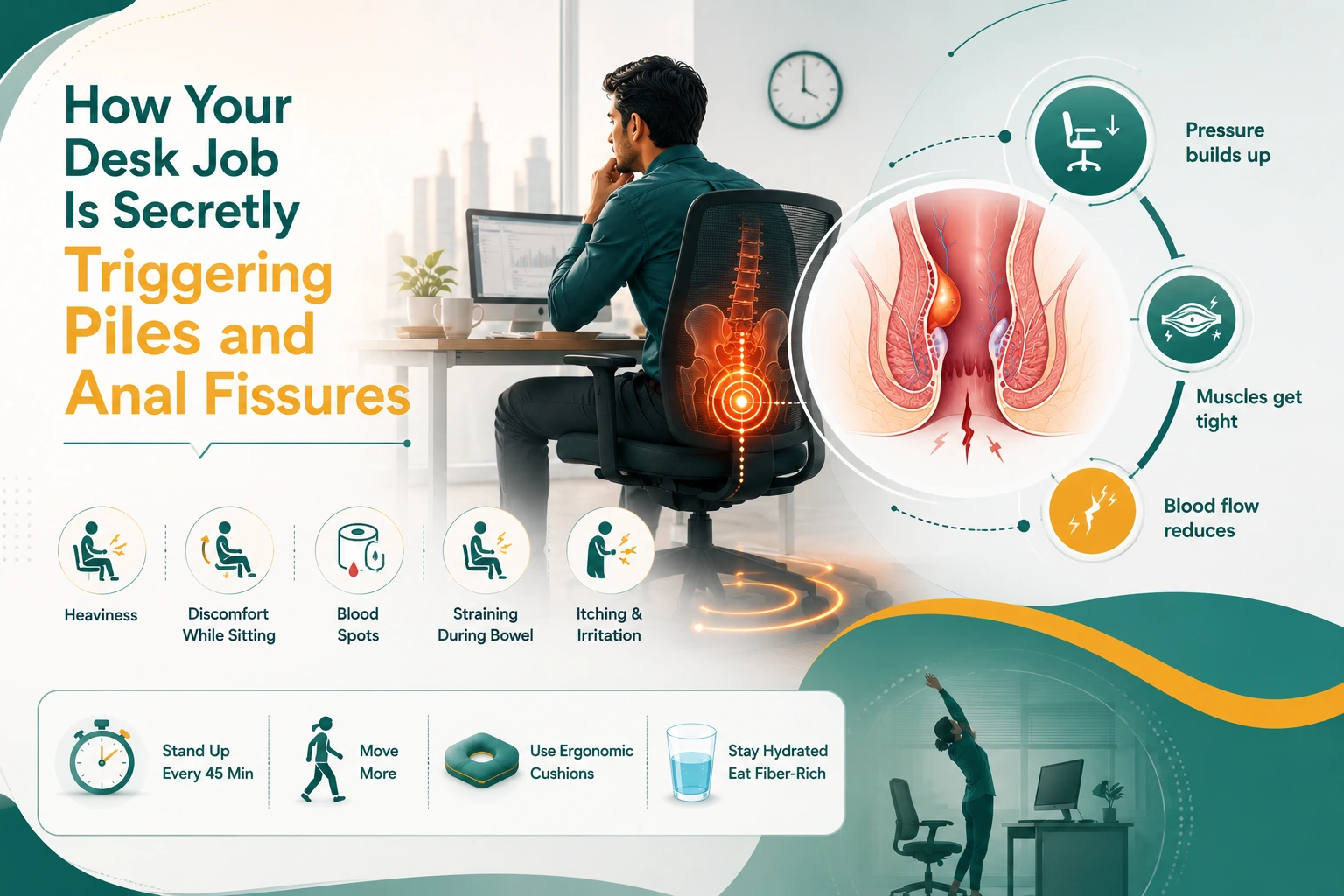
How Your Desk Job Is Secretly Triggering Piles and Anal Fissures

Piles are also called as hemorrhoids in medical terms. In simple terms, they are veins in your rectal and anal area which are swollen. Piles are generally self-resolving—meaning you take away the trigger, the veins go back to being normal. But this reversal happens mostly during early stages, and with active interventions.
A 2024 study recognized by the National Institute of Health reported nearly half of study participants identified constipation and straining as their primary trigger, while 90% pointed to a diet high in refined foods. While dietary triggers get most of the attention, a quiet, underestimated, and rapidly rising factor is increasingly resulting in rectal and anal conditions in urban populations like Bengaluru—prolonged sitting due to desk jobs.
Constant sitting reduces blood flow and increases pressure in the pelvic area, which causes veins to swell into piles and can also lead to anal fissures (painful tears in the anal canal lining.) Even if you eat a fiber-rich diet, sitting for majority of the day can secretly trigger both these conditions. Take a look at how your desk job is affecting your rectal health secretly.
How does prolonged sitting increase pressure on the anal veins?
The sitting posture on a chair involves putting the majority of your upper body weight on the lumbar, spinal, and pelvic regions. There are many arteries and veins supplying blood throughout your body, including the pelvic and anal regions.
Imagine these veins like a flexible pipe or tube. Blocking or squeezing one part of the pipe stops the free flow of blood and causes a bulge to form behind the restriction. A similar scenario happens to your rectal and anal areas when you sit for long periods.
This mechanical pressure remains as long as you stay seated. Once you stand up, the pressure is relieved and normal blood flow resumes. However, when this sitting posture is repeated for hours every day, the swollen veins lose their ability to snap back, and the bulge remains even after standing up or changing positions.
These bulged or swollen veins can feel painful or irritated when sitting or passing stools. At this juncture, even if all other lifestyle factors like exercising, eating a fiber-rich diet, and staying hydrated are taken care of, the piles may not resolve optimally because the primary cause—prolonged sitting—remains unaddressed.
Can static posture cause sphincter tightness and anal fissures?
Your anal muscles include something called sphincter muscles which help you control the movement of stools. When you remain in a static or fixed sitting posture for hours, your pelvic floor muscles—including the anal sphincter muscles, are mildly contracted and remain like this due to the pressure. This constant contracted form prevents them from relaxing fully. This results in long-term sphincter tightness over time.
You can take the example of a tight elastic band here. When the band is tight and remains so over time, it gets brittle. Similarly, when a muscle is constantly tense, the blood supply gets restricted. This less blood flow means the skin of the anal canal loses its natural elasticity and becomes brittle. Just like how rigid elastic band snaps when something is forced through it, so too a tight sphincter muscles means passing even a normal stool can stretch the anal skin lining causing it to tear. This results in a painful anal fissure.
Like with piles, this sphincter muscle tightness happens quietly at your desk. Even if your stool is soft due to high fiber intake, when you force it through a tight anal canal, it results in skin tears (fissures) and bulged veins (piles).
What are the warning signs that desk fatigue is turning into piles?
By recognizing just a few signs, and teaching yourself to be aware of them can help you go a long way to give yourself the all rounded rectal health you deserve.
Desk fatigue is primarily related to cardiac, eye or even spinal/lumbar health, due to which the lesser known and understood rectal health goes unnoticed till it gets too severe.
Warning signs of your desk job resulting in piles: catch them early, resolve them quickly
- A dull pain in the lower pelvis: after your workday, you might feel a sensation of heaviness or pressure in your lower back area. It is thought of as just muscle tiredness; however, in addition, it is also blood pooling in the pelvic veins due to gravity and lack of movement.
- Discomfort while seated: If you find yourself constantly shifting positions, leaning on one hip, or your chair suddenly feels uncomfortably hard, your rectal veins are likely under strain.
- Mild irritation or itching: Feeling a slight itch or warmth around the anal area after a long stretch of sitting is actually the first sign of lower local blood circulation and vein irritation.
- Straining during bowels: Even when your stool is not particularly hard, feeling restricted when passing it can suggest that the tissues in the rectum and anus are already inflamed from the sitting pressure.
- Spotting blood on toilet paper: Spotting faint, bright red blood on the tissue paper is a clear indicator that the swollen veins are tearing slightly.
How many minutes of standing can prevent pelvic venous congestion?
There is a very simple solution to the prolonged sitting problem—movement. However, it is quite obvious that a desk job will does not provide much room for movement as and when one feels like it.
Hence, aiming for timed movements, and doing them regularly and intentionally can compound over time and give your pelvic region the much needed pressure relief it needs.
The medical rule of thumb is a simple 2–5-minute standing break for every 45 minutes of sitting. Standing up for just 2–5 minutes in an hour is gives time for the pelvic floor muscles to relax and allows free flow of the blood. This effectively removes a lot of pressure from this area.
You can do this by setting a quite timer on your computer to go off every 45 minutes. Take a small walk of five minutes before retuning back to work. You can also force yourself to walk to the water cooler to take a drink. This ensures hydration and movement—two very important factors to keep piles away.
What are the best seat cushions to relieve pressure on the perineum?
Regular movement is one way to help reduce static sitting pressure on your pelvis. But you can also protect your rectal health while actively sitting at your desk. Simple tools like ergonomic seat cushions reduce local pressure on the anal and perineum areas by naturally improving blood circulation.
- Doughnut (Ring) Cushions: These cushions have a hole in the exact center. By placing the open space under your anal region, your body weight shifts to the thighs and outer buttocks. This removes direct sitting pressure from the anal area.
- U-Shaped (Coccyx) Cushions: These cushions have a U shaped cutout at the back where your tailbone and anal area rest. This design gently relieves local pressure while supporting a healthier, and upright posture.
- Contour Memory Foam Cushions: These are designed with grooves rather than an open hole, which help distribute your upper body weight evenly. Thus, they prevent hard pressure points from forming on the anal area during long work hours.
Managing a desk job and maintaining good health is one of the most difficult tricks created by mankind. The human body thrives best when there is plenty of movement; movement helps in easier blood flow and keeps muscles alive. Sitting does the contrary—reduces blood flow and stiffens the pelvic muscles, hence affecting rectoanal health. While dietary factors like fiber and hydration are essential, understanding the hidden impact of prolonged sitting is important in preventing both piles and anal fissures. The encouraging news is that reversing this pressure requires just small, and intentional adjustments like taking brief standing breaks every 45 minutes, and utilizing proper seat cushions. Do not wait for mild discomfort or desk fatigue to escalate into long term advanced piles. Start making these movements today for an easier tomorrow.
Frequently Asked Questions
Can a desk job cause piles?
Yes, sitting for long hours places continuous mechanical pressure on your pelvic floor muscles. Over time, this constant pressure restricts normal blood circulation in the rectal area, causing the veins in the area to swell and bulge into piles. This results even if you follow a healthy diet.
How to avoid hemorrhoids when having a desk job?
To protect your pelvic veins while working a desk job, you can use two proven ways to relive the pressure on them. Firstly, break up long periods of sitting by moving for 2–5 minutes every 45 minutes or hour. Secondly, while sitting, consider using an ergonomic seat cushion to relieve direct pressure on the anal area even when sitting.
Can sitting for 8 hours a day at a desk cause both piles and anal fissures simultaneously?
Yes, sitting for long hours triggers two conditions at the same time. The continuous downward pressure while sitting causes blood pooling in the pelvic veins. This makes them swell resulting in piles. The constant and static nature of sitting causes muscles to be under a constant state of tension. This posture restricts blood flow and tightens the sphincter muscle. When you pass stools through a rigid anal hole, it can tear the skin of the anal canal, leading to anal fissures.
What is the best sitting posture at a desk to reduce rectal pressure?
The best sitting posture for your rectal health is to sit upright and where your feet rest flat on the floor. Your hips must be slightly higher than your knees. This helps your weight to evenly distribute across your thighs and pelvic region. In contrast, slouching shifts your upper body weight onto your tailbone and pelvic floor, resulting in compression of the anal veins.
