

Fistulas are abnormal tracts or tube-like structures formed inside the body in response to long term or chronic infections in the body. Infections in the body generally imply collection of infectious liquids in a pocket nearby. To drain these liquids out of the body and to prevent the further spread of the infection, your body may grow tube-like structures connecting this pus pocket to an opening on the skin. This tube-like structure is called a fistula tract, and the tube remains as such even after all the liquid drains out.
The anal fistula is one of the most common fistula types and occur in the anal region. The anal hole is lined with mucus glands which help prevent friction during the passage of bowels. These anal glands may get infected due to a variety of causes like clogged/blocked glands, injury from previous surgeries, Crohn’s disease, or STIs. Long term infection of these glands result in collection of pus in pockets called perianal abscesses. With the help of fistula tracts, your body drains the abscess and reduces accumulation of infectious liquids.
Unlike a few years ago, interventional advancements have made it very easy to treat a fistula in 2026. Precision instruments allow a doctor to treat just the affected portion without touching other vital muscles nearby. The laser treatment for fistula is one such technique that has extreme precision and thus, allows for a more effective and quicker recovery time.
Is laser treatment successful for fistula?
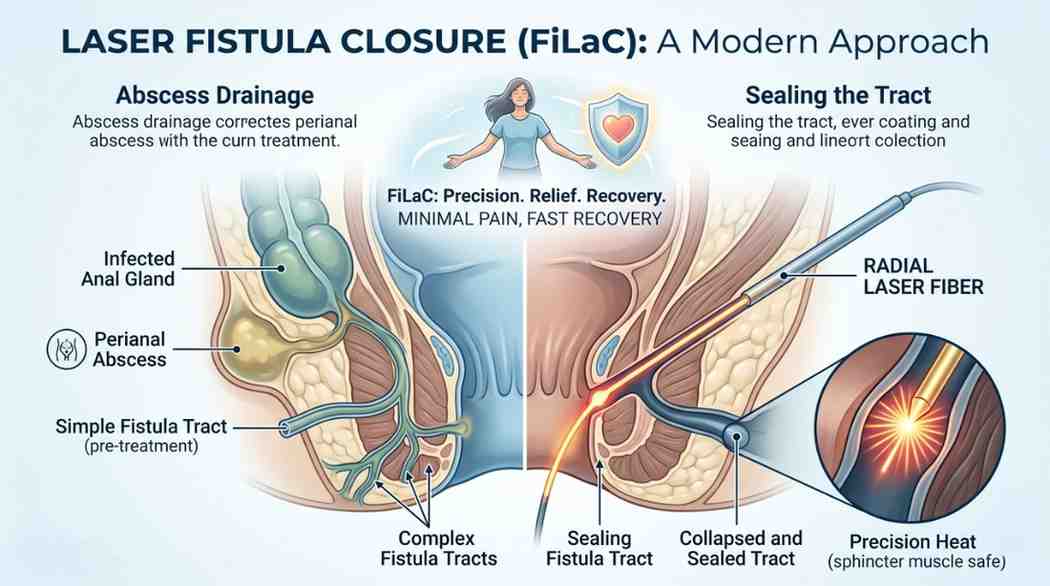
Laser treatment for fistula, also called FiLaC (Fistula-tract Laser Closure), has become a popular choice in India because of its minimally invasive nature. Although it may not be the single fit choice for every fistula, it is chosen over traditional surgery owing to its comfort and effectiveness.
The procedure is typically done as a daycare surgery, allowing you to return home on the same day. This makes it highly convenient for anyone who would not choose to stay in the hospital for long. In very simple terms, here is the step-by-step walk through of the procedure.
- Cleaning: The surgeon first cleans the fistula tract to remove any pus or debris.
- Mapping: A thin probe is inserted into the tract to map the path the tract has grown in.
- Laser Insertion: A specialized radial laser fiber is inserted into the tract.
- Sealing: As the surgeon slowly pulls the fiber out, it emits laser energy. This heat dries the fistula tract/tube from the inside and seals it shut. The laser energy is precise so as not to make any unnecessary cuts to the surrounding muscle tissue or the sphincter muscle.
The preciseness and almost painless experience makes it an often preferred procedure for fistula removal. Over the past decade, India has seen a rapid wave in this procedure and also has impressive success numbers.
What is the recovery time on laser surgery for fistula?
Recovery from laser fistula surgery (FiLaC) is generally much faster and smoother than traditional surgery because there are no large open wounds to monitor or recover from. The bleeding experienced is also much more minimal as compared to traditional surgeries.
Here is a timeline of the recovery period:
- Immediate Post-Op (First 24 Hours): Most patients are discharged on the same day or within 24 hours. You may still feel a dull ache or pressure in the area but it is usually manageable with basic painkillers.
- Back to Work (3 to 5 Days): Unlike traditional surgery which might need more bed rest time, most people opting for FiLAC can return to a desk job or light activity within 3 to 5 days.
- Resuming physical activity (1 to 2 Weeks): You can usually resume walking and light exercise within a week. However, about 2 weeks of wait is advised before starting heavy lifting, cycling, or strenuous gym workouts.
- Full Internal Healing (2 to 4 Weeks): The internal tract that was sealed by the laser takes about a month to fully scar/recover and close. However, this is more of an internal recovery and most people feel fully fine externally after the 2-week period.
Does a fistula come back after laser surgery?
A common question on any patient’s mind will be the recurrence rate—how fast and how many times the condition can come back. In India, the success rate for fistula laser surgery generally ranges from 70–85%. This means that for the majority of patients, the fistula is cured permanently.
However, there is still a 20% risk of recurrence. This means approximately 15–30% of patients may see the fistula return. This usually happens within the first year after the procedure.
Fistula recurrence can be attributed to a number of factors like:
- Simple or complex fistula: If your fistula is a simple straight tunnel, the recurring chances are very low. However, a complex fistula with multiple branches or hidden pockets of pus increases the risk of recurrence as the laser energy might not reach every corner to seal the tract.
- Having an unsealed internal opening: Since a fistula is like a tube, it will have two ends. If the inside opening where the tract begins is not sealed perfectly, the tunnel can refill with fluid and reopen over time.
- Underlying medical conditions: Some fistulas result from other medical conditions like Crohn’s disease. If the root cause is not managed, a new fistula could form in the same area.
- Follow-up care: Recurrence is also linked to how well you follow post-op advice. Staying hydrated, eating fiber to avoid constipation, and keeping the area clean are all very important to prevent any further infected glands and thus, fistulas from reforming.
What are the disadvantages of laser surgery for fistulas?
Nothing is a perfect fit in the medical field. Each person’s body is different, and also reacts to the same treatment in different ways. Something like the laser removal for fistula also has its own set of disadvantages.
- It has a lower Success Rate for Complex Cases: Compared to traditional surgery, the laser is slightly less effective for complex fistulas where the laser tube cannot go and seal efficiently. It works best on straight, simple tracts.
- Higher risk of recurrence: There is a 15–30% chance that the fistula might return. The laser shrinks the tract unlike a doctor physically cutting/removing it out. Thus, the tract can sometimes reopen if it does not scar completely.
- Higher Cost: FiLAC requires special equipment and laser fibers which are expensive. This often makes the procedure significantly pricier than conventional surgery.
- Cannot be used until the tract is completely empty: If there is an active collection of pus in an abscess, the laser cannot be used until the infection is drained and cleared first.
Although fistula treatment may seem like a daunting thing to do, there are effective and quick solutions nowadays for this. Choosing laser treatment for a fistula is one such easy step toward regaining your comfort and quality of life. By opting for this advanced technology, you are prioritizing a path that offers significantly less pain, a remarkably fast return to your daily routine, and yet not compromising on the protection of your natural muscle function.
Take the First Step Toward Relief. Come and consult with a specialized laser proctologist today at Smile Gastroenterology Centre, Bangalore. With an understanding nature and state-of-the-art equipment, colorectal specialists here can help you with your fistula in just a single day. Schedule your consultation now and start your journey toward a pain-free life.
