

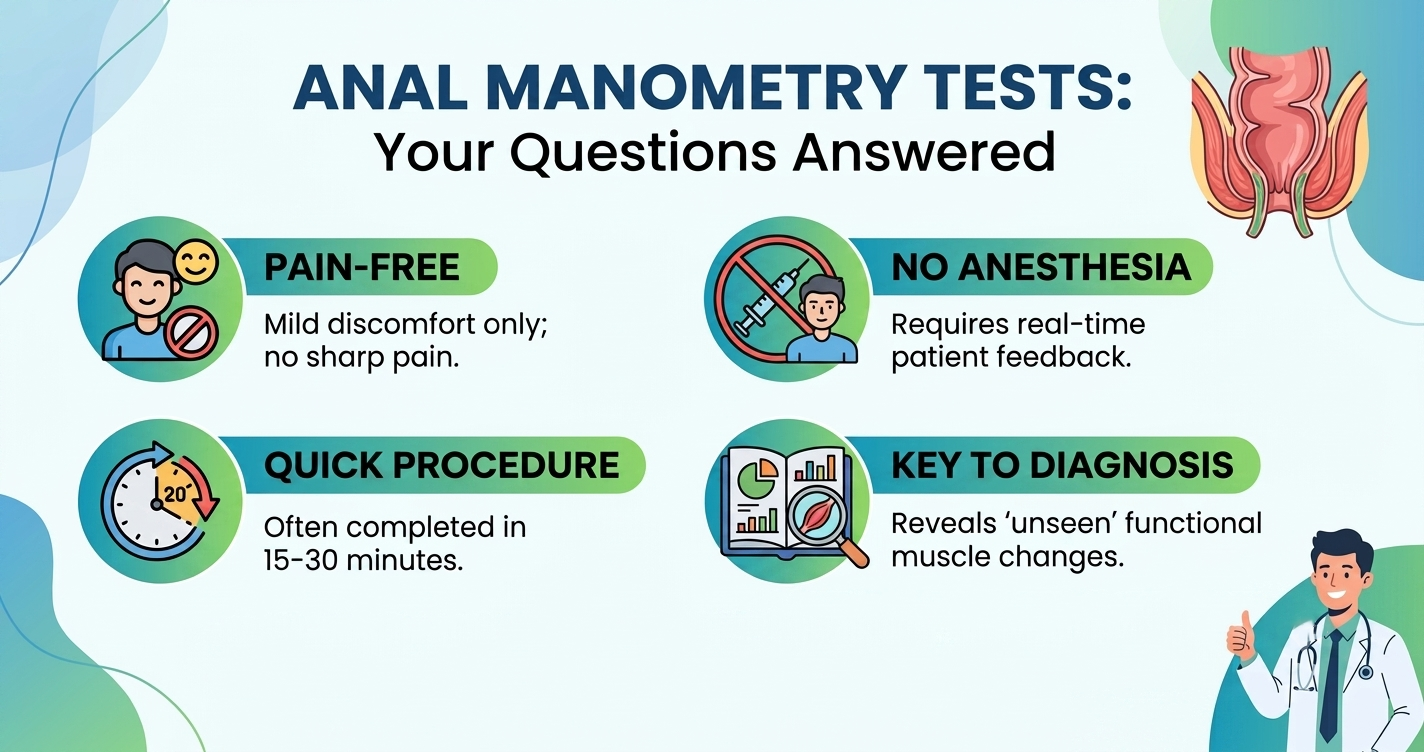
Not all disorders of the anal or rectal regions manifest in a way that has physical or visibly observable changes as its root cause. Often, there are “unseen” changes like functional loss to muscles which also show up as chronic pain or even something as common as constipation. Such changes are difficult for even an experienced colorectal surgeon to see or feel during a consult. For these reasons and also for obtaining a more complete picture of the cause in each individual case, doctors use a set of tests called anal manometry tests (ARM). In the ARM group of tests, different techniques are used to determine the functionality of the anal and rectal muscles. In this article, read about the common concerns that you may get when you are suggested to undergo these tests.
How painful is anal manometry?
Anal manometry in general does not cause any pain during the test. In the ARM group of tests, one of the tests involves inserting a probe which is about quarter inch thick into the rectum. While this may sound scary, it generally causes only mild discomfort and a feeling of fullness like what you would feel if you had to pass stools. Here is a table with the general category of tests under the ARM group, and how you may feel.
| What the test involves | Physical Sensation |
| Catheter Insertion | Most often coolness, mild pressure, and fullness are felt |
| Squeeze Test | Feels like tightening of your pelvic floor muscles |
| Push Test | Straining like a normal bowel movement |
| Balloon Inflation | Feeling of a growing fullness, progressing to a strong urge to go |
| Balloon Expulsion | Pushing out a firm stool |
An important pointer to notice is that almost under none of the tests, you feel pain as the primary or secondary sensation. This feature alone makes anal manometry tests highly patient friendly and widely usable.
Do you need anaesthesia for manometry?
- The good news is, along with no pain, none of the anal manometry tests require you to undergo any needle pricks.
- Anal manometry tests are mainly used to look at muscle function and activity when being instructed to do so.
- Sedation or anaesthesia defeats this purpose and can actually alter the test results significantly.
- Anaesthesia, sedatives, or even local numbing creams artificially relax the pelvic floor and sphincter muscles. The main point of this test is to measure the real-time pressure of these muscles, and numbing them would cause inaccurate data.
- Some tests like the balloon inflation test also requires the patient to verbally tell the exact moment they feel the first sensation, a normal urge, and a strong urge when the balloon is inserted. This aspect too can be compromised under anaesthesia, and hence, it is completely avoided when doing anal manometry.
How long does a manometry take?
An ARM procedure can be easily completed in about 15–30 minutes. However, the total time spent at the clinic is generally around an hour including the preparation time for the tests.
The various tests which come under ARM group use different ways of testing the anorectal muscles. For example, if the test is to check for muscle squeezing pressure, it takes just a few minutes, while testing for rectal sensation with a small balloon requires a bit more time.
Since the procedure does not require anaesthesia, there is also zero recovery time. Patients often return to their normal daily activities or work immediately after the test is over.
What should I avoid before manometry?
Although anal manometry tests do not require strict 12 hour fast before the test, there are other considerations which must be followed to get the most accurate data on the test day and to avoid repeating the testing process multiple times.
- Talk to your doctor about medications: Since anal manometry tests involve testing for pain, and muscle reflexes, any medications you may be taking for such complaints may interfere with the results. Medications like muscle relaxants, laxatives, or diarrhoea medications must be skipped for the day of testing. Other medications like narcotic pain medicines which have side effects of severe constipation are also to be avoided.
Note: This rule also applies for topical painkiller ointments and creams which work by numbing the anal muscles.
- Avoid heavy meals right before the test: Your doctor is the best person to decide your eating schedule around the test timings, but having a full stomach while doing tests which involve pushing or squeezing the pelvic muscles can make you feel a bit nauseated. Thus, it is best not to keep a full stomach before the tests.
- Always perform the enema (if advised): Never skip this step. An enema is a technique used to flush out already present/residual or built-up stools inside the rectum. Most of the manometry tests require inserting probe or a balloon; if there is stool in the rectum, it blocks the sensors on the probe, meaning the machine cannot get an accurate measurement of muscle pressures or nerve sensitivity. Having an enema also means you can eliminate any anxiety about having an accident during the test.
What should I expect after manometry?
- Anal manometry is a very no-fuss test which has very few preparation steps and even fewer post-test effects.
- Some minor physical sensations you may feel are:
- Fullness: It is normal to feel a slight sense of fullness or awareness in the rectum for about 30–60 minutes after the probe is removed. Your nerves are stimulated during the balloon test, and this causes the feeling.
- Mild Gas or Bloating: If air was used during the balloon inflation test, a tiny amount might remain. Passing gas afterward is normal and can bring quick relief.
- Zero Pain: Generally, there is no lasting pain, sharp cramping, or bleeding.
- Most patients can return to normal activities immediately and by themselves as there is no anaesthesia used during ARM tests.
- There are also no dietary restrictions on food or drinks after the test, and this can also be resumed normally.
What about the test results?
- Most results are not instant: Although the muscle function is recorded in real time, because a technician is involved in interpreting the results, the final report takes some time.
- A gastroenterologist then reviews the pressure data. Most of the results and next steps are generally in your hands within a few days to a week.
It is completely natural to feel nervous about an anorectal manometry test. Afterall, the region being tested is highly private, and the process sounds unfamiliar. The worst part of any test is generally the time spent in anticipation leading up to it. however, anal manometry test procedures are quick, safe, and pain-free. By getting a clear, “unseen” picture of how your muscles are working, this short test is often the missing key to finding a treatment plan that actually works. So, why wait when you have a host of gentle and empathetic doctors to lead you through these tests at Smiles Institute of Gastroenterology , Bengaluru. Visit, and claim back your confidence, after all it is just a short 20-minute pain free test for your personalised treatment.
