

Piles, also known as haemorrhoids, is widely understood now to majorly a lifestyle disorder. A very recent study https://www.jptcp.com/index.php/jptcp/article/view/10174 done in India, clearly reports how lifestyle factors like sedentary behaviour, low water and fibre intake accounts for nearly 60% of the haemorrhoid cases in the study. However, for the remaining numbers, there are many medical conditions too which can result in piles—like pregnancy.
Pregnancy involves significant hormonal and physical changes to the mother’s body. Although it may be thought of more as a gynaecological condition, pregnancy affects almost all parts of the mother’s body whether they are interconnected directly or not—even the anal and rectal regions.
And just like how there are several options to help with piles for the general population, piles is nothing to be scared about during pregnancy too. In this article, you can understand why you may develop piles during pregnancy. You can also find easy, proven, and incredibly effective post-partum recovery tips to safely recover from piles.
How do postpartum hormones slow down digestion and cause severe constipation?
- Pregnancy is filled with extreme hormonal changes right from the first month itself. It is therefore, natural for the body to take a few months to calm the hormonal storm after delivery.
- Among the list of fluctuating hormones is progesterone—well known to be at an all-time high during pregnancy.
- Progesterone helps support your baby’s growth by loosening all your smooth muscles—including the intestinal/gut muscles, so that there is space for the uterus to expand.
- On the other hand, your intestine can function well only by being in a constant state of motion (called peristalsis), to help move the food through it.
- A relaxed intestinal wall means it sluggishly the peristaltic movements become very sluggishly slow.
- After delivery, progesterone levels suddenly plunge and oestrogen resets. However, your digestive tract still needs time to find its normal rhythm again.
- When you add other factors like abdominal muscle separation, dehydration from breastfeeding, and the fear of pain around stitches, your gut can easily find it very difficult to work in its original rhythm for a very long time.
Why does push-stage labor cause sudden hemorrhoid prolapse and tears?
- Labor during delivery is an extremely intense process for your body. It involves forceful and intense contractions of all the pelvic/lower abdominal muscles.
- Your rectal and anal muscles also are in the pelvic floor muscle group and undergo contractions when the baby is being pushed out during labor.
- When the veins in the rectal and anal region experience contractions, the veins in this region face a significant increase in pressure. The pressure increases so much that it naturally results in tears and hemorrhoid prolapses.
Take a look at the numbers to understand the push -stage labor process:
Under normal conditions, the resting pressure inside the anal canal is around 75 to 80 mmHg. Straining during a difficult bowel movement spikes this rectal pressure. Exceeding this baseline pressure restricts any venous blood flow. When there is sustained (long-term/repeated) pressure above this resting pressure, it causes the surrounding veins to swell, stretch, and bulge into hemorrhoids.
Labor pressure dynamics: During the second stage of labour, every contraction which occurs naturally increases pressure to about 40–70 mmHg.
During push-stage labour, a woman needs to voluntarily “bear down” or “push actively” along with a contraction. This results in the total uterine and abdominal pressures sky-rocketing to 100 to 150+ mmHg, occasionally spiking even higher depending on the pushing technique.
From these numbers alone, it is easy to understand the force at which the muscles and veins in the pelvic region are stretched and contracted. Eventually, the muscles and veins can feel the strain and snap, resulting in muscle tears and also stretched piles/hemorrhoids.
How long does it typically take for post-delivery piles to shrink naturally?
Regardless of how you birthing method was, post-delivery piles can go away naturally, and take almost the same timeline to get cured.
Both vaginal and C-section births can result in piles, and in both cases, it takes about 6 weeks for the swollen/stretched veins (piles) to shrink back to normal.
However, the catch here is, hemorrhoids cure naturally only when they are in stage 1 or stage 2.
Adopting practices to avoid piles during pregnancy (you can link article from 9/Jan here) can greatly help restrict piles post-delivery to the initial stages 1 and 2.
Post-delivery piles—The 6-week recovery timeline
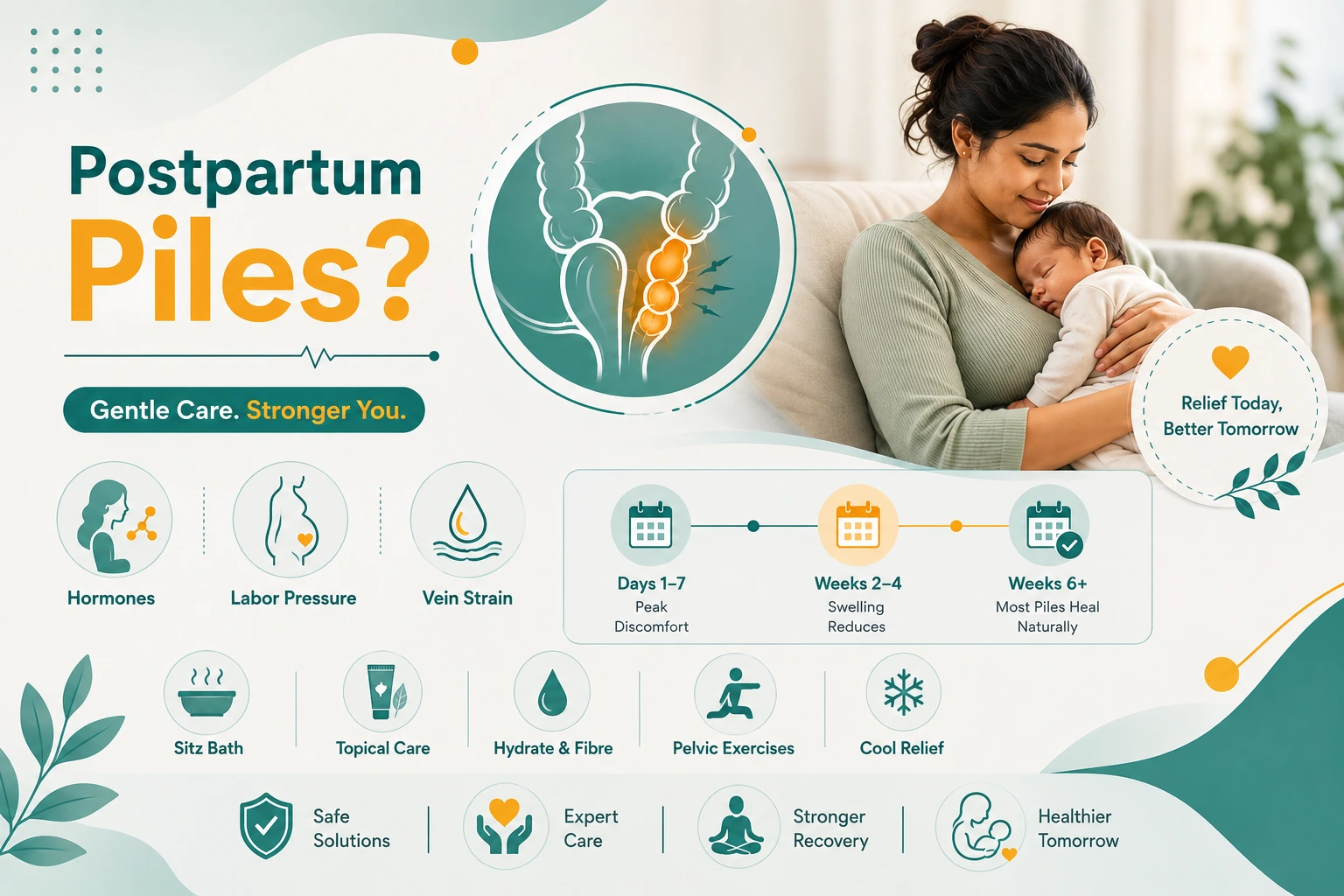
Days 1 to 7 (Peak Discomfort): Pain, swelling, and itching are usually highest during this time resulting from delivery strain or C-section pressure. With proper and daily care, symptoms often start to stabilize by the end of the first week.
Weeks 2 to 4 (Gradual Shrinking): The acute pain you were feeling would subside significantly. Due to a drop in hormone, and blood volume returning to normal, the swollen anal veins (piles) would start to shrink easily.
Weeks 6 and Beyond (Full Resolution): For the majority of new mothers, hemorrhoids disappear entirely by 6 weeks—given they are in the starting stages. However, about 25% of new mothers still can have persisting piles even up to a year post-delivery. For easier care, persistent or severe cases that do not respond to care by this point require evaluation by a specialist.
P.S: The 6-week recovery timeline is highly dependent on piles not progressing beyond stage 2. For piles to be restricted to stage-1 and -2 of the condition, it is important to take all precautionary steps to prevent piles during pregnancy. Push stage labor can worsen any existing piles which can make the piles to go to stage 3 or 4, at which point it would require surgery as treatment options.
Which topical treatments and sitz baths are safe while breastfeeding?
There are multiple safe, proven, and effective ways to do deal with post-delivery piles discomfort.
- Try warm sitz baths—soaking your pelvic area in plain warm water or a doctor-approved Epsom salt soak for 15 to 20 minutes two to three times a day—are completely safe, highly effective ways to soothe inflamed tissue, boost local blood flow, and speed up healing.
2. For local relief, witch hazel pads provide a gentle, natural anti-inflammatory cooling effect to calm swelling and stinging.
3. Over-the-counter hydrocortisone creams or OTC hemorrhoidal ointments containing a reagent called pramoxine are generally considered safe for short-term use.
4. Applying pure aloe vera gel or a plain ice pack wrapped in a soft cloth for 10-minute intervals can also offer immediate, risk-free comfort throughout the day.
What pelvic floor exercises speed up anorectal healing after childbirth?
No exercise gears or equipment. Safe and gentle postpartum recovery tips.
Apart from topical treatments, you can also adopt some very easy, gentle and safe exercises right from the comfort of your home. These exercises mainly focus on post-partum pelvic floor, where the muscles are stretched and have undergone a lot of strain.
Try these following exercises:
1. Pelvic Floor Contraction (Kegels):
This exercise focuses on getting the pelvic floor muscles their strength by contracting and relaxing them.
- Lie on your back with your knees bent and feet flat on the floor.
- Squeeze the your pelvic floor muscles/vaginal muscles as if trying to stop passing gas or urine.
- Hold the squeeze for 3 to 5 seconds, then fully relax for 5 to 10 seconds.
- Repeat 8 to 10 times, aiming for 3 sets a day. Keep your buttocks and thighs relaxed. 2. Reverse Kegels (Pelvic Floor Relaxation):
- This exercise works to ease anal sphincter tension, and relieve the throbbing discomfort of piles and anal fissures. It is essentially the reverse of Kegels.
- Lie down comfortably. As you inhale gently, consciously allow your pelvic floor muscles to relax (like a gentle downward release). Repeat about 5 times a day for it to take effect on the anal muscles. 3. Legs Up-the-Wall Pose (Viparita Karani):
- This exercise works to help the all the fluid in the anal/pelvic veins to flow back. This greatly helps reduces swelling and congestion in the anal area.
- Lie on your back and extend your legs straight up against a wall.
- Stay in this position for 5 minutes at time. You can begin with lesser time intervals and gradually increase it. Do this exercise at least 2—3 times daily for effective flow.
Worried about using any treatment without talking to a doctor. Or concerned if you are doing a Kegel correctly and effectively. Worry not, right from experienced and gentle colorectal specialists to trained pelvic floor therapists, Smiles Institute of Gastroenterology has them all. You will be guided and given the utmost well-rounded and effective care during this sensitive time.
Frequently Asked Questions
1.Why does pooping hurt so much weeks after a C-section delivery?
Many mothers assume a C-section spares their pelvic floor, but as Dr. Pavithra of Smiles Institute of Gastroenterology explains, that is a common myth. Pregnancy is the shared journey before both birthing methods. For nine full months, your pelvic floor muscles expand, and stretch to support your growing baby. That heavy strain happens regardless of how you deliver your baby.
Because of this long-term pressure, your core and pelvic muscles do not bounce back to normal overnight. The incision pain made during a C-section, reduced abdominal strength, and temporary nerve sensitivity also add a lot to the discomfort—and you will feel this significantly when you bear/push down when you have to pass stools. Always remember, it takes weeks of gentle, and consistent efforts to get your pelvic muscles back to normal.
2.What is the best cream for treating fissures?
When treating painful post-delivery anal fissures, use topically(skin) applied prescription nitroglycerin ointment (such as 0.2% Rectiv) or calcium channel blocker creams (like diltiazem or nifedipine). These are considered the most effective first-line treatments.
You can also ask for over-the-counter creams containing 4% or 5% lidocaine. They can numb the sensitive skin before or after a bowel movement.
However, do discuss heavy usage of these creams to your doctor or even specialized colorectal lady doctors like Dr. Pavithra if you are breastfeeding.
3.Can pelvic floor physical therapy help heal chronic postpartum fissures and piles?
Yes! It may be surprising since this exercise is very passive, but consistent and correctly done pelvic floor therapy is a total game changer for experiencing natural healing of postpartum piles and fissures.
It may be tempting to learn and follow from online sources. However, you would feel the maximum effect of this exercise when a pelvic floor therapist helps to train you to recognize your muscles and work on them consciously. This therapy typically involves biofeedback, gentle manual release, breathing techniques, and posture adjustments during bowel movements. These are best taught by a trained professional for experiencing long-term effects.
4.When should rectal bleeding or anal pain after childbirth be evaluated by a doctor?
Mild bleeding and discomfort from piles or small fissures is very common after childbirth. However, you should seek medical attention right away if you notice large amounts of bright red blood, dark maroon or black sticky stools, or heavy bleeding that coats the toilet bowl. Also persistent, and throbbing pain that makes sitting, walking, or resting unbearable also needs the care of an experienced colorectal doctor.
Additionally, a consult is required if your symptoms do not improve after two to three weeks of gentle at-home care. Symptoms like a fever, chills, pus-like discharge are signs of an active infection.
