

When you or a loved one receives a diagnosis like this, it natural and obvious that you would want clear answers: What exactly is a horseshoe fistula? Why did it form? Could it have been prevented?
It is completely natural to feel anxious when visiting a gastroenterologist or proctologist for long-term anal pain, only to be faced with unfamiliar diagnostic terms like “complex fistula” or “horseshoe fistula.”
This article answers those exact questions in simple, everyday language. By removing all the complex medical terms, this article will help you clearly understand what is happening inside your body, why this specific type of fistula requires specialized care, and how it can be successfully resolved.
Horseshoe fistula or U-shape fistula—why is it called a “complex fistula”?
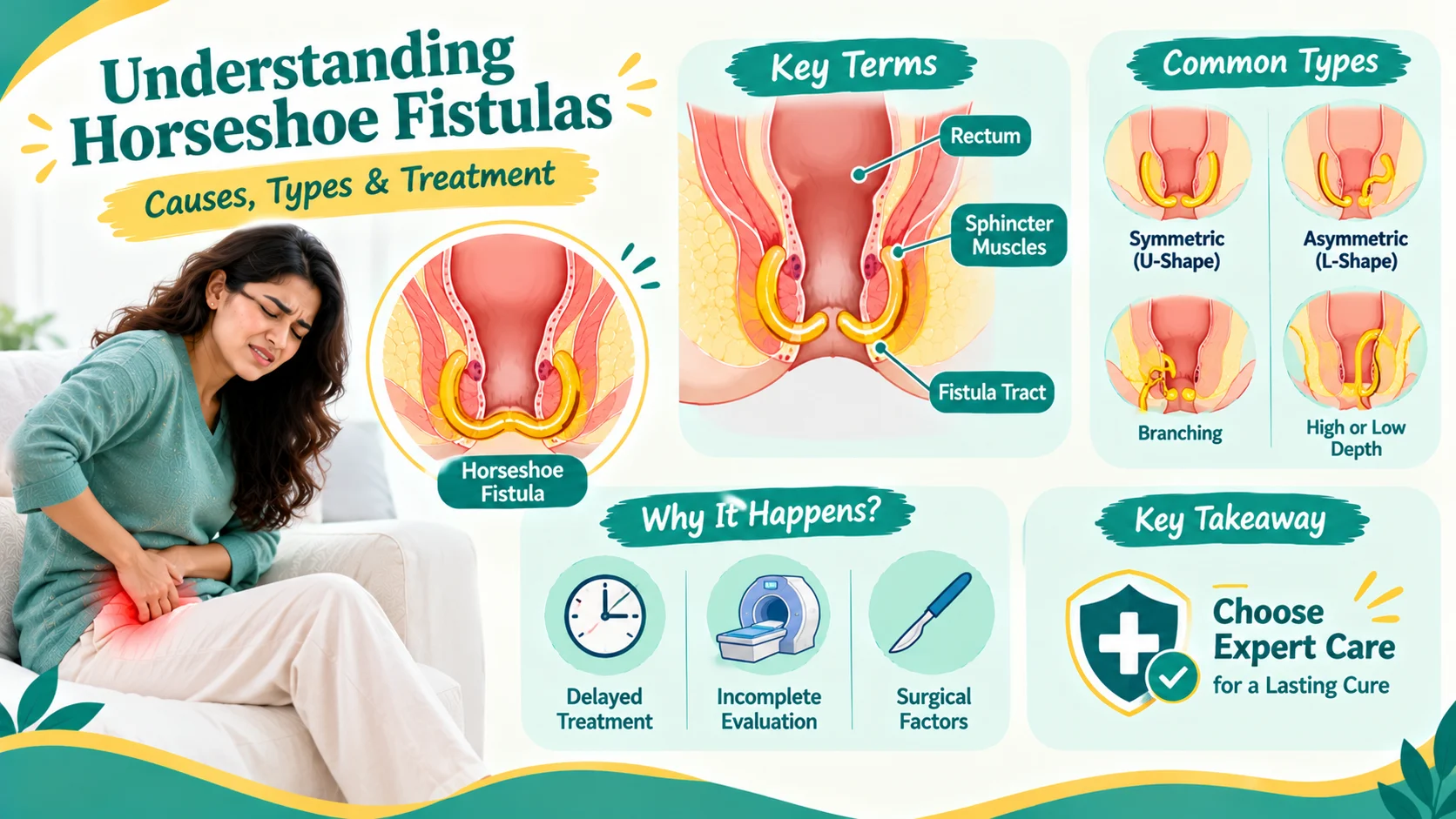
Before exploring about a horseshoe fistula, it helps to understand they key body part terms your doctor may have used or your MRI report might mention. Think of the area around your anal canal as a structure of hallways, doors, and rooms:
Key Terms used to see how complex your fistula maybe
- Anal Canal: It is a short tube at the end of the digestive tract through which stools are pushed out from the body. ( Consider this as the central hallway).
- Sphincter Muscles: The inner and outer rings of muscle around the anal canal; they help control bowel movements to prevent any accidental or untimely stool leakage. (They are like doors of the hallway).
- Deep Postanal Space: A hidden pocket located directly behind the anal canal. This is just a space where there are no organs, and is under the sphincter muscles and in front of the tailbone. Because of the anatomical location of this space, fluids can get trapped very easily here. (A back corridor).
- Ischioanal Spaces: Large portions filled with fatty tissue situated on either side of the buttocks surrounding the anal canal. (Like spacious side rooms on the left and right).
- Primary Fistula Tract: A tunnel like structure formed through all the above tissues connecting the internal origin of an infection sit to an external exit (generally a hole on the skin of the buttocks). (The main pipe).
- Secondary Extensions / Blind Branches: Branches of the main tunnel (the primary fistula). These can either just be like dead-end hallways/roads within the tissue or can break through as a hole on the skin. (these are like side corridors).
- Cryptoglandular Glands: Tiny glands lining the inside wall of the anal canal that produce lubricating mucus. When they become blocked and infected, a fistula typically begins. (The origin point of the main tunnel/pipe).
Let us put these together to picture a horse shoe fistula
To understand why a horseshoe fistula is called complex, let us take a step back to what doctors consider as simple fistulas.
The Basics: What is a Fistula?
- An anal fistula is an abnormal tunnel connecting an internal opening inside the anal canal to an external opening on the skin around the anus.
- They typically begin when an infected anal gland collects infectious liquids in an abscess/pocket.
- The body forms an escape route to remove out the infectious fluids.
- It forms the main pipe/tunnel which burrows through muscle tissue to the skin.
Simple Fistulas: A Straight Line
- In a simple fistula, this tunnel acts like a short, direct pipe.
- It goes straight from the internal source straight out to a single external opening on the skin.
- It has no branches, and goes only slightly through the sphincter muscle (the doors).
- These features make it their treatment and removal easy.
The Horseshoe Fistula
In a horseshoe fistula, instead of a single pipe/tunnel, the main tunnel branches out deep within the surrounding ischioanal, postanal tissue spaces around the anal canal. (The main tunnel branches to send mini side-tunnels into the back corridor and other rooms surrounding the main hallway.)
Why does branching make it a ‘complex fistula’:
In very simple terms, a complex fistula runs through many different tissues around the anal canal—including the sphincter muscles (the doors/controllers). Removal of these branches would mean cutting into these tissues, and complex recovery timelines.
What is happening in the horse shoes fistula—the complex pathway:
- A hidden infection spot: The main infection usually starts in a mucus gland on back wall of the anal canal.
It drains into the pocket behind the sphincter muscles—deep postanal space (aka, the back corridor). - The horseshoe shape curve: Because the infection is trapped in this space, it cannot move backward.
How the body removes this fluid: it spreads sideways around both sides of the anal canal, forming a curve shaped like a horseshoe or the letter “U.” - Branching Tracts: As the pressure increases because of fluid increase, it forms branches into the soft fatty tissue of one or both buttocks—the ischioanal spaces (aka the spacious side rooms).
Horseshoe Fistula—Does It Change Its Shape?
You may picture the horseshoe fistula tract to be like a like a classic U shaped tube.
No two horseshoe fistulas are exactly the same. The way the infectious liquid travels through tissue is on the path of least resistance, leading to several distinct structural variants.
The treatments your doctor suggests are highly based on these tracts formed, and hence, is different in each individual case.
Some variant names you may come across in your medical reports and your doctor usages are:
| Variant Type | What It Looks Like | Explanation of the route formation | Why It Matters for Treatment |
| Symmetric (Classic “U”) | Like a symmetrical U-shape. | The infectious liquid/pus spreads evenly into the tissue on both sides, forming a symmetrical U shape. | Both sides need equal drainage; treating just one side almost always results in the infection to recur. |
| Asymmetric (“L” Shape) | One-sided and heavy branched tract/tunnel | The pus passes through the back corridor (postanal space), but burrows almost only one side of the buttocks. | Even if pain is felt on just one side, it is treated as a horseshoe fistula because the behind/postanal space is heavily infected. |
| Sinuous / Multi-Branching | Branched tracts looking like tree roots | Instead of a straight pipe, the tract is twisting (like a snake) with branches through tissue layers. | It is easy to miss winding branches or even accidentally puncture delicate tissue. Thus, treatment gets complex here. |
| Blind Branches (Dead Ends) | Branches leading to dead ends (like dead-end roads) | The Side tunnels split off from the main tunnel, but end inside deep tissue with no opening on the skin. | Because there is no skin opening, pus gets trapped in these “dead ends”, which require treatment or else the infection can easily recur. |
| Infralevator (Low Depth) | Tract below the pelvic floor muscle | The fistula stays entirely in the fatty space below the main muscle floor of your pelvis. | Most common type; easier to access surgically while protecting core pelvic strength. |
| Supralevator (High Depth) | Above the pelvic floor | Here, a branch of the main fistula can travel upward above the pelvic floor muscle layer, going into the deep pelvis. | This type is rare but requires careful planning to avoid any damage to the sphincter muscles (the door of the anal canal) to prevent faecal incontinence issues. |
Why Do Horseshoe Fistulas Occur?—it is not just because of a delay in going to the doctor.
When a patient is told their fistula has become a complex horseshoe fistula—the natural assumption is often to blame themselves. It is natural to wonder “Did I wait too long to see a doctor? Did I delay reporting my symptoms?“
- Initial delay does play an important role in a fistula going from simple to complex.
- However, patient delay is only one of the reasons.
- Horseshoe fistulas also can form because of the unique tissue structuring around the anal canal of each individual.
- Other important factors for horseshoe fistula formations are incomplete initial evaluation during your doctor’s visits or even premature surgical intervention by the doctor.
Here are simple explanations on reasons for a horseshoe fistula formation
- Patient Delay: Giving the Infection Time to Spread
- Initially it is common and natural to hope any anal pain or boils to resolve on their own.
- However, because of deep hidden spaces behind muscle tissue, trapped pus cannot easily escape outward.
- Overtime, as the fluid accumulates, the growing pressure forces it to go through tissues around the anal canal, making it become more complex and winding.
- Incomplete evaluation-the blind approach
- Operating without high-resolution MRI images means not having an entire clear picture or map of the tunnels.
- This can easily lead to missed deep anatomical or hidden side branches. Any fistula tunnel which is left behind with infectious fluid can always lead to recurring and more complex fistulas later.
- Premature Intervention & Medically Induced False Tracks
- Aggressive probing of an unmapped, active tract can accidentally puncture surrounding tissues.
- These injuries can create entirely new artificial channels (called false tracks).
- If an operation takes place without first draining the infectious liquid the primary infection source stays alive and active, increasing chances of recurrence.
Hearing a diagnoses like complex/horseshoe fistula can make anyone naturally very anxious. Not understanding complex terms on your MRI report or what the doctor may say, also adds to the feeling of pain. However, remember, for achieving a lasting cure ensure you go to colorectal surgeon specialists, who rely heavily on pre-surgical MRI mapping rather than quick fixes or blind procedures.
Work with such specialists at Smiles Institute for Gastroenterology, who understand deep postanal spaces and prioritize sphincter-sparing techniques (ensuring you maintain bowel control after complex fistula removals too). This ensures you can approach your treatment plan with confidence and ease of mind.
Frequently Asked Questions (FAQs):
1. Is a horseshoe fistula dangerous or life-threatening?
A horseshoe fistula is not life-threatening, but it is a complex medical condition that requires specialized care. If left untreated, the infection can spread deeper into the tissues around the anal canal, to create additional complex tracks.
2. Can a horseshoe fistula heal on its own without surgery?
No. Anal fistula is a physical, lined tunnel inside the tissue. Antibiotics can only trat any active inflammation and reduce pain. The tunnel still remains even after the infection goes away.
3. How do I know if I have a simple fistula or a horseshoe fistula?
No one can tell the difference based on physical symptoms or surface appearance alone. An MRI fistulogram is the only definitive way to accurately map a horseshoe tract.
4. Will horseshoe fistula surgery cause bowel incontinence?
Not necessarily. Modern treatments followed at Smiles Institute of Gastroenterology heavily give importance to sphincter-sparing techniques (such as LIFT, VAAFT, and FiLaC laser closure). These help with removal of fistula tract while preserving your sphincter muscle function for bowel control.
5. Why did my horseshoe fistula come back after surgery?
This often happens if the operation is performed without prior high-resolution MRI mapping. Without a clear map of the entire tract and branches, it is easy to miss hidden portions of it. This is one of the major contributions for fistula recurrences.
