

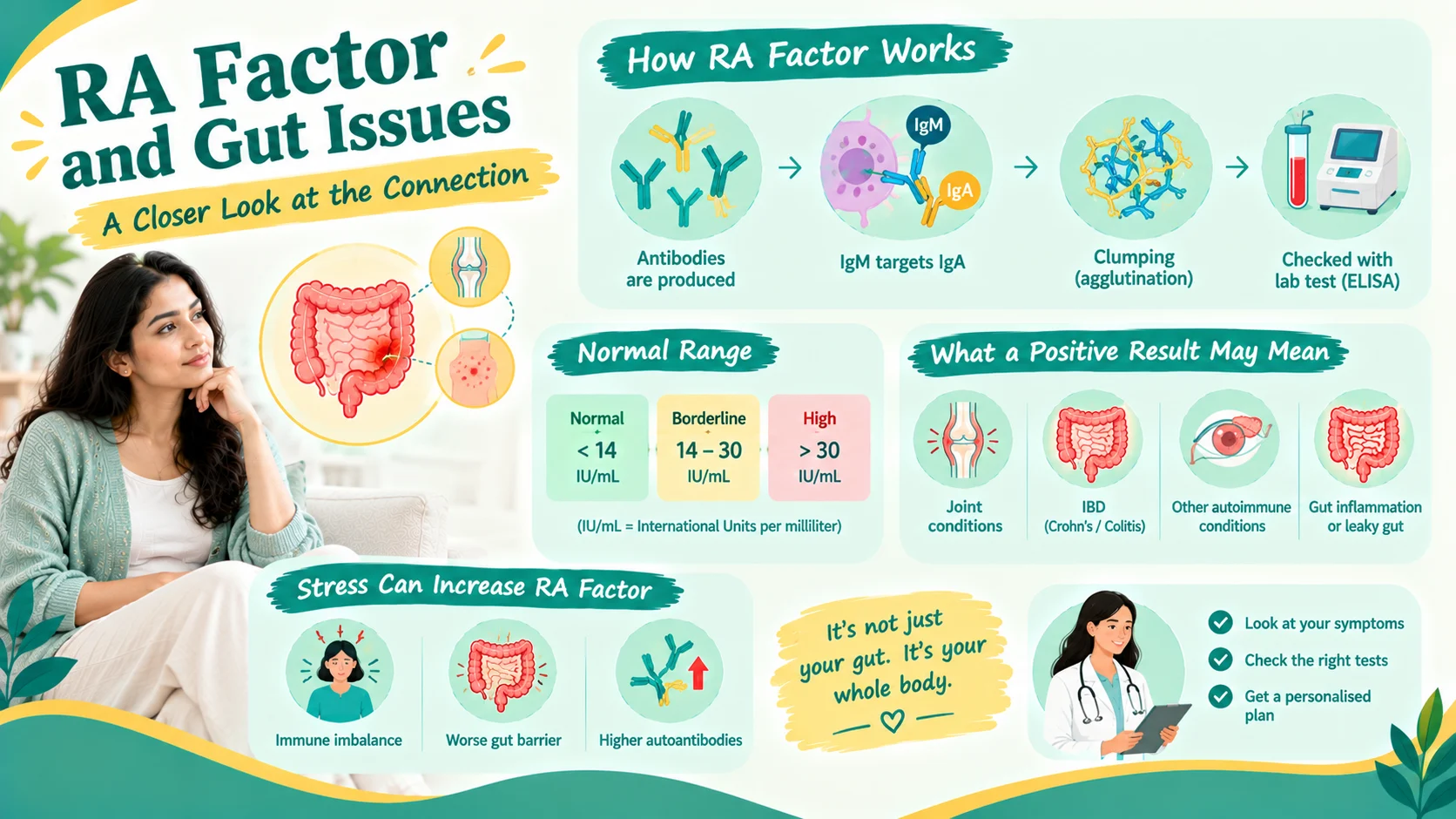
Ever visited the gastroenterologist for long-term stomach pain, bloating, and cramping, only to be asked about joint issues or other skin rashes? If you are wondering what does aching knees or itchy skin have to do with your gut, the answer lies in another system called the immune system.
When stomach issues and other parts of the body are acting up together, it is often a sign that the root cause may not be just a stomach virus, but an underlying autoimmune condition. Here, your immune system mistakenly identifies healthy body tissues as foreign, triggering inflammation that can show up in your intestines, joints, and skin.
To know for sure if it is an autoimmune condition, gastroenterologists look beyond routine gut tests. One main test they use to is a simple blood test called the Rheumatoid Factor (RA Factor) test.
How Does the RA Factor Indicate a Possible Autoimmune Gut Issue?
What happens in your body:
- In the body, there are different proteins are produced. In the immune system of the body, some of these proteins are called antibodies—they help recognize foreign objects, bacteria, viruses and other microbes.
- But in autoimmune individuals, there is a particular antibody called IgM which target other healthy antibodies called IgA, resulting in immune responses like swelling and inflammation.
What happens during the test:
- The technician takes your blood, separates the serum component (which contains the antibodies from you).
- It is then mixed with another sample which contains IgA.
- If you have an autoimmune condition, the IgM from your serum sample binds aggressively to the IgA from the control/lab samples to form big clot like structures. This is called agglutination.
- The degree of clumping is then observed using special lab equipment like the ELISA reader.
What is the Normal Range for RA Factor?
Normal reference ranges does vary slightly between laboratories and also depending on the testing method used. However, the standard clinical guidelines are:
- Normal (Negative): Less than 14 IU/mL (International Units per milliliter)
- Borderline / Mildly Elevated: 14 to 30 IU/mL
- Positive (High): Above 30 IU/mL
A value below 14 IU/mL generally means RA factor was not detected, which is also considered as a normal result.
What Does a Positive RA Factor Mean?
If the RA levels is in the positive range, it can indicate a potential autoimmune condition. In other words, your immune system is making antibodies that mistakenly target your body’s own healthy tissues.
- However, a positive RA factor is not exclusive just for joint diseases. Other autoimmune and inflammatory conditions, including Sjögren’s syndrome, lupus, and chronic liver or just intestinal inflammation can also turn up in the positive RA factor range.
- RA factor in gastroenterology: RA factor elevation is shown to be sometimes seen in patients with Inflammatory Bowel Disease (IBD (Crohn’s Disease or Ulcerative Colitis) because these are autoimmune conditions.
- Additionally, general gut inflammation and a leaky gut—condition which allows bacterial products into the bloodstream, also can elevate the RA factor values.
“A positive RA factor value alone does not confirm or rule out an autoimmune condition. It simply indicates that your immune system is in a hyperactive state. Qualified gastroenterologists—such as the specialists at Smiles Institute of Gastroenterology, Bengaluru—evaluate this result alongside your specific digestive symptoms, joint health, and physical examinations to reach an accurate diagnosis.”
Can Stress Increase RA Factor Levels?
Yes, it can indirectly work to increase RA levels—over the long term. While short-term emotional stress will not immediately spike RA factor levels, chronic psychological or physical stress has is shown to highly impact the immune function.
A few ways this happens is:
- Immune system dysregulation: Prolonged stress keeps stress hormones like cortisol and cytokines elevated. Over time, this chronic stress response weakens the immune system. This increases autoantibody production.
- Gut breakdown: High stress changes gut motility and can also worsen a leaking gut. When this happens, foreign molecules enter the bloodstream, triggering autoantibodies to increase.
- Triggering Flares: Stress is a well-known trigger for flare-up of symptoms in autoimmune individuals. During periods of severe stress RA factor levels increase alongside digestive or joint symptoms.
RA factor test is mostly used for diagnosing joint conditions. However, gastroenterologist often use it to establish the connection between whole-body autoimmune symptoms and gut health issues. An elevated result simply means your immune system is hyperactive and is causing an inflammatory response—whether it’s in your joints, your intestinal lining, or both. Ultimately, the RA factor levels can help your qualified gastroenterologist at Smiles Institute of Gastroenterology, Bengaluru to understand what’s the reason behind your persistent stomach pain, and design a personalised treatment plan that addresses both your gut and overall body health.
Frequently Asked Questions (FAQ)
1. Can you have a positive RA factor without having autoimmune gut issues?
Yes. Approximately 5–10% of healthy older adults can test positive for RA factor without having autoimmune gut issues. A positive result is also seen in other autoimmune conditions, active (Inflammatory Bowel Disease) IBD, chronic liver disease, long-term viral or bacterial infections.
2. Can gut issues like IBS cause a positive RA factor test?
Irritable Bowel Syndrome (IBS) is a functional disorder and not an autoimmune condition, so IBS alone usually does not cause a positive RA factor. However, Inflammatory Bowel Disease (IBD) which involves autoimmune inflammation in the gut is associated with elevated RA factor levels.
3. Does a negative RA factor rule out autoimmune gut disease?
No. A negative RA factor test only means an antibody was not elevated at the time of testing. Many people with active autoimmune conditions, including IBD or early-stage autoimmune disorders, test negative for RA factor.
4. Can dietary changes help lower RA factor levels?
Dietary changes indirectly work to lower inflammation, not the antibody production. Anti-inflammatory diets rich in fiber, omega-3 fatty acids, and traditional anti-inflammatory spices like turmeric while eliminating ultra-processed foods can calm immune activation. As overall body inflammation reduces, the gut heals. As this happens over a long-time, autoantibody production may gradually decrease.
