

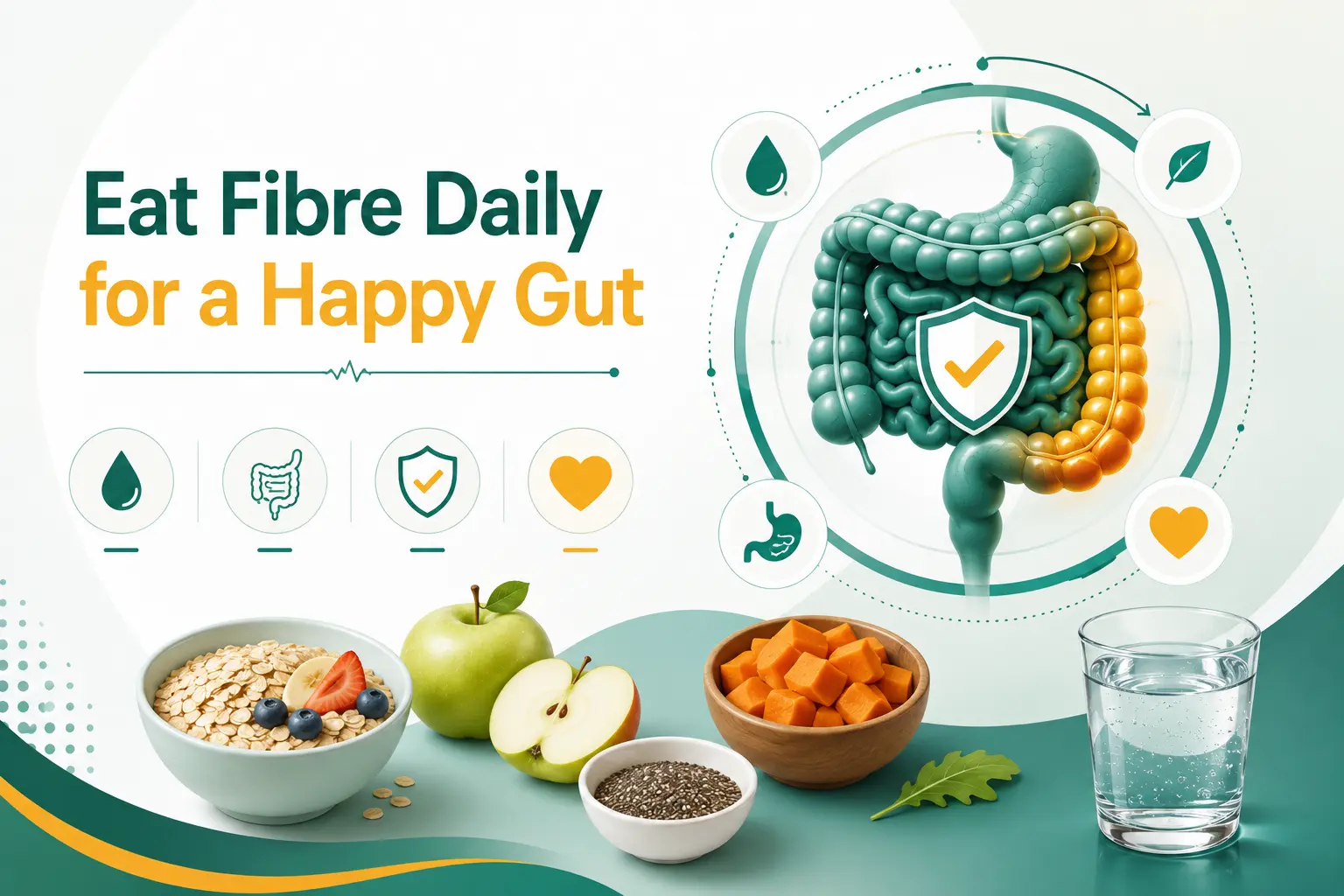
Eat your fibre daily – this is a very common advice given by almost all doctors for maintaining a good digestive health. This advice has been constant since the 1970s when refined flour usage became regular, and perhaps is of even more importance in today’s diet of readymade food abundance.
Why is fibre needed for the gut health?
Well, fibre is like a net. It enters your intestines, combines with water to become a bulky mesh. This helps it to move all the digested waste along for easy and effective stool exit from the body. Many reports have shown that without fibre, the digested waste gets collected in places along the intestine, leading to it getting hard over time. This over time results in constipation and many other stomach issues.
There are different fibre types you can aim for, and many easier and proven pointers in this article to help you reach your optimal fibre goals daily.
What is the critical difference between soluble and insoluble fiber for the gut?
Dietary fibre is of two main types – soluble and insoluble fibre. Both are important and needed for optimal gut functioning, and both types are used by your gut to serve different purposes.
Soluble fiber acts like a sponge. It uses the water in your digestive tract, to become into a soft, gel-like mass. This gel binds with digested waste to keep your stools soft, and easy to pass without straining.
Insoluble fiber, on the other hand, is more like a broom. It cannot dissolve in water, so it largely remains intact throughout your gut. Its primary job is to add bulk to your stool. When stools become bulky, it stimulates your intestines to keep moving the digested waste efficiently through the intestines.
Based on their functional difference, their critical difference remains in how they help with constipation and piles. Soluble fiber keeps your stool soft enough, and this ensures that it won’t cause any tears in the anal tissues. Insoluble fiber keeps the food moving fast enough so it doesn’t dry out and become hard. Hence, it is critical to keep a healthy balance of both the fibre components daily to keep efficient gut health.
Which fiber sources soften stool without causing excess gas and bloating?
Soluble fibre is the component which you must focus on, to keep stools soft and smooth. Since they are digestible and dissolve in water, they cause much less bloating that insoluble fibre which remains as such during digestion.
There are many sources of soluble fibre. Aim for low-fermentation soluble fiber sources like:
- Oats: Oats are rich in beta-glucan, a soluble fiber that absorbs water to create smooth stools. It also ferments slowly in the gut, making it a good inclusion specially for guts sensitive to bloating.
- Apples and pears (without peels): The inner flesh of apples and pears contains pectin, a soothing soluble fiber. The skin contains the insoluble fiber that often causes the bloated feeling. Removing the peels leaves behind only soothing soluble fibre which acts as a stool softening gel.
- Cooked carrots and sweet potatoes: These root vegetables are full of fibre which turn into the soluble form only upon cooking.
- Psyllium husk: Pure psyllium husk is one of the most effective non-bloating soluble fibers available. It expands with water to form a smooth gel to help pass stools through the digestive tract without producing excess gas.
- Soaked chia seeds: Chia seeds form a gelatinous outer layer upon soaking. This layers acts like pre-hydrated gel which passes through your intestines easily without you needing to put too much pressure.
Can eating too much raw fiber make hard stools more painful to pass?
Fibre is good for the gut, but how much is too much? A much too common complaint many colorectal specialists like Dr. Parameshwara CM get is where the person is having a hard time with bowel movements, so loads up their food intake with many of the fibre rich foods. However, the constipation worsens over the next few days, increasing the frustration and anxiousness.
The ideal daily fibre intake as advised by the World Health Organisation (WHO) is about 25–38 grams. But this quantity works optimally and efficiently only when paired with water.
The concept of fibre becoming a soft gel like mass is dependent heavily on it absorbing the water in your intestines. When you drink less water, the digested fibre solidifies even more and becomes a hard mass which would put considerable pain and pressure on the anal veins during passing stools. This pressure directly results in piles.
How does water intake dictate whether fiber helps or hurts your digestion?
Fiber and water are important partners to keep your digestive system active—one cannot function effectively without the other. While fibre provides the structural mass for your stools, water ensures the structure remains soft and easy to pass.
Fibre behaves like a sponge. When you eat lots of high-fiber foods without drinking sufficient fluids, the fiber turns into a dense, cement-like mass. Your colon and rectum then has to work twice as hard to push this dry stool forward.
Passing a dry, and bulky stool requires intense straining, which directly results in increased pressure on the veins and also causes tears in the anal lining.
Thus, fiber is helpful to creates bulky stools. However, without adequate hydration, extra fiber will hurt your gut far more than it helps.
What is the ideal daily fiber-to-water ratio for fissure and piles prevention?
A well-researched study published in 1998, establishes in the ratio of water to fibre based on clear cut evidence. Published in Hepatogastroenterology (Hepatogastroenterology. 1998 May-Jun;45(21):727-32. PMID: 9684123), it shows how a group of participants who received about 100 millilitres of water per gram of fibre, had improved their stool movements consistently even after being constipated over a long time.
Thus, this study gives us a simple golden rule for preventing piles and fissures:
10 grams of fiber : 1 Liter of water.
To make this practical, let’s look at how this ratio applies to a day of common Indian meals and how much fluid you need to drink alongside them to keep your stool soft and smooth.
| Daily food generally consumed in India | Approx. Fiber (grams/g) | Required Fluid Intake | Simple hydration strategy |
| Breakfast types
• 3 Plain Dosa’s + Chutney & Sambar • 2 Vegetable Stuffed Parathas • 1 Bowl Vegetable Upma or Poha • 3 Idly + Sambar |
6 – 7 g | 600 – 700 mL
(~2 to 3 glasses) |
Drink 1 large glass of water after breakfast and 1 glass of warm water/tea midway through the morning. |
| Lunch types
• 1 Bowl Kosambari/Salad + Rice/2 Roti & Dal • 1 Bowl Rajma or Chole + Brown/White Rice • 2 Roti + Sabzi + 1 Bowl Curd Rice • 1 Plate Vegetable Biryani/Pulao + Raita |
10 g | 1 Liter
(~4 glasses) |
Have 1 glass of buttermilk with lunch, followed by 3 glasses of water spread across the early afternoon. |
| Evening Snack types
• 1 Handful Roasted Chana / Makhana • 1 Medium Apple or Pear (with skin) • 2 Whole Wheat Khakhras |
5 g | 500 mL
(~2 glasses) |
Drink 2 full glasses of water during or immediately after your evening break. |
| Dinner types
• 2 Phulkas + Palak Dal + Sabzi • 1 Bowl Khichdi + Mixed Veggies • 2 Jowar or Bajra Rotis + Sabzi • 1 Bowl Oats or Broken Wheat (Dalia) Porridge |
8 g | 800 mL
(~3 glasses) |
1 glass of water 30 minutes before dinner, and 2 glasses of warm water over the course of the evening before bed. |
| Daily Total Target | ~30 g | ~3 Liters | Spreading your fluid intake across meals keeps the fiber fully hydrated and soft. |
A typical day of healthy Indian meals easily provides the 25 to 30 grams of fiber per day requirement. By pairing your meals with the correct amounts of water, buttermilk, or other liquids, you can ensure that you using all the fibre you eat in optimally and efficiently in keeping piles and fissures away.
Frequently Asked Questions:
1.Why does my constipation get worse when I take more fibre?
As aptly explained by Dr. Parameshwara CM of Smiles Institute of Gastroenterology, most people assume that just eating fibre helps with making soft stools, but they forget that fibre becomes soft only by absorbing water. Hence, constipation gets worse with fibre only if there is not sufficient fluid intake along with it.
2.Can eating fiber worsen hemorrhoids?
Hemorrhoids or piles are swollen veins in the anus and rectum. They swell when you put pressure while passing hard stools. Eating more insoluble fibre—which does not absorb water, can make stools hard which worsens or results in haemorrhoids. Also eating soluble fibre, but not hydrating enough can result in painful piles. Always eat correct portions of soluble and insoluble fibre along with plenty of fluids to effectively soften your stools and thus, avoid making your piles worse.
3.Which type of fiber is better for constipation?
Soluble fiber is generally better for easing constipation because it absorbs water to form a soft gel that makes stools smooth and easy to pass. For best results, you can opt for soluble fibre sources like oats, psyllium husk, and cooked root vegetables paired with plenty of water.
4.Why can’t I poop freely even with enough fiber intake?
Stools are easiest to pass when there is plenty of the soft gel like material in them. This gel like material is formed only when the fibre you eat has plenty of water to absorb. Thus, if you are upping your fibre intake, always remember the golden ratio – 1 Litre of water for 10 grams of fibre. Drink enough of liquids to maintain this ratio, and your gut health will be at its best.
