

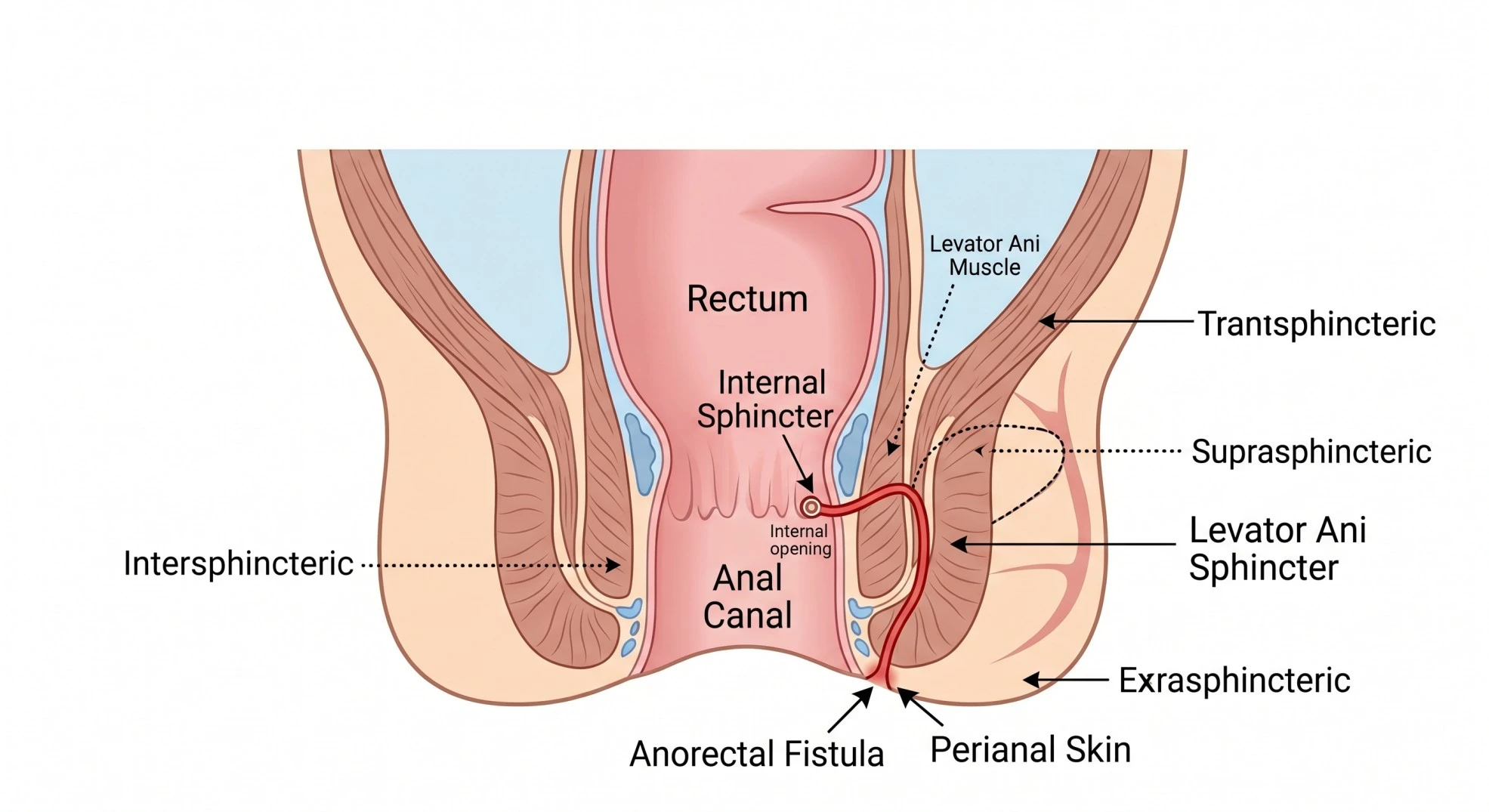
Fistula is an abnormal tube-like structure formed in the body. It forms when there is long-term infection and the body needs to drain out the infectious liquids and pus. Fistulas can be formed anywhere between organs, or between organs and an opening in the skin, and are frequently found in the stomach region, between the bowels and skin. The most well-heard of fistulas are anal fistulas. They are formed in the anal region when the glands in this region get infected. In 2026, modern medical innovation has made it possible to cure fistulas easily, with recovery times of just about a week. Read to know more about these innovations, and how fistulas need not be feared like they were a few years ago.
What is the root cause for fistula?
To understand the cures for fistula, it is important to understand why and how they form. Once you understand these simple points, and how a fistula looks, it is easier to recognize why your doctor has narrowed to a particular procedure.
The root cause of fistula formation is when the mucus glands lining the anal canal get infected. Infected anal glands can develop because of a number of different reasons such as clogged/blocked glands, injury from previous surgeries, Crohn’s disease, or STIs.
Whatever may be the reason, the infection ultimately results in significant amounts of pus collection, collected in pockets called perianal abscesses. When there is chronic or long term active perianal abscesses, your body automatically makes a tube-like structure to drain out all the collected pus. This tube structure from the abscess to the opening on the buttocks skin is called a fistula tract.
Is fistula common in kids?
Anal fistulas in children are rare, with studies reporting fistula incidences of about 0.5–4.0% in children. The primary age group is observed as infants under one year of age, with the numbers peaking at the two-year age group. Anal fistula in children show a very significant male predominance, with over 95% of the cases being male infants.
However, the good news is, fistulas in kids heal spontaneously and rarely need any sort of medical intervention. Even in cases where medical treatments are necessary, the simplest procedure—fistulotomy, does the job and the healing also happens quickly. Most pediatric anal fistulas are simple or superficial fistulas, where the tube/tract does not go through any anal sphincter muscles unlike adult fistulas, which makes them simple and easy to resolve.
Is a fistula 100% curable?
Yes, fistulas are 100% curable in 2026. The main point to understand about fistulas is that the underlying infection which causes the pus collection and abscess can be taken care of by antibiotics and other medications. However, the physical tunnel or fistula tract which is formed will remain as such which can cause pain and discomfort on a daily basis. Leaving the tract as such can also lead to branching which can complicate the treatment. Thus, surgery is the only way for making a fistula 100% curable and to minimize its recurrence.
What is the modern treatment for fistula?
To understand the answer to this interesting question, it is important to know how a treatment for fistula is planned.
For treating an anal fistula, your doctor has two important medical considerations in mind while deciding the further course of action.
- Removal of the entire fistula tract.
- Preserving the anal sphincter muscles. The sphincter muscles are very important and help you control your bowel movements. Any damage to these muscles can mean faecal incontinence—a condition which no one would naturally want to have, however minor.
So with these two pointers in mind, the choice of procedure depends on the complexity of the fistula (how much muscle it crosses) and its location in the anal region.
Some modern procedures for fistula treatment are:
For simple fistulas: No sphincter muscle involvement, fistula tracts are usually straight.
- Fistulotomy: It remains as the gold standard for simple, low-lying fistulas. The surgeon cuts the entire length of the fistula, and opens it up across, so it heals from the inside out as a flat scar.
- Seton Placement: Here, a surgical thread (seton) is placed through the tract to drain the infection followed by a surgery to remove the empty fistula tract.
For complex fistulas: these tracts go through the sphincter muscle, and also are always curved or some even take a horseshoe-shaped pattern.
- VAAFT or Video-Assisted Anal Fistula Treatment is best for a fistula which has many branches. It uses a high-definition camera to look inside the tract. It is paired with other methods to ensure no branches remain untreated.
- LIFT or Ligation of Intersphincteric Fistula Tract remains a staple in many Indian hospitals. It is highly effective and does not require any implants. Since it is a 100% sphincter-sparing procedure, it is highly used for patients who are very concerned about preserving 100 % of their bowel control.
- TROPIS or Transanal Opening of Intersphincteric Space is a more open version of LIFT, and is used for complex horseshoe-shaped fistulas which are hard to cure. It is used for quicker drainage of the pus, and for faster healing of the internal parts of the fistula tract.
- FiLaC (Fistula-tract Laser Closure) remains to be the most advanced and chosen form of fistula treatment where high-precision laser is used to ablate the fistula tract for permanent recovery. It is highly opted due to its painless and no-cut procedure. This procedure takes only about 45 minutes to get done, and most patients go home on the same day itself. There is also a near-zero risk of faecal incontinence with FiLaC.
Which is better, laser or open surgery for a fistula?
Each surgery type is the best for different fistulas. A general consensus in 2026 is that the laser surgery is the most preferred choice by many fistula patients. However, you should note that the open surgery or fistulotomy stands to be the best choice for simple fistulas or low-lying fistulas.
The FiLaC procedure is often chosen for its painless and no-cut nature. The recovery is faster, with almost no blood loss. However, chances of fistula recurrence even after opting for this procedure remains as high as 30% if the surgery is not done by a highly skilled specialist.
Open surgery is advised highly by surgeons for simple fistula tracts which do not involve much muscle. This procedure has almost zero recurrence rate as the tract is physically opened by the surgeon. It is also significantly more affordable in India than laser treatments.
What is better? It is always best to decide this with the help of your surgeon. A simple point you can look to help you decide which surgery to opt for is—if your MRI shows a simple, low fistula, then open surgery is the most reliable and cost-effective cure. If your fistula is complex or you are worried about bowel control, laser surgery is the safer, and more comfortable option.
