
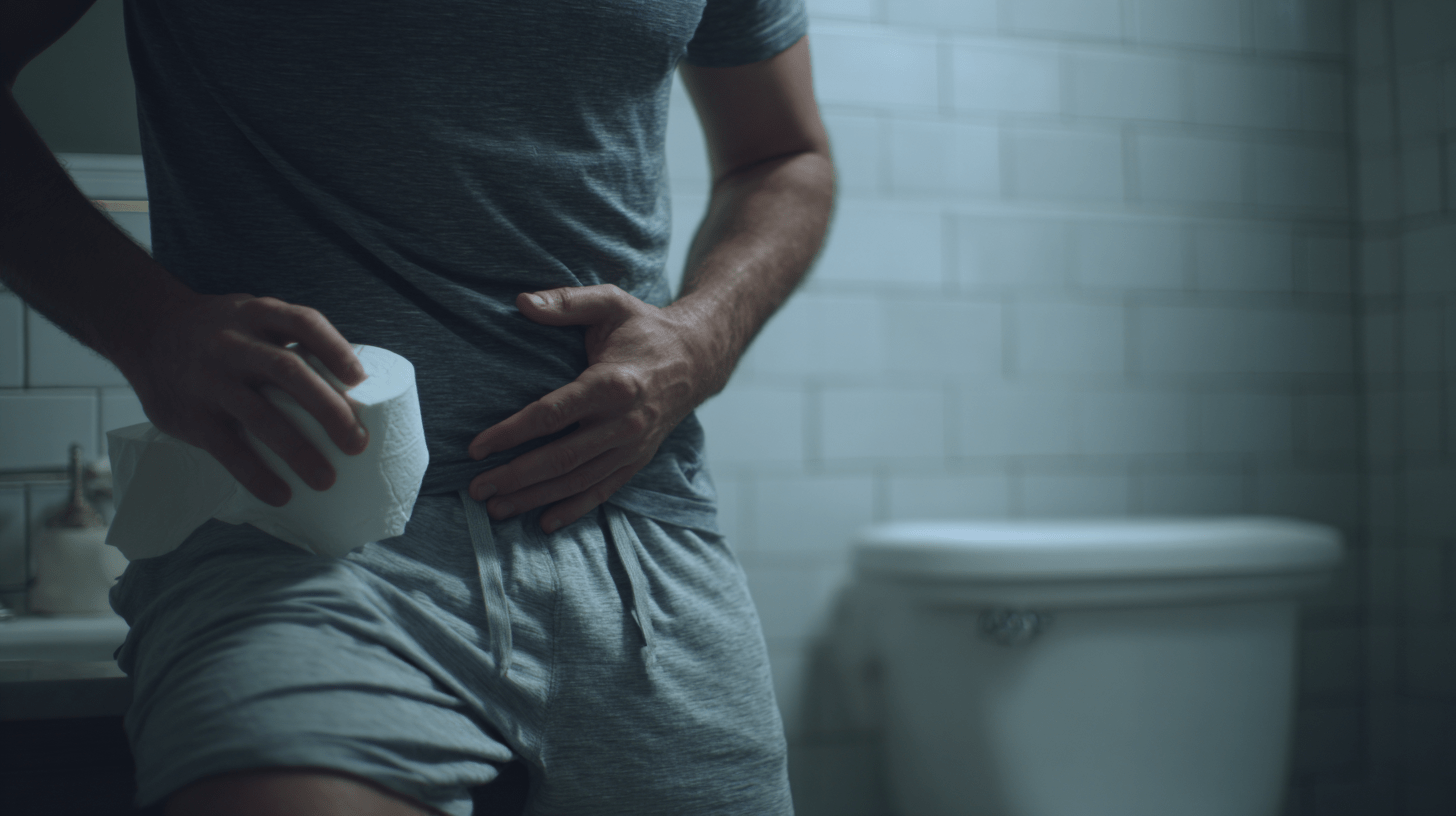
You would have heard of the saying ‘the dose makes the poison’? meaning, anything which happens only sometimes cannot be poisonous or harmful to the body. Same is the case for constipation and piles. Occasional constipation episodes would not lead to piles formation, but when it happens frequently or is there for a long time, it is strongly linked to the development of piles. What exactly is happening in these two situations, and how does constipation cause piles? Read on to find out.

What is constipation?
Constipation is a condition where there is difficulty in passing hard, dry stools, and having infrequent bowel movements. Other symptoms are bloating, stomach discomfort, painful bowel movements and most importantly, a feeling that you have not passed your bowels completely. Constipation is a common condition, with about 10—30% of adults in India facing it at some point in their lives. This could be occasional or chronic (long-term); and when it is chronic- it results in piles.
What causes constipation?
Just like piles, constipation also develops majorly due to unhealthy lifestyle factors, but it can also be caused by certain medications and other underlying medical conditions.
-
Lifestyle factors causing constipation
Did you know- in India, out of the 30% adults facing constipation, approximately 14% are reported to be from urban areas. This indicates how frequently lifestyle factors such as consuming a low fibre & processed diet, dehydration and a sedentary lifestyle leads to formation of hard stools.
When you have low fibre and water in your diet, the waste food settles down in the colon making them hard and dry. Sedentary lifestyle reduces the natural wave motion of your intestine, stagnating the stools and contributes to their hardening. Another factor is when you ignore the urge to defecate, the stool accumulates over time resulting in hard stools.
-
Medications
Some medications do indeed have constipation as their side effect. Medications like iron supplements, antacids (look for aluminium or calcium as their ingredient), some blood pressure medications, antidepressants and some heavy painkillers such as morphine, and oxycodone over regular use cause hard stools as their side effect. If you have been prescribed these types of meds on a regular basis, remember to mention them during your visit to the gastro doctor.
Other medical conditions
Underlying medical conditions can also have constipation as their symptom. Metabolic conditions such as hypothyroidism, and diabetes; gastrointestinal conditions like IBS, and blockages in the intestine; pregnancy (but putting pressure on the intestines), and age (older adults have slower metabolism and digestions along with weak muscle contractions of the abdomen) all lead to long-term hardened stools overtime.
Can Constipation Cause piles your Piles Problem ?
As you can already guess, one is a cause and the other is the result. When you are experiencing constipation, you strain harder to pass the stools. The hard stools irritate the anal canal, and the straining puts pressure on the veins in the rectal and anal area. When this happens habitually and frequently, the veins swell and bulge out forming piles.
We have understood that hard stools and infrequent bowel movements lead to constipation, but you could ask “how hard” is “too hard” and “how less” is “infrequent” to be considered as constipation? Interestingly, there are well-researched answers to these questions. Reading on may make you a bit uncomfortable, but keep at it, after all knowledge is power!
Surprising stool types you probably did not know about.
Based on how hard or soft they are, they have been categorized on the Bristol Stool Chart.
1- Separate hard lumps in the stools (feels like passing pebbles or nuts).
2- Lumpy and Sausage shaped (still firm and bumpy).
3- Sausage shaped but with mild cracks (medically still considered a bit hard)
4- Smooth without cracks and easy to pass (best Bristol stool type according to doctors)
5- Soft blobs which break easily (when you eat lots of fibre)
6- Fluffy pieces, pass easier than expected (indicates mild diarrhoea)
7- Watery, no pieces (severe diarrhoea suggesting infection)
As you can see, type 3-4 indicates healthy stools. Type 5-7 indicate loose stools or infection. Type 1-2 are the focus of our reading. Having type 1-2 is when a doctor will medically term it as constipation. When you have type 1-2 stool types frequently or over a long time, it leads to piles formation.
Having constipation for how long and frequently causes piles?
There are no exact number of days or weeks, but here is an easy and simple table to remember for that will answer this question
|
Duration of constipation |
Frequency (within a few months how many times you experience constipation) |
risk of piles formation |
Why does this happen |
|
Just for a few days |
Rarely-maybe once or twice in six months |
Very low |
Straining is usually temporary here; thus, the veins can recover easily. |
|
Lasts for several days together |
Occurs several times in a week over a month |
Moderate risk |
Repeated pressure happens during straining; this weakens the veins |
|
Ongoing for months |
Frequency is considered as high and termed as chronic constipation |
Very high |
Continuous straining over months causes permanent vein swelling/bleeding. Piles are formed. |
Get quick-relief from constipation with these impactful lifestyle changes:
After reading the above, you would have guessed what has caused your episode of constipation. But worry not, here are some powerful tips to give you effective and quick relief strategies you can try at home. The end goal is to make your stool softer and heavier and easy to pass. You can do that by these tips:
- Boost your fiber intake: Adding plenty fiber to your diet makes a drastic impact on your bowel movements. You can do this by aiming for 25-38 grams of high-fiber food types in a day.
An easy way to understand this is a table below:
|
Food type |
Few examples |
How many bowl/handfuls |
|
Legumes |
Dals, black beans |
About 1.5 bowls |
|
Grains |
Oats, wholewheat (even bread works) |
1 big bowl of oats for breakfast or 5-6 bread slices too |
|
Fruits |
Berries, banana, apple, pineapple |
5 individual whole fruits or 3 cups of berries |
|
Vegetables |
Broccoli, carrot, all gourds, pumpkin |
3-4 handfuls of each vegetable at lunch and dinner |
|
Nuts and seeds |
Almonds, chia, and flax seeds |
6-7 small handfuls of almonds, 2-3 tbsp of seeds |
- Drink more water: fiber without water makes more hard stools, so make sure you drink plenty water. Aim for at least 8 glasses (about 3-4 litres) of fluids in a day. It can be water, clear teas, juices without sugar, soups from actual veggies.
- Remember-Action and movement help the colon move more effectively. So, aim for moving for at least 30-minutes daily.
- Do not ignore the urge to go to the bathroom. Go as soon as you get that familiar feeling of pressure, stomach noises, and a bit of tightness.
- You can also try having bowel movements at the same time every day—also known as bowel training. Try to have a bowel movement about 30 minutes after your breakfast (this is when your colon is the most active).
- If you have tried the above methods, but still it has not been so effective? There are some over-the-counter laxatives you can always try. These are called stool softeners and have concentrated fiber or other additives to make your stools soft. Some common examples are: dabur isabgold powder, dulphalac syrups, and ayurvedic formulations like churnas.

Gain back your confidence and smile with our help
If you are experiencing persistent discomfort or find yourself straining during bowel movements, it is crucial to identify the starting stage of piles early on, as addressing the condition at this juncture can prevent the progression into more severe complications that often stem from chronic constipation.
However, if you’ve been following the above for 6–7 days and are still finding yourself straining, then it’s time to take the next step. Instead of waiting, do not let constipation bother you anymore—act now before it results in piles.
At this point, Smiles Gastroenterology Centers, especially in Bangalore, have super-specialized colorectal experts who can gently yet effectively guide you in gaining back your bowel confidence. With this in mind, their state-of-the-art facilities, tailored specifically for colorectal needs, ensure that the team at Smiles helps you overcome constipation safely and permanently—often even before you can say piles.

Dr. Parameshwara CM is a global authority in Coloproctology and the visionary founder of SMILES Hospitals, with an extraordinary track record of over 50,000 successful surgeries. A true pioneer in the field, he was the first to introduce Advanced Laser Piles Treatment and sophisticated procedures like LIFT, VAAFT, and STARR to Karnataka, revolutionizing the way digestive disorders are treated. He combines surgical precision with state-of-the-art laser technology to offer bloodless, minimally invasive solutions. Call us: +9108099008800 for further help.
- Dr Parameshwara CM

- Dr Parameshwara CM
- Dr Parameshwara CM
- Dr Parameshwara CM