

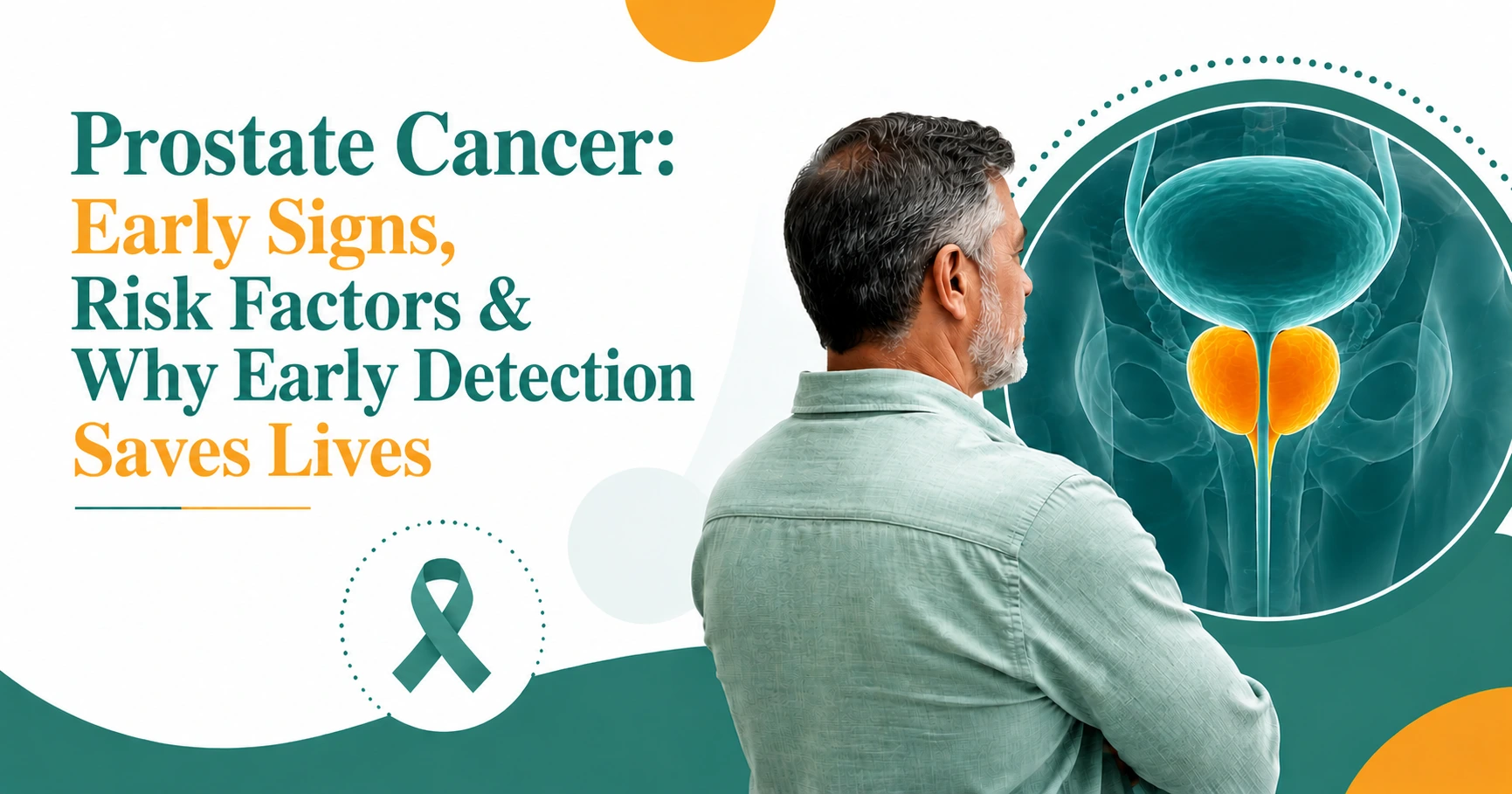
Prostate is a small gland found only in men that plays a vital role in the reproductive system. As with other organs of the body, the prostate is also maintained in an optimal functioning state during the prime reproductive years of a man. However, after about the age of 55, aging and changes in bodily defences cause the risk of prostate cancer to increase significantly. Rates of prostate cancer is been reported to increase in the recent years—it is one of the top three cancer types diagnosed in the Indian population.
There are several reasons for this sharp rise in incidence of prostate cancer. Altered and unsupportive dietary and lifestyle habits, a growing aged male population, and an increase in the availability of better diagnostic tests all contribute to the increased reported numbers.
Catching it early—is it possible?
Advancements in the medical field have dramatically increased the survival rates even of individuals with advanced stage prostate cancer. Treatment in the early, localized stages (stages 1 & 2) have a strong 5-year survival rate (chances of survival after 5 years of treatment without relapse) of a 100%.
However, the challenge lies in getting diagnosed when the cancer is localised and before it spreads. There are quite a few tell-tale symptoms which can be noticed early on at home, and can be used as pointers to warrant a doctor’s visit.
Find in this article well-reported, researched and reliable pointers to what it would feel like early on in prostate cancer, and why any related symptom is always worth a doctor’s visit.
What is the first hint of prostate cancer?
- The prostate glands sits below the bladder and wraps around the urethra (the tube that carries urine out of the body).
- Thus, early changes to this gland show up as changes in urination patterns.
- Early-stage prostate cancer often has no symptoms at all and is frequently caught during routine doctor check-ups.
- However, there are certain warning signs which warrant an immediate medical evaluation.
Always visit the doctor if you notice the following top 5 warning hints of prostate cancer:
- Blood in urine: If your urine is pink or red, see a colorectal specialist or a urologist right away. This is a not to ignore sign, and must be checked even if it has happened just once, very slightly, or there is just pain while urinating.
- Difficulty urinating: Urine retention or the inability to pass urine completely, happens as the tumor grows in size. The urethra runs through the prostate, so when the prostate grows in size, the tube gets squeezed and urine cannot get past it.
- Pelvic pain: Pain or a sensation in the pelvis can be a sign of advancing prostate cancer.
- Frequent urination: You may wake up many times in the night to use the bathroom. You may even observe this during the day.
- Weak urine stream: Due to the pressure from the cancer mass and tube getting pressed, you may find it difficult to feel a strong urine stream, or even find yourself putting pressure while starting to pass urine.
Other signs which may indicate later stage prostate cancer are:
- Bone pain: Bone and joint pain without exertion activities can indicate that the prostate cancer has spread to your bones.
- Blood in semen: Even tough rare, but you should see a doctor if it occurs.
- Difficulty holding back urine: Urinary incontinence is when you unintentionally pass urine. It can happen due to the continues pressure of the tumor mass in the prostate gland.
- Erectile dysfunction: You may even face difficulty in having or maintaining an erection.
What are the most common causes of prostate cancer?—being on the alert.
Knowing what increases the risk of developing prostate cancer is equally valuable, as it can keep anyone with risk factors vigilant of their symptoms. Cancer is multifactorial, meaning it rarely stems from a single cause. It happens when one or many genetic and environmental insults damage the defense systems meant to keep the division of cells in the body in check.
Thus, doctors often call the causes of cancer as “risk factors,” meaning the presence of some specific factors found very commonly in individuals with a certain type of cancer, has made them more liable to develop it.
The most common risk factors for prostate cancer include:
- Ethnicity: Race or descent of a man can make them more prone to prostate cancer. It is least common in Asian males, but risk increases if you are man of African descent or a Hispanic descent compared to a white descent.
- Age: One of the clearest risk factors. Men older than 50 years of age face a higher risk of developing it. Prostate cancer risk peaks as men get older, at about 65-70 years is when most of the diagnoses are made.
- Family history: Just like other multicausal disorders, risk of developing prostate cancer is higher if there is a family history of it. In fact, the risk increases if the relative is a first degree relation like father, first cousin, uncle. The risk also increases if they were diagnosed before they turned 60 years of age.
- Faulty hormonal levels: Specially of a hormone called the Insulin growth factor-1 or IGF-1 which is very well known to be involved in cell division. Individuals with higher IGF-1 were found to be at a higher risk of developing prostate cancer.
- DNA mutations: DNA dictates all which is produced and functions in the body. Based on the DNA the proteins are made, and cells divide. Mutations are changes to this fundamental DNA structure or sequence. There are some well-known mutations which are strongly associated with development of prostate cancer.
- BRCA1 and BRCA2: these genes are also very closely associated in breast cancer. These genes (portions of DNA) are involved in stopping the cells from dividing uncontrollably. Mutations in them are well-studied and shown to have a direct increase in risk of cancer development
In fact, men with BRCA2 mutations are reported to develop more aggressive forms of prostate cancer. - Some other genetic mutations linked to higher risk of prostate cancer development are TMPRSS2-ERG (two gene products fuse together wrongly)-very commonly found in prostate cancer, PTEN-mutation of this gene is found in very aggressive forms of resistant prostate cancer, and ATM, CHEK2 mutations seen in about 15% of prostate cancer cases.
- There are even life style factors involved which strongly increase prostate cancer risk.
- Obesity: Having a BMI of more than 30 sharply increases the risk of prostate cancer
- Smoking: Along with other cancer types, even risk of developing prostate cancer increases for chronic smokers
- Exposure to pesticides: Risk of prostate cancer is higher in people exposed to high levels of pesticides.
How does prostate cancer start and spreads?
- As with all types of cancer, even prostate cancer begins when there is a fault in control systems of cell division. All organs in the body are made up of fundamental units called cells.
- Think of cells like the bricks of a building. All the bricks need to be sturdy, and of proper make and shape.
- Many forces cause wear and tear in the bricks, but they can be replaced with the correct sized ones again. However, if the bricks are faulty, the imperfections spread through the building, leading to damage.
- A similar scenario happens to the cells in your body. Wear and tear can cause cell damage; however, there are strong systems in place to induce healthy cells to divide and make more healthy cells.
- When some damaged cells (containing the mutations mentioned above) manage to escape the systems, they divide uncontrollably, leading to cancer.
- In stages 1 and 2 of prostate cancer, the cancer is entirely confined to the prostate and is highly treatable.
- However, these mutated cells develop the ability to break away, migrate, and enter the bloodstream. Once they travel to distant parts of the body, they begin dividing to form new tumours. This process is called metastasis, representing the advanced stages of the disease.
Early-stage prostate cancer is so quiet, and is difficult to catch. This highlights the importance of regular medical check-ups for men over 50. Additionally, if you experience any of the warning symptoms in this article, make sure to get it checked by a good urologist. Smiles Institute of Gastroenterology , Bengaluru houses experienced and empathetic urologists and colorectal specialists. Just one check-up can clear all doubts and help you smile with confidence after their definitive, and safe all-clear.
