

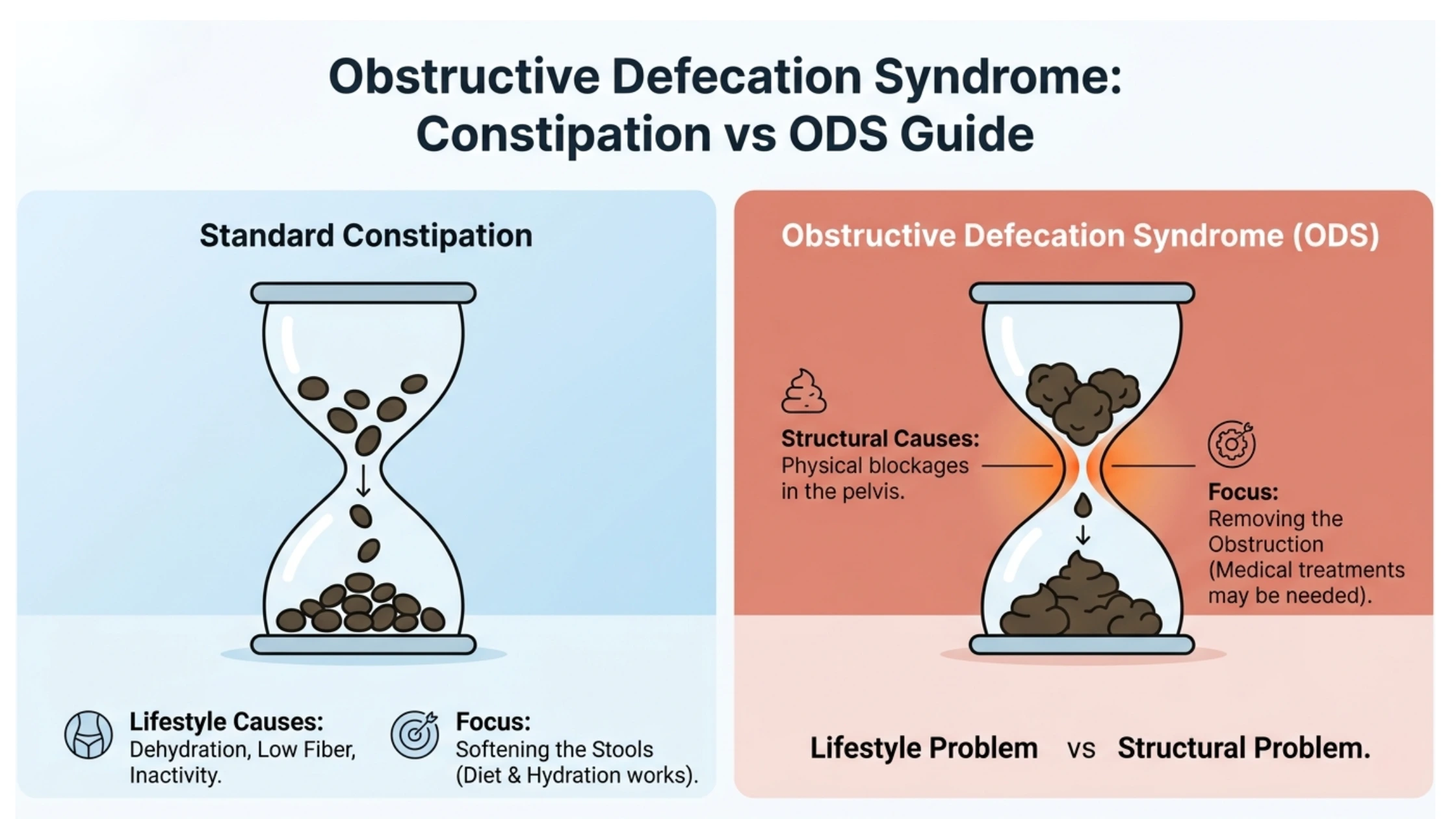
Obstructive Defecation Syndrome or ODS, is a term used when you have chronic, long-term constipation along with some form of physical or functional changes in the pelvic and rectal regions. As the name suggests, an obstruction in the body, rather than just hard stools, results in difficult defecation. ODS is mainly observed in women, with an increase in numbers as age progresses.
Although ODS may come across as just another case of constipation, it is not so. In this article, the first of a three-part series, you will be able to understand easily about ODS and how it differs from constipation. You can also understand why it is essential not to ignore any signs early on—when treatments are more conservative and easier to access.
What is obstructive defecation?
- Obstructive defecation is the process where there is difficulty in completely pushing out your stools, not just because they are hard, but because you may have other physical changes in the pelvic region which makes it harder to push out the stools effectively.
- Other terms you would hear with obstructive defecation are bowel obstruction, outlet obstructed constipation, pelvic floor dyssynergia, and anismus.
- When you experience obstructive defecation or blocked bowels along with other symptoms needing to spend more time on the toilet, having less bowel movements, or maybe using manual evacuation to push the bowels out, it is collectively called as Obstructive Defecation Syndrome.
ODS in numbers—why does this matter?
- ODS is more common than thought of even in the Indian population. ODS is also categorized as a sub-type of constipation.
- Roughly 1 in 7 people complain of chronic or long-term constipation.
- Nearly half of this group who have chronic constipation, when on a visit to a gastroenterologist, discover that they have ODS.
- The numbers for women are reported to be more common and striking. Women are roughly three times more likely to suffer from ODS than men. In fact, women make up anywhere between 60% and 70% of all diagnosed cases.
- The condition becomes increasingly common as women age. By the time they reach their 40s and 50s, physical changes in the pelvic region makes more than half of women report “difficult” bowel movements, who are likely experiencing ODS.
- ODS is often linked to the weakening of pelvic muscles during pregnancy and childbirth. This also means many women naturally assume their symptoms are just a normal part of getting older.
Why this matters?
- The main characteristic of ODS is constipation.
- Constipation is very commonly known to everyone as a lifestyle disorder. Meaning, the causes of feeling backed up are thought to be tied down to diet and lack of physical activity.
- Thus, it is natural for anyone with undiagnosed ODS to think that drastic changes to diet like a higher fiber intake, more hydration and movement will help with the symptoms.
- However, there are a lot of physical changes in the pelvic regions which also prevent complete and effective stool passage, even if the bowels are soft to pass.
- While this approach does work, it may help only to a certain extent. ODS is a long-term and multi-causal disorder.
- This means, fibre and water can take care of only a part of it. Any physical changes to the pelvic regions must also be taken care of to address all of the ODS symptoms.
- When a good colorectal specialist identifies ODS in the earlier stages, it is easy to understand why the treatments must move beyond just fibre and water to many other easy and conservative treatments.
What are the two types of bowel obstructions?
- ODS is a bowel obstruction disorder involving physical and functional changes to the pelvic region. There are different types of obstruction/changes which result in difficult defecation.
- There are two main types of obstructions: functional and anatomical (also called mechanical).
- Functional obstructions: These are characterised by a loss of functioning in the pelvic floor or rectal muscles.
- In this type, difficulty in passing bowels/stools mainly happens because there is loss of functioning in the muscles used for pushing out the stools.
- Loss in muscle function can be either because of some neurological issues or muscular weakness issues.
- Because of these aspects, the pelvic floor muscles fail to relax or act in a coordinated manner when passing out the stools.
Anatomical or mechanical obstructions:
- In this type, there is a physical defect in the pelvic floor or rectal muscles which lead to ineffective stool passage.
- There are many organs in the pelvic floor like the rectum and vagina which have smooth muscle walls. When these walls extend into each other’s spaces, it causes stool collection and hardening.
- Hardening of the stools ultimately results in its incomplete passing and thus, results in obstructed bowel movements.
As can be understood from the above few sections, ODS is a comprehensive term used when there is a difficulty in passing bowels. Unlike the occasional bout of constipation, ODS is a chronic/long term issue with multiple causes involved. While the above mentioned obstructions may seem very distinct, they may happen together too in some cases to result in ODS.
However, as you will read in the next two parts of this series, ODS is not anything to be scared of or worry too much about. Nothing equals the feeling after a good and healthy toilet time; hence, it is natural to feel frustrated about the repeated issues faced during this personal time. Rest assured, when caught early, there are sufficient numbers of conservative and holistic treatments the experienced doctors at Smiles institute of Gastroenterology Centre, Bengaluru can easily guide you with to restore your smile sooner than you can know.
