

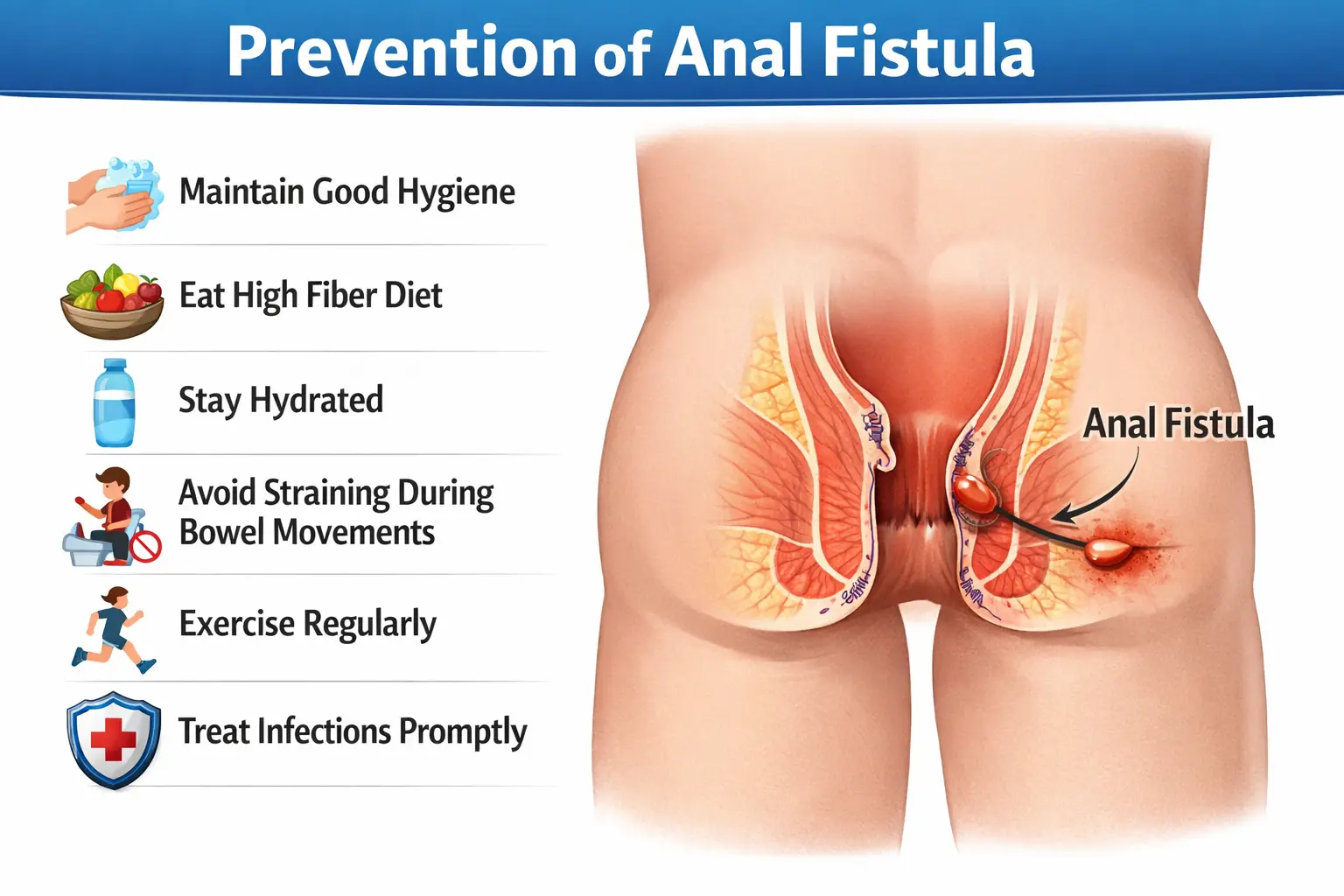
A fistula is a medical term used when doctors refer to a tunnel or a pipe-like structure formed in the body. It is formed when a pus pocket (abscess) is formed within the body, and needs to be drained out. A fistula is generally formed from the abscess to an organ or the skin. It is named based on where they form, for example: anal fistulas broadly refer to fistulas formed from the anal glands to the skin surface. It is the body’s natural way of healing itself from within, by draining out the infected liquid from the abscess. But beyond the physical pain, living with a fistula brings a mix of discomfort, frustration, and a natural sense of embarrassment. This article aims to answer some very natural but important questions about fistulas.
In the context of caring for your digestive health, being aware of fistula symptoms — such as pain or swelling around the anus, pus or blood draining from a tiny opening, and redness or discomfort especially during bowel movements — can help you recognize when something isn’t right and take action early. These signs often begin with an anal abscess that hasn’t been treated promptly, and if ignored the ongoing infection leads the body to form a tunnel-like tract (a fistula) to drain the pus to the skin surface. Recognizing these early symptoms and seeking professional care to treat the underlying infection and promote proper healing is an important step in preventing the development or recurrence of an anal fistula, as emphasized in guidance on stopping infections before they progress to more serious fistulas.
What is the main cause of anal fistulas?
An anal fistula is formed mainly due to infected anal glands. The inner lining of the anal canal has several anal glands which secrete mucus to make the passage of stools smoother. When these glands get blocked, they get infected. Infected gland and often release pus, which collects in pockets near them called abscess. When the body needs to drain the pus, it creates the tunnel-like structure to drain the infection, this is called a fistula.
There are several reasons for an anal gland to get infected:
- Clogged glands: This stands to be the most common cause of fistula formations to date. When the internal anal glands get clogged with liquid, bacteria, or faecal particles, they get infected and form abscess. When the abscess remains for a long time, the body creates a fistula to drain the liquid out. While this can happen to anyone, it is most frequently seen in adults between the ages of 30 and 50.
- Conditions like Crohn’s disease and Ulcerative Colitis: These diseases cause long-term inflammation in the intestines which can thin down its walls. This makes them more susceptible to forming fistula
- Traumatic injury or previous surgery in the anus: Very rarely, any previous surgery for piles or fissures can result in fistula if the tissues do not heal properly.
- STIs: Sexually transmitted infections can make the anal glands infected, resulting in fistula tract formation
- Anal Tuberculosis: Although less common, anal TB can also cause recurring fistulas.
- Weakened immunity from conditions like repeated radiotherapy of the pelvic region, or diabetes can make the immune system too weak to fight infections. This naturally makes the it easier for fistula formation.
How to reduce a fistula naturally?
Fistulas are caused when the body wants to drain out any collected or infected liquids from inside the body. Once the infected waste is drained out completely, the tunnel-like structure or fistula tract remains, and does not collapse back naturally. Hence, a fistula cannot be cured permanently without any surgical interventions.
Having said that, the symptoms of a fistula can be easily managed naturally at home.
- Take warm sitz bath daily: Using a sitz bath soothes the infected area, improves blood flow, and helps to keep the fistula tract clean. Try soaking the area in warm water for 10–15 minutes daily.
- Hydration: Constipation is one of the biggest enemies of fistula. Passing hard stool increases the pain and pressure felt on the fistula tract.
- High fibre diet: This works in the same way as hydration to soften the stools and pressure felt during bowel movements.
It is quite natural to believe in the assumption that antibiotic treatment closes a fistula tract. While antibiotics are prescribed by doctors, it is mainly to control the infection from spreading to the surrounding healthy tissues and preventing complicated sepsis.
Thus, while there is no natural way to cure a fistula permanently, you can always take proactive steps to visit your colorectal specialist as soon as you notice the symptoms. Simple and low-lying fistulas can be cured easily with a procedure called fistulotomy, with almost no recurrence.
How do you stop fistula from forming?
Fistulas are formed when there is chronic or long-term infection or inflammation. When the abscess formed from these infections are left un-treated, the body naturally forms fistulas to drain them out.
The key point by which you can prevent fistula formation is, you must stop the anal abscess that precedes it. Almost 50% of the developed anal abscess turn into fistulas, preventing this initial step will be the target to stop fistulas from forming.
Some simple but powerful ways which can stop fistula formation.
- Treat the abscess promptly: When you notice an abscess, get it shown to a colorectal specialist who will be able to treat it easily. Some common symptoms which you would feel if you had an abscess are
- Painful lump—indicating the fluid filled pocket underneath. You can feel the pain more when you touch the lump.
- Swelling near the anal area—again indicative of an active underlying infection
- Throbbing pain—due to the infected glands
If the abscess is drained early by a professional, there is no pressure from the abscess to push the liquid out. This itself majorly prevents fistula formation.
- Get checked and treated for any other underlying causes. Infection is caused by a compromised immune system—which can be due to other conditions like diabetes, inflammatory conditions such as Chron’s disease and Ulcerative Colitis. These conditions make it more prone for your body to develop abscess, resulting in fistulas.
- Keep stools soft and easy to pass. This habit works to stop many conditions which result from hard stools. Piles, fissures, and even anal abscess can be formed due to hard stools. You can maintain soft stools by following a high-fibre and adequate hydration diet. Fibre in the food absorbs the water to form a gel-like material and keeps the stools soft.
Hard stools do not directly result in anal abscesses. When you put increased strain to pass the hard stools, chances of the damage to the anal lining increases. This can allow bacteria to easily access the underlying anal glands and cause infections.
- Maintain proper hygiene by keeping the anal area clean. Preventing a buildup of stool particles by not cleaning the area can easily cause irritation to the skin, allowing bacteria to enter it.
Consider using water for washing after every bowel movement. Paper usage often causes minor tears in the skin due to dryness, giving the bacteria a free pass into the healthy anal glands.
Also keeping the area dry by pat drying with a towel is important to prevent bacterial and fungal growth and infection.
- Often minor problems such as fissures and sometimes piles can become infected. Treating these conditions early on prevents them turning into bigger fistulas.
what is the rule of six for fistula?
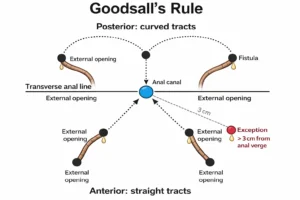
When a doctor uses the term ‘The rule of six’ for fistulas can refer to two different rules.
-
Goodsall’s rule:
- This rule was formed in the late 1800s by an English surgeon Dr. David Henry Goodsall.
- It is an important rule followed by fistula surgeons to help them predict what path the fistula is taking, or where the internal opening (inside end) of the tunnel like structure is based on where the external opening (outside end) is located.
- This rule is something like a surgeon’s map, and can also help them understand if it’s a simple or complex fistula.
- Based on this point, the surgeon can tell you if the surgery will be simple or complex.
- Goodsall’s rule is based on the location of the external opening of the fistula with relation a transverse line drawn across the buttocks. It states that—
- For front side (anterior) openings: If the external opening is front (towards genitals) to this transverse line, the tract will generally follow a straight line to the anal canal.
- For back side (posterior) openings: If the external opening is behind the transverse line (towards the tailbone), it generally follows a curved path or may have a horseshoe pattern.
It will be worthwhile to note that, while Goodsall’s rule is a good standard for a surgeon to identify the general path of a fistula, they cannot know about its exact path map, branching status, and length, till they see images from an MRI Fistulography. This technique gives a 100% accurate image of the fistula and greatly helps the surgeon to get a complete picture for deciding treatment options.
- The doctor could also be referring to a ‘6-week’ recovery milestone.
The number 6 is often used by colorectal surgeons to help patients get an idea about the healing timeline.
- Patients can expect the most significant healing in the first 6 weeks after the surgery is done.
- Timelines of exact events can vary. But general timelines are:
Week 1-2: Discharge and drainage are normal.
Week 4: The wound begins to close significantly.
Week 6: The surgeon usually does a final check-up to confirm the tract has successfully closed.
Fistulas naturally sound scary and complex. They are not immediately life-threatening, and cannot by themselves be fatal. However, its underlying cause—mainly infections, can prove to be an emergency if the infection spreads to the blood, resulting in sepsis. Delaying treatment can also allow the fistula to branch out over time, making it more difficult to resolve.
However, you do not have to live with that fear anymore. In 2026, an experienced fistula surgeon can easily use a wide range of techniques to close the fistula tract and prevent them from recurring. At Smiles Gastroenterology centre, Bangalore, the doctors do just that. They ensure to tailor the treatment approach to personally suit your unique fistula tract to deliver effective and lasting solutions. Choose Smiles Gastroenterology today to regain your confidence, comfort, and smiles.
