
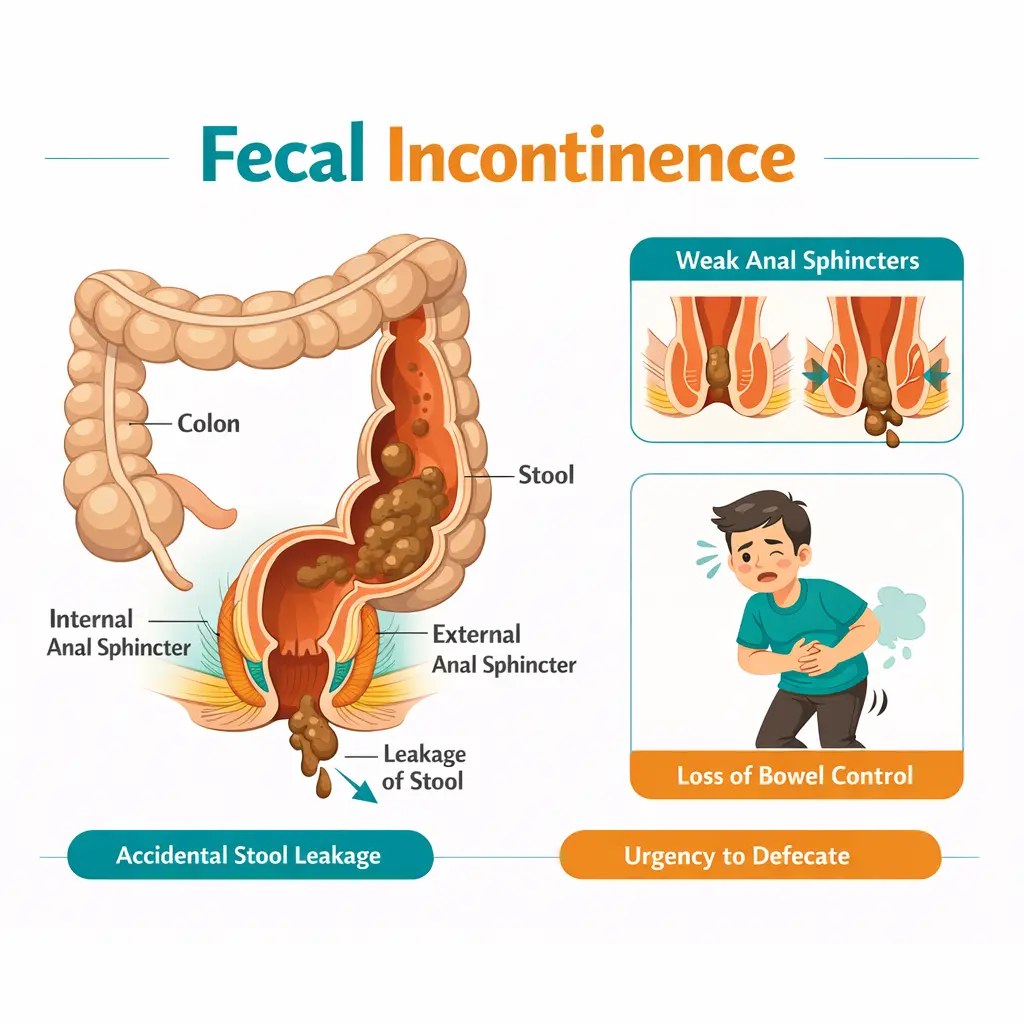
Incontinence is a general term meaning the inability to control the release of solid or liquid waste (urine or stools). It is a naturally overwhelming challenge that impacts daily life. The inability to control bowel movements, it is known as faecal incontinence. While the condition is deeply personal, it is a common medical issue having muscle, nerve, or structural causes. However, understanding it is the first step toward regaining control and finding a treatment that works for you.
What does it mean when you have faecal incontinence?
Faecal incontinence means you would feel that you cannot control passing your bowel movements (otherwise casually termed as poop) till you reach the toilet. Although there can be several causes, the main symptoms of faecal incontinence remain the same—the feeling of bowels leaking before sitting on the toilet.
Some familiar symptoms which mean that you may have faecal incontinence:
- Leaky bowel movements: it feels like stools are leaking even whenever you pass gas with or without force.
- Feeling of passing stools when you are physically active. This can be when you are exercising, weight lifting, or sometimes even just during walking.
- Sometimes you get the feeling that you need to pass bowels, but majority of the times, you are unable to make it to the toilet before it begins to leak out.
- You may also have noticed the presence of bowels in your undergarments—even after having a fully satisfactory toilet visit.
What are causes of incontinence?
Faecal incontinence occurs so commonly; sometimes, more than many people would care to admit. This is because, it can result from various causes. Some causes can make it a temporary condition, like having diarrhoea from eating something bad, and some causes can mean faecal incontinence may be a long-term issue for you.
Some known causes of faecal incontinence:
- Frequent diarrhoea: an occasional episode of diarrhoea (or what is commonly called as loose motions) does no major damage. But when it happens frequently enough, it may lead to an eventual inability to control poop even when it is of normal consistency. You use your rectal and anal muscles when you want to control passing bowels outside the toilet. When your stools have a very liquid consistency, your muscles have to work quite hard to stop it from leaking out. Over time, if they work like this, they may weaken and not function to control bowels efficiently.
- Frequent constipation: It may be difficult to understand why having hard bowels (being constipated) can lead to faecal incontinence. However, you will soon understand why it is so. having hard stools naturally requires you to put considerable strain to pass it out. overtime, straining consistently with your anal muscles can weaken them. There is also another issue where the liquid collected around the constipated poop passes out easily, making the incontinence worse.
- Rectal muscle damage: Rectum is the part just above your anal region. This portion stretches and stored the bowels till they are pushed out. Certain conditions and procedures on these muscles can make them a bit stiff, and incapable of storing poop as well as healthy rectal tissues. As a result, the faecal material comes out even when you do not voluntarily push it out. Conditions such as Crohn’s disease can give this side effect. Sometimes, receiving radiation therapy to this region can also cause rectal muscle damage.
- Damage to surrounding muscles: in women, vaginal delivery is a major risk factor causing faecal incontinence. The delivery of a baby through the vaginal canal stretches it and the muscles in this area. There can also be tears to these muscles, making them lose their natural tightness. This may cause inability to control bowels efficiently.
- Nerve damage: Such procedures also can cause damage to the nerve endings in these muscles. Since nerve endings are what is used to feel the need to use the toilet, any damage to them can decrease your sensation to know when to use the toilet. This also unfortunately means that, you may pass the bowels without knowing or without being able to control it in time.
- Pelvic organ prolapse: an organ prolapse is when they slip or sag out of their original place. The pelvic floor muscles support a lot of organs like the rectum, urinary bladder, uterus, etc. When these muscles get weak, the organs it supports also start to slip, leading to faecal incontinence.
There are also some uncommon causes of faecal incontinence as they primarily involve nerve damage. These are Alzheimer’s disease, Parkinson’s disease, multiple sclerosis, stroke and inflammatory bowel disease.
Is incontinence a serious problem?
Faecal incontinence is a condition with many layers. Its seriousness depends on several different points like the physical, social, or psychological feelings associated with this condition. Below are a few key points which talk about these aspects.
Acute or chronic: many times, faecal incontinence is felt during an acute (short-term) stomach infection such as gastroenteritis, or dysentery. Incontinence easily stops after the infection is treated with a round of antibiotics. But in some cases, chronic (long-term) conditions like Chron’s disease or Inflammatory Bowel Disease (IBD) which cannot be treated easily, can cause faecal incontinence over months.
When the incontinence happens over such a long time period, it naturally feels like a very serious condition needing extra attention.
Physical aspect: the leakage of faecal matter even over a short time, can cause irritation and redness around the anal canal. You may also feel itching, pain, and sometimes burning of the anal skin. Experiencing these over a few days can feel annoying. When it becomes a long term issue, in addition to the incontinence, skin issues begin which makes it feel serious and burdensome.
Social aspect: faecal incontinence is a private matter. However, it is but natural to feel anxious, or embarrassed if you experience it in a social setting. You may also feel that you are not as social as your natural self. Being constantly worried about the smell, or feeling leakage, or being noticed for it, is enough to take a toll on the mental and emotional well-being of anyone experiencing it. Thus, from a social stand point, faecal incontinence would seem like a very serious matter.
Faecal incontinence, although more common than anyone admits, is a deeply private matter. The uncomfortable feeling it gives, along with the social stigma around it can leave a serious impact on anyone experiencing it—for whatever duration it maybe.
However, there are many steps which can be taken for managing this condition. And the best part yet, it can even be done at the privacy of your home. There are also multiple options which you can easily get from an experienced colorectal doctor to help stop faecal incontinence. After you read the next section, you will be ready to manage this condition with confidence.
How do you fix incontinence?
Nowadays, there are multiple ways to fix faecal incontinence. You can have your pick of treatments—at home remedies for short term incontinence, non-invasive natural treatments, and permanent procedures for long-term incontinence.
Some well-known ways to fix incontinence:
Dietary changes:
Your stools are a direct result of what you eat. Aim for food types which give you a soft and healthy bowel movement. You will know the food types once you keep a close track on the food you consume daily. Once you know a particular food is causing drastic changes in your stools, you can avoid them to reduce incontinence.
If you are noticing more liquid stools, avoid foods that can loosen your stools like:
- Caffeine, fruit juices and prunes
- Beans and cabbage family vegetables
- Spicy foods
- Artificial sweeteners
- Dairy products (specially if you are lactose intolerant)
Conversely, if you are more constipated, change your diet to prevent chronic constipation. Do this by:
- Eating fibre-rich foods (examples: whole grains, fruits, vegetables, beans and nuts)
- Drinking more water (at least 8–10 glasses a day).
Some easy exercises to help strengthen the anal muscles:
The anal sphincter muscles help control your stool movement daily. And the pelvic floor muscles are responsible for maintaining all the organs in place for efficient functioning. Some exercises focus on strengthening these muscles to help you naturally overcome incontinence. These can be done from the comfort of your home after being trained by a certified physiotherapist.
Bowel training: this involves using the toilet at the same time every day. Your doctor will teach you how to teach your body when to poop. Initially you may need to take enema with your doctor’s guidance to make your bowel movements happen at a set time, but later your body learns how to do it naturally. The advantage of this method is that can better manage your bowel movements under your control.
Kegel’s exercises: one of the most well-heard of exercises which are very effective when done consistently. These exercises strengthen the pelvic muscles that support organs like your rectum and bladder. When these organs are in their proper places, they function efficiently. You may need to do it for several weeks to notice considerable effect for controlling your stools.
Biofeedback: this method is done under supervision only. Here, a trained therapist will use electrodes connected to your body to register muscle movement onto a computer. This helps to locate the muscles you need to use when you pass stools, which can then be exercised so they work better to prevent leakage.
Procedures to fix incontinence: surgeries are used in cases where incontinence cannot be improved with either medicines or muscle strengthening exercises.
Some common surgical treatments are:
- Sphincteroplasty: here, a surgeon repairs a torn or weakened anal sphincter muscle by sewing them back together. It is used for injuries caused by childbirth or previous surgeries.
- Sacral Nerve Stimulation (SNS): A small device is implanted under the skin to send mild electrical pulses to the nerves that control the pelvic floor.
- Sphincter Replacement (Artificial Anal Sphincter): A small cuff is placed around the anal canal that can be manually inflated or deflated using a small pump implanted under the skin. This mimics the natural function of the sphincter for those with severe muscle damage.
- Colostomy: In severe cases where other treatments have failed, the colon is brought to an opening in the abdomen, and the faecal matter is collected in a bag.
Living with faecal incontinence can feel isolating. It brings with it challenges to both physical health and social/mental anxiety. But you must try and remember, whatever is the issue, there is always a path forward. Modern medicine nowadays addresses not just the medical cause, but also other important aspects like your dignity, and your quality of life.
At Smiles Gastroenterology Centre, Bangalore top-notch colorectal specialists can provide discreet, empathetic, and world-class care for gastrointestinal conditions. Doctors here will create personalized treatment plans tailored to your unique needs. Take the first step to reclaiming your confidence with Smiles, today.

Dr. Parameshwara CM is a global authority in Coloproctology and the visionary founder of SMILES Hospitals, with an extraordinary track record of over 50,000 successful surgeries. A true pioneer in the field, he was the first to introduce Advanced Laser Piles Treatment and sophisticated procedures like LIFT, VAAFT, and STARR to Karnataka, revolutionizing the way digestive disorders are treated. He combines surgical precision with state-of-the-art laser technology to offer bloodless, minimally invasive solutions. Call us: +9108099008800 for further help.
- Dr Parameshwara CM

- Dr Parameshwara CM
- Dr Parameshwara CM
- Dr Parameshwara CM