

Understanding Crohn’s Disease
The digestive system begins from the mouth and ends at the anus. It is primarily made up of smooth muscles which can move the food through the various organs. These muscles can experience a variety of conditions which you would feel as stomach pain, nausea etc. They can develop ulcers, or be infected with viruses and bacteria. Alternatively, they can even undergo chronic, long-term inflammation. When any of these tissues are inflamed over a long time, the condition is called inflammatory bowel disease (IBD).
IBD has many types, and one of the most common is Crohn’s disease. In Crohn’s disease, the main characteristics are irritated and swollen tissues which results in inflammation. Although the inflammation can be found anywhere from the mouth to intestines, the majority of the people with Crohn’s disease show significant inflammation at the ending of the small intestine and beginning of the large intestine. Because of this characteristic, people with Crohn’s disease have an inability to absorb certain nutrients. They also lack proper digestive abilities.
What are the causes of Crohn’s disease?
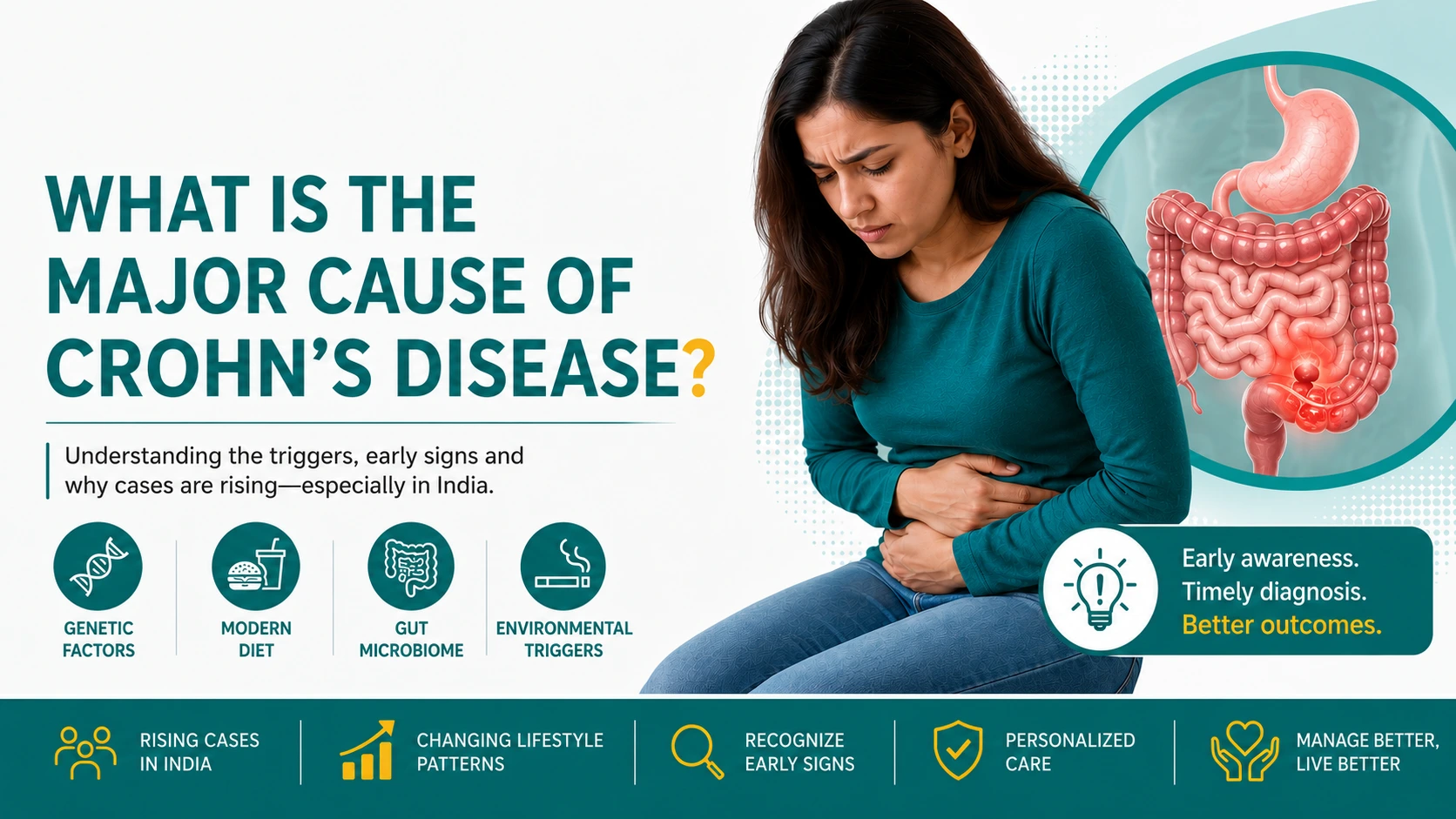
Crohn’s disease is a multifactorial disease. This means that, apart from genetic factors, certain lifestyle practices can also tip the scale to favor gut inflammation. See below for the list of factors, all of which have repeatedly been observed in people with Crohn’s disease.
- Modern diet: The strongest reason as to why Crohn’s cases are exploding in countries like India lies in how the current diet has changed to adopt many Western influences. The transition from traditional, high-fiber foods to a more westernized lifestyle plays a major role in resulting in inflammation.
- Increased use of ultra-processed foods: Urban diets are rich in refined sugars, trans-fats, chemical preservatives, and emulsifiers. These substances directly damage the inner gut lining. Traditional diets rich in vegetables, grains, and pulses provide fiber that feeds beneficial gut bacteria. Without it, the protective mucus layer in the intestines weakens, making it incredibly easy for inflammation to happen.
- Disrupted gut microbiome: The digestive tract has trillions of bacteria (needed for digestion and nutrient absorption) that co-exist with your immune system. These bacteria feed on fiber from veggies and fruits. Increased reliance on antibiotics, and processed foods can reduce the variety of good bacteria. The remaining harmful microbes increase, activating the immune system against your gut wall harboring the harmful bacteria.
- Environmental triggers: Our daily environment also has a direct link to our immune health. Smoking is the most dangerous risk factor in this category. Smoking doubles the risk of developing Crohn’s disease, creating severe inflammation. Also, medication overuse, especially with common medicines like OTC non-steroid pain relievers like ibuprofen can irritate the gut, triggering immune responses.
- Genetics: Having a first-degree relative with an inflammatory bowel disease increases your risk of developing Crohn’s disease increases significantly. Over 200 specific gene variations have been identified in population studies that can alter how certain gut linings react to certain bacteria, making these individuals naturally more prone to an overactive immune response.
Are you born with Crohn’s or is it developed?
Conditions or diseases which are present from birth are termed as inherited disease; for example: Type 1 Diabetes, sickle cell anemia, dwarfism (achondroplasia). These are present from birth because either one of the parents would have the gene responsible for causing it. Similarly, since Crohn’s disease also has a genetic component as the cause, the gene which causes Crohn’s is present at birth. However, this does not guarantee that the symptoms will be developed from an infantile age itself.
In fact, infantile Crohn’s disease is observed and reported to be very rare—only about 6% of the cases are reported to show symptoms before 6 years of age. Symptoms are generally observed to develop during adolescence or teen years to early adulthood. The symptoms generally worsen over time and feel more severe with each episode. It is very hard for scientists or doctors to predict how likely it is for a child to inherit Crohn’s disease. And this is mainly because of the environmental/lifestyle component which can influence whether someone develops it or not.
However, the National Human Genome Research Institute has reported some numbers
- If a child has one parent with Crohn’s disease, they have a 7 to 9% risk of developing it.
- The child also has a 10% chance of developing some form of Inflammatory Bowel Disease (IBD), such as colitis.
- If both parents have any type of IBD, the child’s risk of developing Crohn’s disease increases to 35%.
Can Crohn’s develop even without genetic factors?
Yes, Crohn’s disease also has environmental or lifestyle factors which can trigger the body to develop this illness. Lifestyle factors are in fact the reason why there is an exploding number of cases over the past few years in case numbers of this disease. This along with other unsupportive changes in daily living habits can induce Crohn’s disease symptoms easily. Read on to the next very interesting section on how even without the weight of genetic factors, you may be at a risk of developing Crohn’s disease.
Why are people getting Crohn’s disease?
You may be hearing a lot more often about Crohn’s disease these days, and you aren’t imagining it. Crohn’s disease case numbers have been rising at an alarming speed, and particularly in India, this rise in numbers have been very significant. Medical reports, and doctors help explain how exactly our changing world is the major culprit here.
Crohn’s disease was some time ago, thought of as an illness of the ‘Western countries’, but numbers published in medical journals show that India now has one of the highest numbers of cases in the world. The number of patients with inflammatory bowel diseases in India has doubled in recent decades—jumping from around 130,000 cases in 1990 to well over 270,000 in recent years.
What is more alarming is that, unlike in Western countries, most Indian patients do not have a genetic factor to explain the case numbers. This sudden rise is explained by doctors as a result of major shift towards “Westernized” lifestyle. Increased eating of packaged junk foods, and artificial food additives damages the healthy gut bacteria. When there are no healthy gut bacteria, nutritious food cannot be digested and absorbed optimally. Doctors also believe that growing up in hyper-clean environments may reduce the efficiency of a child’s developing immune system. Later, this immune system can overreact and mistakenly attack the body’s own digestive tract. Over-the-counter misuse of antibiotics and common painkillers like ibuprofen, which can irritate and damage the stomach lining also contributes majorly to gut inflammation.
This disease has been observed to be targeting mostly young adults between the ages of 20 and 40 years, during their most active working years. The increase in cases in the recent decade and the age of disease manifestation also line up with the increase in adopting a western lifestyle in India. This heavily supports what the doctors suspect. Another aspect to the increase in case numbers is, finding the right answer takes time. Because Crohn’s disease symptoms like diarrhea, severe stomach pain, and weight loss look like common stomach infections or other stomach specific ailments, many patients end up misdiagnosed. It takes months or even years before they finally get the correct diagnosis and the relief they need.
What are the first signs of Crohn’s disease?
Just like many other chronic diseases of the body, Crohn’s disease also does not begin overnight. It is natural to mistake the early symptoms as just a bad stomach bug. But when it recurs over time, it is best to visit a doctor. Recognizing the early warning signs of Crohn’s disease is essential, as treatment in early stages is often more effective and easier.
Unlike just an episode of stomach infection, these early signs usually come and go in waves, worsening over time as the lining of the digestive tract becomes more inflamed and swollen.
Common first signs to watch for:
- Long-term, recurring diarrhea:
This is often the very first noticeable sign. Unlike a standard stomach infection that goes in a few days, this diarrhea can last for weeks. It may also feel like it does not respond to standard anti-diarrhea medications. - Frequent pain and cramping:
You may feel a dull ache or sharp cramping, most commonly in the lower right side of your abdomen. This pain often feels worse after eating, when the food passes through inflamed areas of the intestine. - Unexplained weight and appetite loss:
Chronic inflammation can make it hard for your body to absorb nutrients from food properly. This combined with the fact that eating causes stomach pain, makes many people begin eating less, leading to rapid, unexplained weight loss. - Constant low energy:
Feeling completely drained of energy, even after a full night of sleep, is another common early sign of Crohn’s disease. Your body is constantly using energy to fight the internal inflammation, making you feel low on energy always. This is often worsened by mild anemia. - Unexplained mild fevers:
Running frequent and low-grade fevers without any other signs of a cold or cough is a classic signal that your body’s immune system is actively fighting off inflammation inside your gut. - Blood in the Stool:
You might notice bright red blood in the toilet bowl or darker blood in your stool. Inflammation in the gut creates small ulcers along the lining of your intestines that bleed as food passes by.
While experiencing this set of symptoms does not mean that you have Crohn’s disease for sure, it is always better to take action. Visit your colorectal specialist or even a gastroenterologist to rule out any other stomach ailments at the earliest. Crohn’s disease may seem like the latest common stomach ailment making the rounds. But just like how effort was put to understand Covid infections, so too, understanding how Crohn’s disease works is your best line of defense.
Genetics certainly provides the baseline, making some people naturally more vulnerable to the condition. However, as the rapid rise of cases in India shows us, genes alone do not explain the whole story. Our changing environment, Westernized lifestyles, and ultra-processed diets are often the final triggers that fire the gun.
Thus, it is often in your best interest to learn to recognize the early warning signs. This allows you to catch the disease before it causes long-term damage. With an early diagnosis and personalized lifestyle changes, it can be successfully managed. This allows anyone experiencing it to lead a healthy, active life.
