

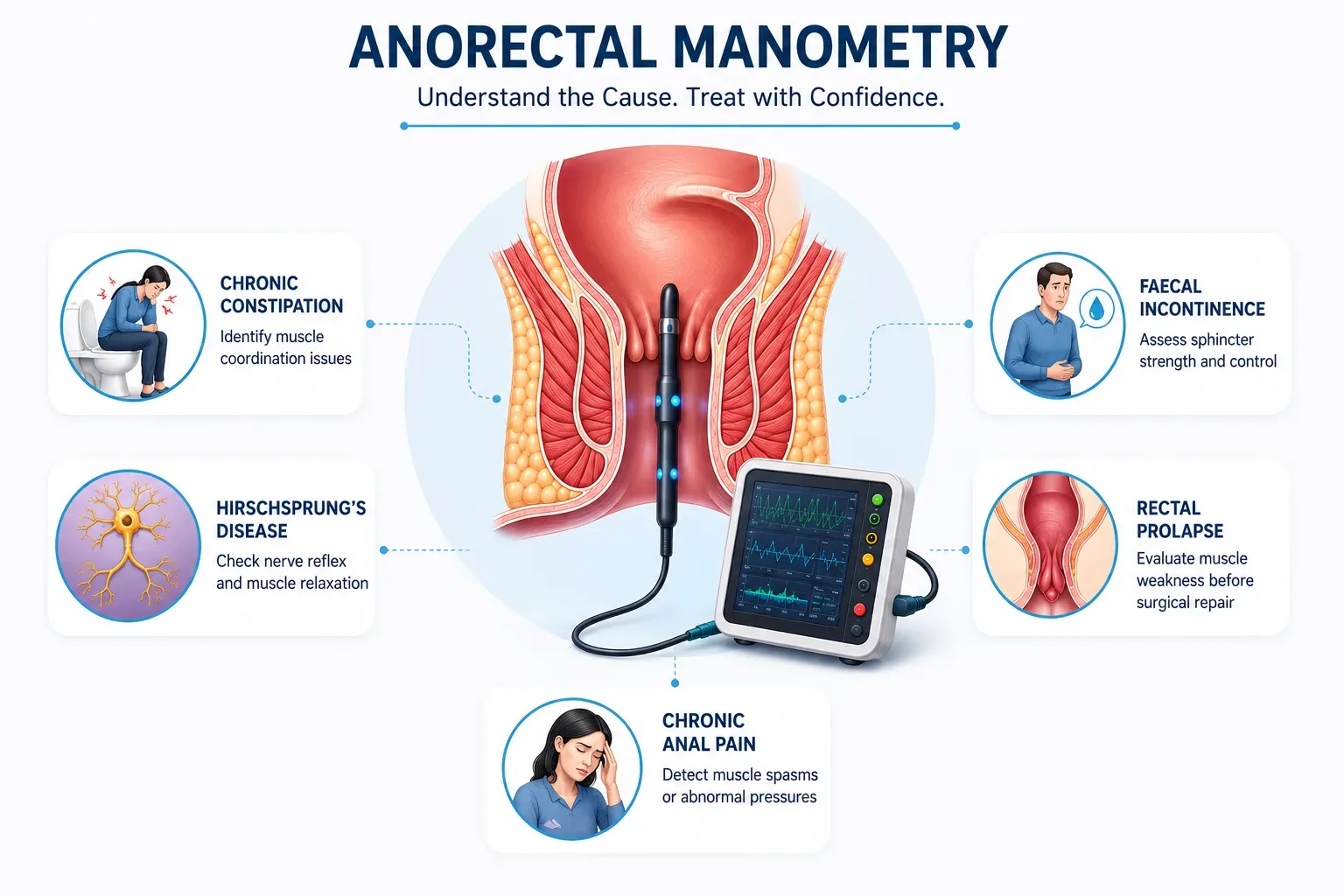
The rectal and anal organs of your body contain several muscles. These muscles work in a very fine-tuned coordination to help expel the digested solid waste (also known as stools or bowel movements). However, like other organs of the body, even these muscles are susceptible to injuries, causing them to function ineffectively. This manifest as conditions like constipation, fecal incontinence, rectal prolapse or even long-term anorectal pain. At such times, it becomes important to identify the exact cause of their ineffective functioning—and that is where anal manometry comes to play. Anorectal manometry (ARM) is a common term used for any test used to check the functioning of the anorectal muscles.
What is anorectal manometry used for?
If your colorectal specialist suggests a manometry, you may be experiencing one or more of these conditions:
- Chronic Constipation: Here, the test evaluates if the issue is something deeper like pelvic floor dyssynergia (muscles clenching instead of relaxing), which prevents stool from passing, resulting in its stagnation, hardening, and thus, constipation.
- Fecal Incontinence: The test measures the structural strength and squeezing pressure of the anal sphincter muscles (anal muscles used for controlling bowels) to find out why involuntary leakage of stools is happening.
- Hirschsprung’s Disease: This disease has a primary symptom of absence of nerve reflexes that communicate to the sphincter muscles to relax. The test checks for this reflex.
- Rectal Prolapse: Here, the test checks for how severely the slipped rectum (in rectal prolapse, the rectum slips and hangs out of the anal opening) has weakened the surrounding sphincter muscles. In this case, the test is mostly done prior to surgical repair to correct the rectal position.
- Chronic Anal Pain: Here, the test detects hidden muscle spasms or abnormally high resting pressures in the anal canal which cause the severe, and unexplained pelvic or anal pain.
- Pre-Operative Assessment: Sometimes, when the patient needs pelvic or colorectal surgeries, a manometry is used to detect the baseline muscle strength so the patient will not face incontinence risks post-operation.
- Post-Operative Evaluation: After such colorectal surgeries, a manometry can help evaluate sphincter muscle function or nerve damage if a patient develops new bowel issues.
- Anorectal Trauma or Obstetric Injury: In case of muscle tears or nerve damage following traumatic accidents or third- or fourth-degree tears during childbirth, a manometry is used to check for the extent of this damage.
- Biofeedback Therapy Screening: The test is used both as a screening tool to see if a patient has the baseline muscle control required for pelvic floor retraining, and during the therapy itself to visually track progress.
Why would you need an anorectal manometry?—The difference between targeted treatments and hearsay solutions.
- Most often, when anyone hears a diagnosis from the doctor about any of the above conditions is ‘Do these conditions really require a manometry test?’ And naturally the first thought is to jump in for off-the-internet solutions.
- Often, many conditions of the anal region are taken in a very superficial manner, partly owing to a social stigma of getting this area checked by a doctor, and partly also because conditions like constipation or fecal incontinence are believed to be a result of “diet.”
- While dietary changes do play a role, chronic forms of constipation, hemorrhoids, fecal incontinence or anal pain are caused by other underlying changes to the muscles in these body parts.
- Unless these changes—whether to the muscle structure or functioning are identified and treated, the chronic conditions cannot be resolved.
- For example, in normal conditions, when the rectum fills with stool, it signals the anal opening to relax so the stools can be expelled from the body. But sometimes, the anal muscles contract instead of relaxing—this leads to ineffective passage of stools, resulting in constipation. Another scenario is where the anal muscles relax untimely, causing fecal incontinence. Both these conditions have many hearsay treatments which may seem like they are working, only for the symptoms to resurface in a worse form.
- In such situations, examining the root cause—be it reduced anorectal muscle sensation, or poor co-ordination between rectum and anus, or even injuries to the muscles, can immensely help in modifying the treatment strategy to provide highly effective results for such long-term symptoms.
How long does anorectal manometry last?
An ARM procedure requires just about 15–30 minutes for completion (yes, it is that quick and simple).
However, the total time spent at the clinic is reported to be around an hour to account for the prep time of the tests.
The various tests which fall under ARM use different ways of testing the anorectal muscles. For example, if the test is to check for muscle squeezing pressure, it takes just a few minutes, while testing for rectal sensation with a small balloon requires a bit more time.
Since the procedure does not require anesthesia, there is also zero recovery time. Patients often return to their normal daily activities or work immediately after the test is over.
There are also no extensive preps like fasting to be done before the tests. If needed, you may be asked only to self-administer an enema about 2 hours before the appointment.
What are abnormal results of anorectal manometry?
Seeing abnormal results after a manometry test would mean that there are functional or mechanical changes to the anorectal muscles. Simply put, abnormal results in manometry mean that your symptoms have causes beyond just refined food intake or low hydration. Below are explanations to a few abnormal results of a manometry test and what they mean:
- Pelvic Floor Dyssynergia: If you see this on your report, it means your anal sphincter muscles contract (instead of relaxing) when you try to push. This coordination mismatch stops stool from passing and is the cause of the final symptom—chronic constipation.
- Abnormal Sphincter Resting Pressure: Here, the internal anal sphincter shows unusually high or low pressures. High pressure may cause painful muscle spasms, while low pressure tells of a baseline weakness which may be the cause for fecal leakage.
- Inadequate Sphincter Squeeze Pressure: Unlike the previous one, here the external anal sphincter cannot generate enough force when you actively try to squeeze. This usually points to direct structural damage or nerve injuries resulting from childbirth, trauma, or pelvic surgery.
- Rectal Hyposensitivity or Rectal Hyposensation: This means that your rectum requires an abnormally high volume of air in the test balloon before you feel any sensation of pushing. This result points to nerve desensitization, meaning you are losing the normal level of urge to use the toilet. This leads to stool backup, another reason for chronic constipation.
- Rectal Hypersensitivity: Reversing the above condition, here the rectum feels an urgent need to evacuate even low volumes of air. This is termed oversensitivity, and indicates rectal inflammation or conditions like Irritable Bowel Syndrome (IBS).
- Absent Anorectal Inhibitory Reflex (RAIR): This diagnosis indicates Hirschsprung’s disease. here, the internal anal sphincter fails to relax when the rectum is filled which shows the absence of this involuntary nerve reflex.
- Abnormal Balloon Expulsion Test: If you are unable to successfully push out a small balloon within the standard time limit, this result is given. This test provides real-time demonstration of an evacuation disorder or pelvic floor weakness.
Hearing the term anorectal manometry test from your doctor can be a bit scary, especially when you are going through a painful and sensitive time. But as you would have understood from this article, it is a fairly simple and non-invasive test. Today’s medical technological sensitivity has improved significantly, and tests can reveal even slight offsets from the normal muscle function. Choosing to do this test at top-class, specialized clinics like the Smiles Gastroenterology Center, Bengaluru, can help increase your treatment effectiveness multifold. Schedule an appointment at your nearest Smiles Gastroenterology branch today, it can be the difference between guesswork with random treatments and having a confident, targeted, and proven cure.
