

The pelvic and anal regions are highly sensitive and prone to a wide variety of issues. There are many ways to group these conditions, one of them is how deeply they affect the tissue. There are deep-tissue conditions like perianal abscesses and anal fistulas. The other type is superficial conditions. The most common and perhaps also the most painful of this type is an anal fissure. Fissures are simply a small tear or crack in the thin, delicate lining of the anal canal. This condition is becoming an incredibly common complaint in gastroenterology clinics across India.
In India, cases are increasing at an alarming rate. Modern lifestyle preferences like eating more processed foods, low fiber intake, sitting at office desks for hours, and high daily stress are making chronic constipation a national struggle. Recent medical data show that among the anorectal complaints, anal fissures now account for roughly 10–13% of all clinic visits for digestive issues. Because these symptoms happen in a private area, many people suffer in silence for months, often misdiagnosing themselves. But trying to ignore the pain usually makes the condition only worse. To find relief, let us understand what turns a simple tear into a long-term problem.
What Exactly is a Chronic Fissure?
On a general timescale, acute or short-term fissures heal within 2–4 weeks of adopting holistic treatments such as a high-fiber diet, increased hydration, using laxatives when needed.
However, when the fissure symptoms go beyond 6–8 weeks, with no reduction in the intensity of the symptoms, it is termed as chronic fissure.
Over these weeks, the constant irritation from the cut causes some changes. The edges of the fissure become thick and a small, flesh-coloured skin tag forms which makes recovery more complicated.
Chronic fissures most often develop if you experience either long-term constipation, or long-term diarrhoea; both these conditions can irritate the anal lining causing tears. Other reasons like a vaginal childbirth, or sometimes even Crohn’s disease can result in fissure formations.
The Vicious Cycle: Why Chronic Fissures Struggle to Heal Naturally
Chronic fissures are very well known for their inability of being healed just by a round of high-fiber diet or increased water intake. In fact, you may notice the symptoms even though your stools have become soft and easy to pass.
This is because of a vicious cycle of pain and natural body mechanisms which cause this inability to heal naturally.
Fissures are fairly simple to visualize. Above the sphincter muscles (which open and close during bowel movements and help you control bowels until you are ready to pass them) in the anal opening, there is a thin, delicate lining of skin.
A tear in this skin like a paper cut is what is fissures. But if they are as simple as a papercut, why don’t they heal?
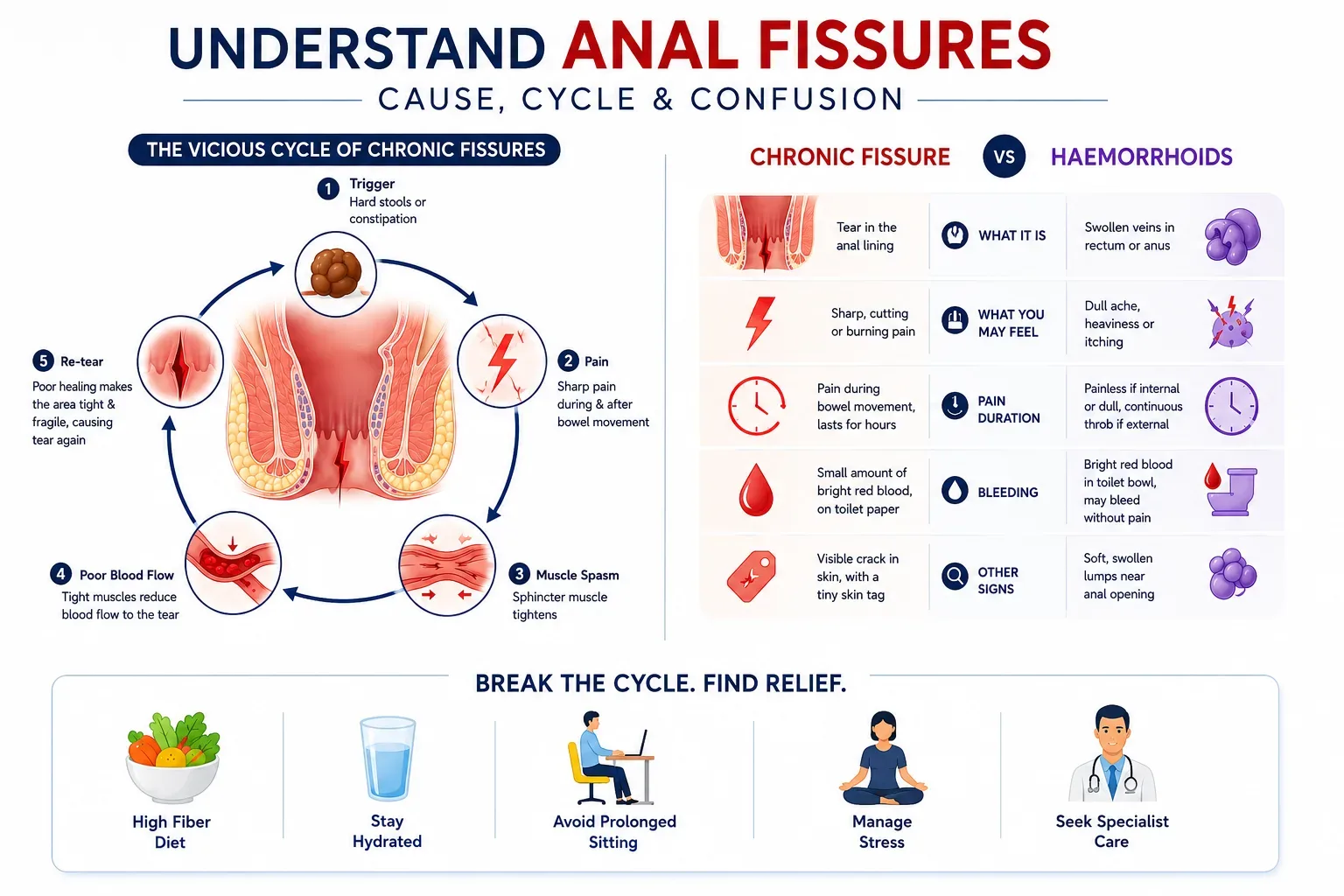
This is how the vicious cycle of chronic fissures looks like:
- It all starts with a trigger like constipation or passing hard stools. Or even with a pre-existing tear. The pressure and stretching of the anal canal make a tear in the delicate lining.
- This exposes a lot of sensitive nerve endings. You immediately feel a sharp, burning pain during and after the bowel movement.
- In response to the pain, the natural body mechanisms cause the area to tighten causing spasms (contractions of the muscles). Spasms cause the anal canal to tighten significantly.
- Because the sphincter muscles are squeezing, it pinches the tiny blood vessels which restricts blood flow to the tear. Blood flow is most important for any wound healing in the body as it supplies nutrients and oxygen for the repair. Hence, the tear does not get what it needs to heal.
- The final step which closes this loop: Incompletely healed tissue and muscle spasm make the opening much tighter and less flexible. Thus, the next bowel movement overstretches the area all over again. The fragile new tissue tears open again.
How to Tell the Difference: Chronic Fissure vs. Haemorrhoids
- Anorectal conditions are more common than you would think. You would have read previous articles where haemorrhoids affect at least 4 in 10 adults, and fissures make up about 10% of all the cases.
- On top of this, both fissures and haemorrhoids develop in the same body part—the anus. Thus, the pain felt when either of them develop is also similar and originating in the anus itself.
- Sometimes, it is possible that you may develop both these conditions, as they have common causes like chronic constipation.
- So, it is natural to get confused between the two conditions. A painful bathroom visit may leave you wondering that you may be dealing with haemorrhoids.
- However, the treatment approaches for both have many differences because they are structurally different in the way they develop.
Here is a small comparison table to help in better clarity.
| Condition | Chronic Anal Fissure | Haemorrhoids |
| What they are | Tears in the anal lining. | Inflamed veins (blood vessels) in the rectum or anus. |
| What you may feel | Sharp, cutting, or burning pain that feels like passing broken glass. | Dull ache, heaviness, or intense itching near the anal opening. |
| Difference in pain durations | Sharp pain starts during a bowel movement and can be there even hours afterward. | Painless if the haemorrhoids are internal or a continuous, dull throb for external ones. |
| Type of Bleeding | Small amounts of bright red blood, seen as a streak on the toilet paper. | Can sometimes be more bright red blood in the toilet bowl; also, can bleed without pain (in case of internal haemorrhoids). |
| Other differences in symptoms | A visible crack in the skin, when chronic-it is accompanied by a tiny skin tag. | Soft, swollen lumps protruding from the anal opening. |
When going through pain in sensitive and very private areas like the anal regions, it is quite natural to feel hesitant to seek help. These topics often makes anyone feel that they are hush-hush, and many consider it a social taboo too. But rest assured, anorectal conditions like chronic anal fissures and haemorrhoids are quite common and in fact, on the rise.
If you have been dealing with persistent pain or bleeding for more than six weeks, take the first step by opting out of using unsupported remedies. Nowadays, up-to-date colorectal speciality centres—like the Smiles Gastroenterology Centre, Bengaluru, offer highly effective, and non-invasive treatments. They often combine them with lifestyle adjustments designed specifically to relax the muscle, restore blood flow, and break the vicious cycle for good. Come, visit any specialist at Smiles Gastroenterology Centres, relief is much closer than you think.
